K-12 school roofing in Manhattan, NY and nearby New Jersey: roof surveys, summer-window replacements, drainage fixes and records for capital plans.
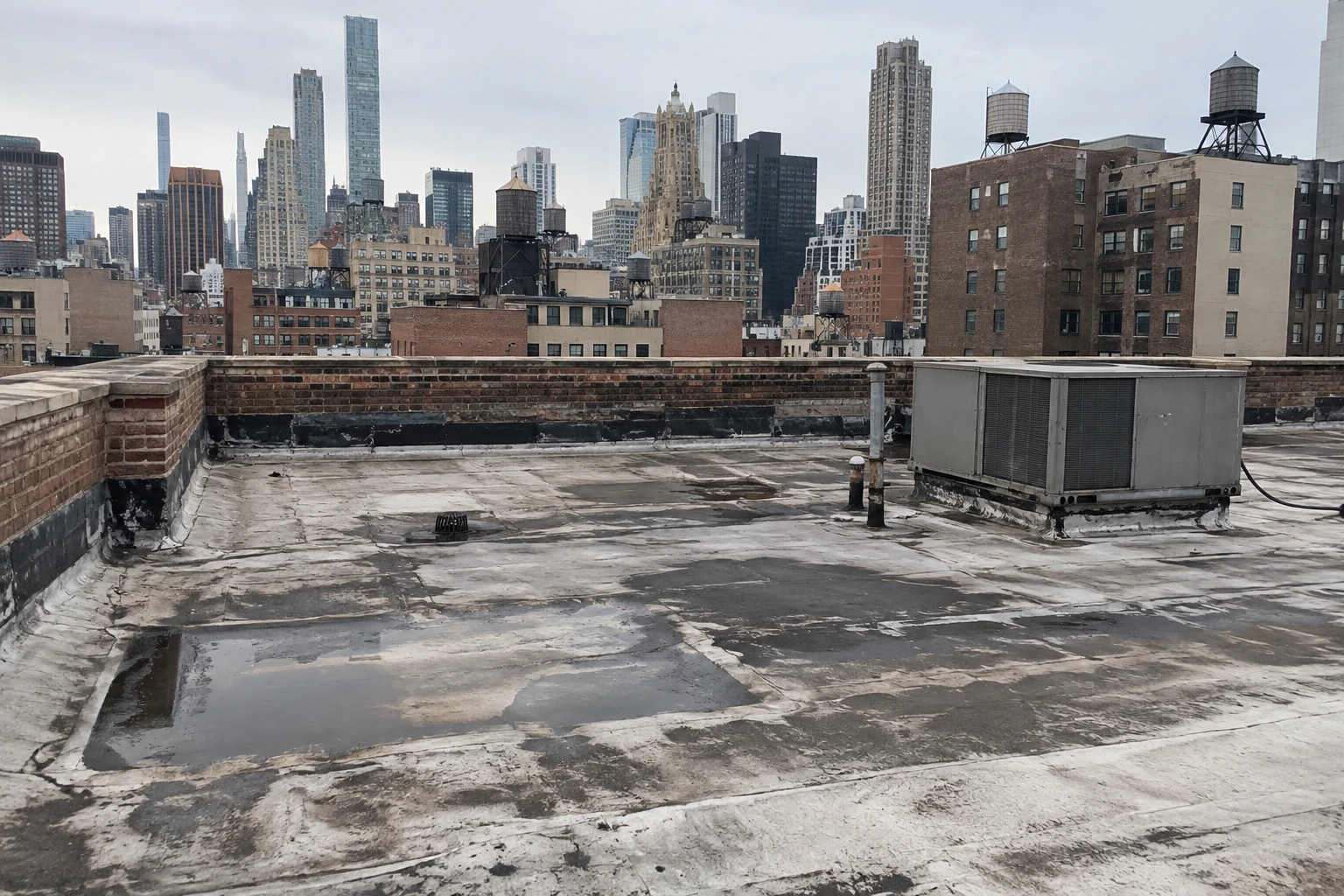
The measurement that matters on a school roof is taken in the week after a hard rain: a ponding depth at the low corner over the gym, read with a level and a tape, and a ceiling tile count below. A school building has a calendar the roof has to fit. Roof work is loud, smelly and dusty, and a school is full of children from September to June. In Manhattan, NY, the one long window the calendar allows is the summer break, and staging a crane or a hoist on a dense street takes permits and lead time that the schedule has to count from the start.
We survey, repair and replace school roofs, and we write the findings in a form a facilities office can drop into a capital plan. Facilities staff can begin the survey with the latest roof report and the building's age, noting any open violations; a price comes only after scope and rating are set.
What does a school roof survey measure?
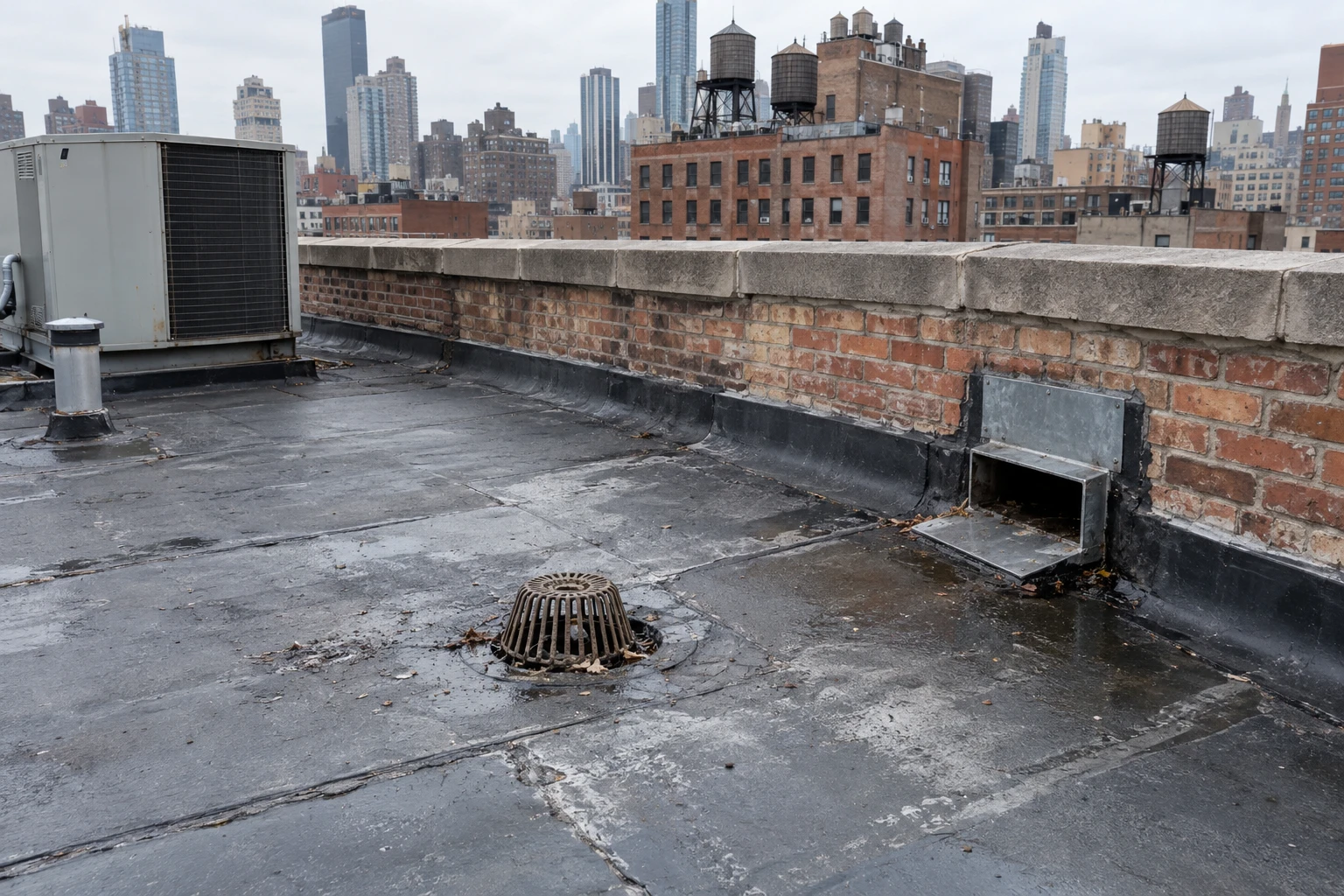
An infrared scan at dusk shows where insulation holds water. Cores at the warm spots and at a few control points confirm what is under the membrane, and each core is labeled, photographed and held until the owner has signed off on the report. Ponding depth after rain shows where the slope fails. And an inspection of each curb, parapet coping, drain leader and skylight shows where the detail work has aged. School roofs often combine several ages and shapes: a main roof, a gym roof, an addition. Each gets its own rating.
Older roofs may contain asbestos-containing materials, and a test of the existing layers comes before any cutting. The results are written in the report so the abatement scope, if any, is clear before the project is priced. Photographs tied to a sketch accompany the condition rating, which feeds the reserve study and lets the owner weigh repair, recover and replacement. Skylights and roof hatches over stairwells get their own line, because a cracked curb or a loose hatch is both a leak and a safety item. Each is photographed open and closed.
How do we fit a tear-off into the summer break?
The window is short, and the schedule starts months earlier. Drawings, permits, submittals and material orders all come first, and the survey comes before them. We work backward from the first day of school: a dry-in date, a final inspection date, a punch-list date. Anything that can slip, such as a delayed permit or a late shipment of insulation, is flagged on the schedule with a decision date, so the principal knows by July whether a zone will wait until the next summer. Every zone follows its own sequence and is closed before dark.
Union City packs 53,293.7 residents into each square mile, by the 2020 census, which makes it the second densest municipality in New Jersey and leaves little room to stage materials, and a Manhattan street takes the same planning. Material arrives in small lifts, the crane location is fixed with the city in advance and the crew clears the street edge each evening. The plan includes a stop rule for rain, so a front does not catch an open roof.
What do storms and snow require of the specification?
Ida's September 1, 2021 storm gave Central Park 7.13 inches and the city a one-hour record of 3.15 inches; the Weather Service had never before declared a flash flood emergency for New York City. A drain leader that cannot carry that rate holds water against every curb and wall. Central Park saw a 27.3 inch snowfall on January 23, 2016 against an average of 29.8 inches for a whole year, and its temperatures have run from minus 15 F to 106 F.
We check leaders, strainers and overflows, then parapet coping and edge fastening. Sandy's 14.06 foot surge at The Battery in October 2012 is ground-level exposure, separate from the roof, yet a school with mechanical rooms in a basement and equipment on the roof needs both reviewed. The roof drains and scuppers scope records flow and overflow height.
Which rules apply to a school roof replacement?
The 2022 NYC Construction Codes frame a school replacement, with the Energy Code deciding how much insulation goes back. Local Laws 92 and 94 of 2019 reach new buildings, enlargements and full replacements, so a school replacement has to plan its sustainable roofing zone around solar, a green roof or both. A school roof, with its limited area and its equipment, makes that a layout question before it is a roofing one.
Zone, equipment and structure are mapped early, and the report notes whether a repair or a partial recover stays outside the rule. Schools in New Jersey work to state and municipal codes, confirmed with the local building department. The same survey method applies in Union City, Jersey City and across the river. Our roof capital planning work turns the ratings into a multi-year table, with the roofs that need the next summer listed first, the ones that can wait two summers listed second and the rest on a maintenance calendar with a date for the next survey.
What should a school district keep on file?
Keep the core log, the infrared images, the asbestos test results where relevant, the ponding record, a sketch showing drains, curbs and skylights, and the product submittals. A district with many buildings benefits from the same format on every roof, so that the ratings can be compared. For school districts, those ratings are the budget document.
The record also protects the district in a claim. If a gym roof leaks and the floor is damaged, a dated survey showing the roof's condition before the loss helps separate wear from storm damage. We keep a file for each roof and deliver it on request, and we update the rating after each repair. A college building or an apartment building on the same system gets the same format. Updates follow every repair, and the rating on file always matches the roof.
Commercial Roofing Questions
What decides whether to replace a school roof this summer or wait a year?
Moisture and leak history decide it. Spreading wet insulation with recurring leaks makes waiting expensive. A dry roof whose leaks trace to flashings can be repaired now and replaced next summer. The core log and infrared map give the proportion, and the schedule must start months before the break.
What roof work is possible while classes are in session?
Limited work can go ahead, such as emergency repair and small flashing jobs. Loud, smelly and dusty steps wait for the break, so a leak during the term gets a temporary seal and the permanent work is scheduled for summer.
How are students kept safe during roof work?
Work areas are fenced and signed, material routes avoid entrances and play areas, and the crane does not swing over occupied ground. Smelly steps are scheduled when classrooms are empty. The plan is shared with the principal and the building engineer.
What happens if asbestos is found in the old roof?
Abatement comes first, performed by a licensed contractor under the applicable rules. Our test identifies what is present, the report lists it and the scope prices the removal separately. The roofing schedule then follows the abatement.
How should a district rank roofs across many buildings?
Rank by condition, adjusted for what lies underneath. A roof with wet insulation above a gym or a boiler room outranks a dry roof over storage. That produces an order the district can defend, and its capital plan adopts it.