Repair of failed base flashing, counterflashing and wall terminations on Manhattan, NY roofs, found by survey and rebuilt to hold through heavy rain and thaw.
Termination height is the number to read where a membrane meets a wall: a base flashing that rises only three inches above the roof surface will take water the first time a pond reaches that depth. Flashing is the edge of a roof's watertight skin, and on a Manhattan building it runs along every parapet, bulkhead, chimney and penthouse wall. The field of the membrane may be sound while the flashing along the wall has cracked, shrunk and pulled free. Photographs of the wall-to-roof joint at several points, with any visible gap noted, give the survey a head start.
Failed flashing on low-slope roofs is found, rebuilt and tested, and every detail goes in the record.
What is a flashing made of, and where does it fail?
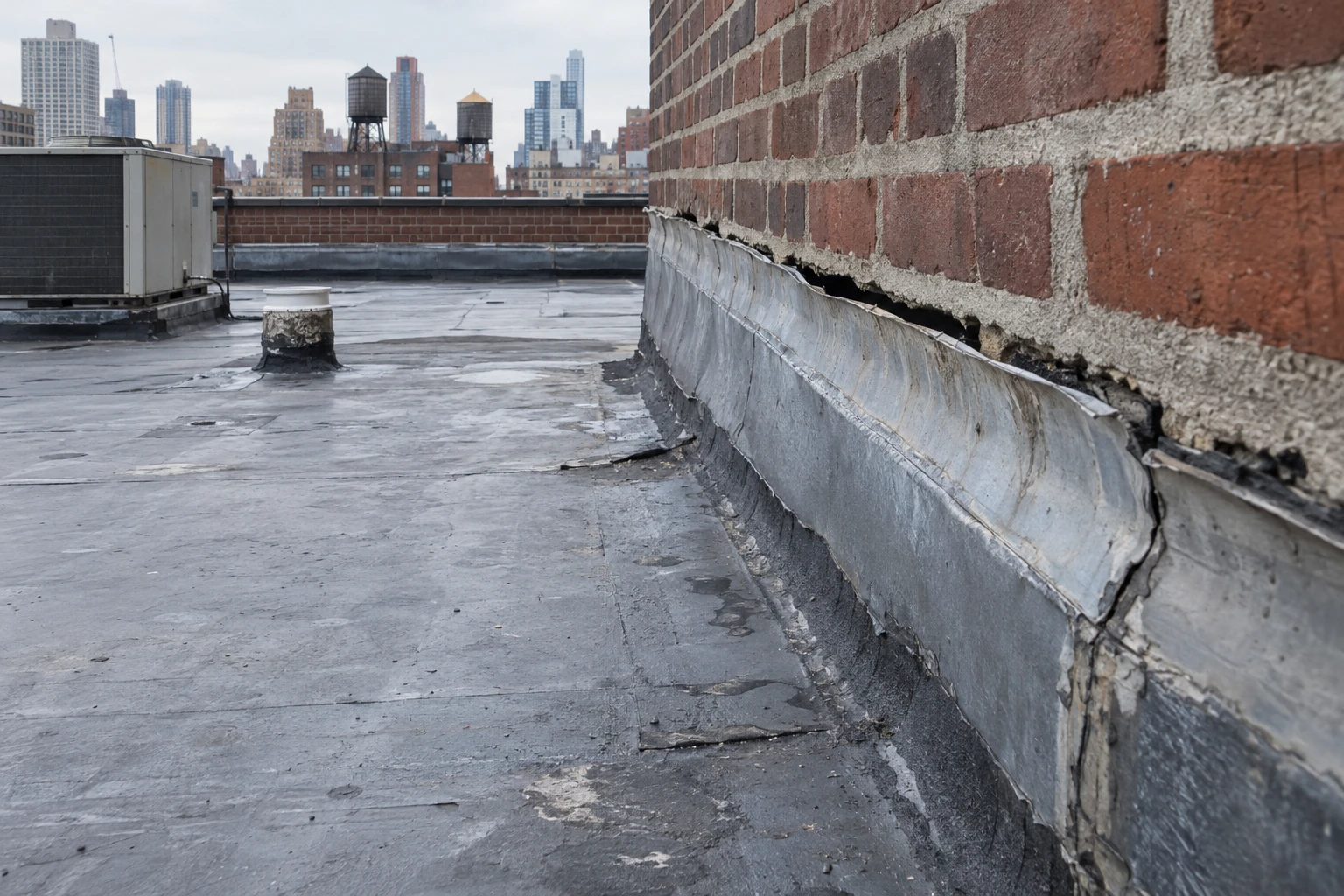
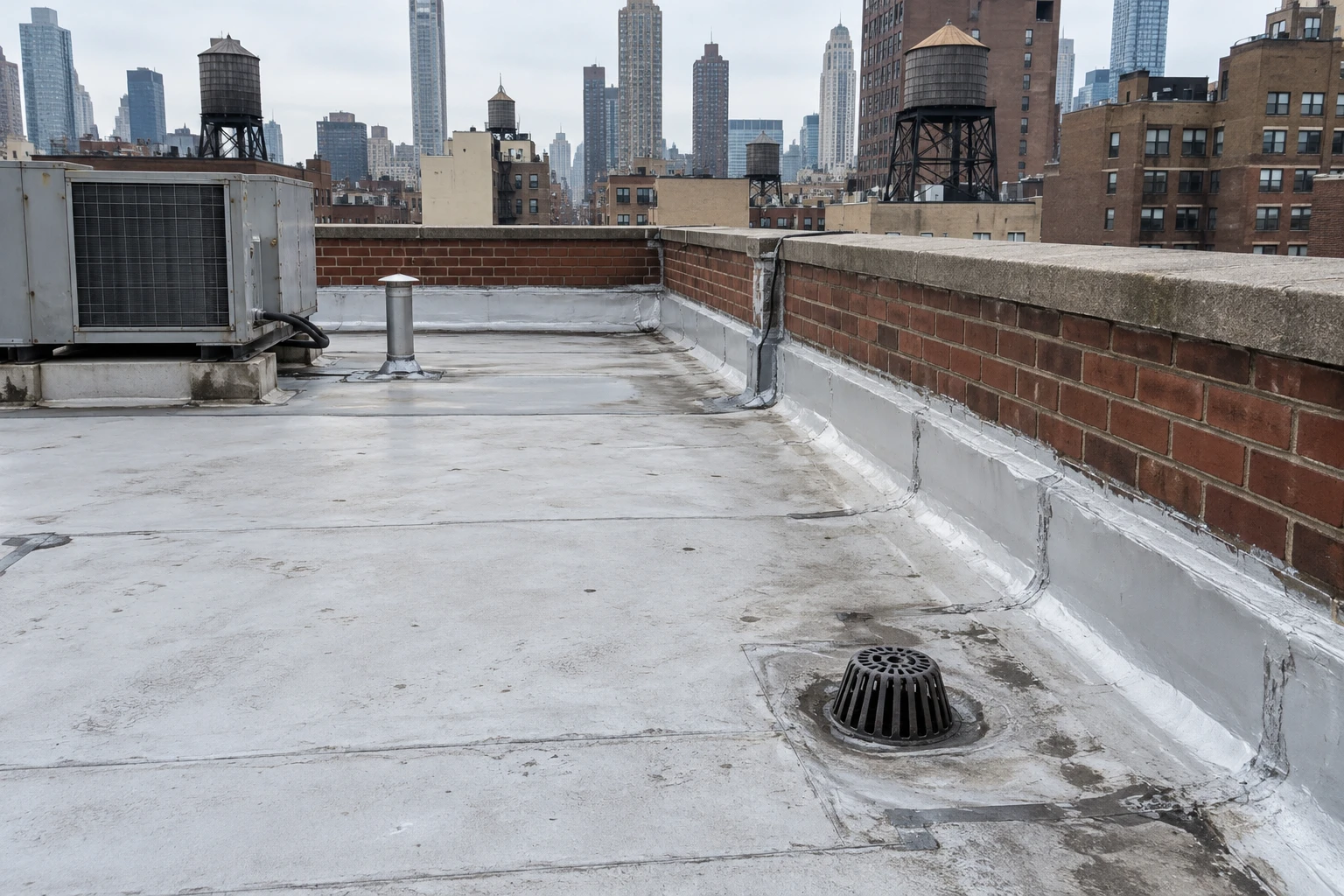
A wall flashing is built in two layers. Turning up the wall from the roof is the base flashing, membrane or bituminous sheet. Over its top edge laps the counterflashing, metal or masonry-set sheet that sheds water away from the wall, while sealant, a termination bar and fasteners secure the base flashing at that top edge.
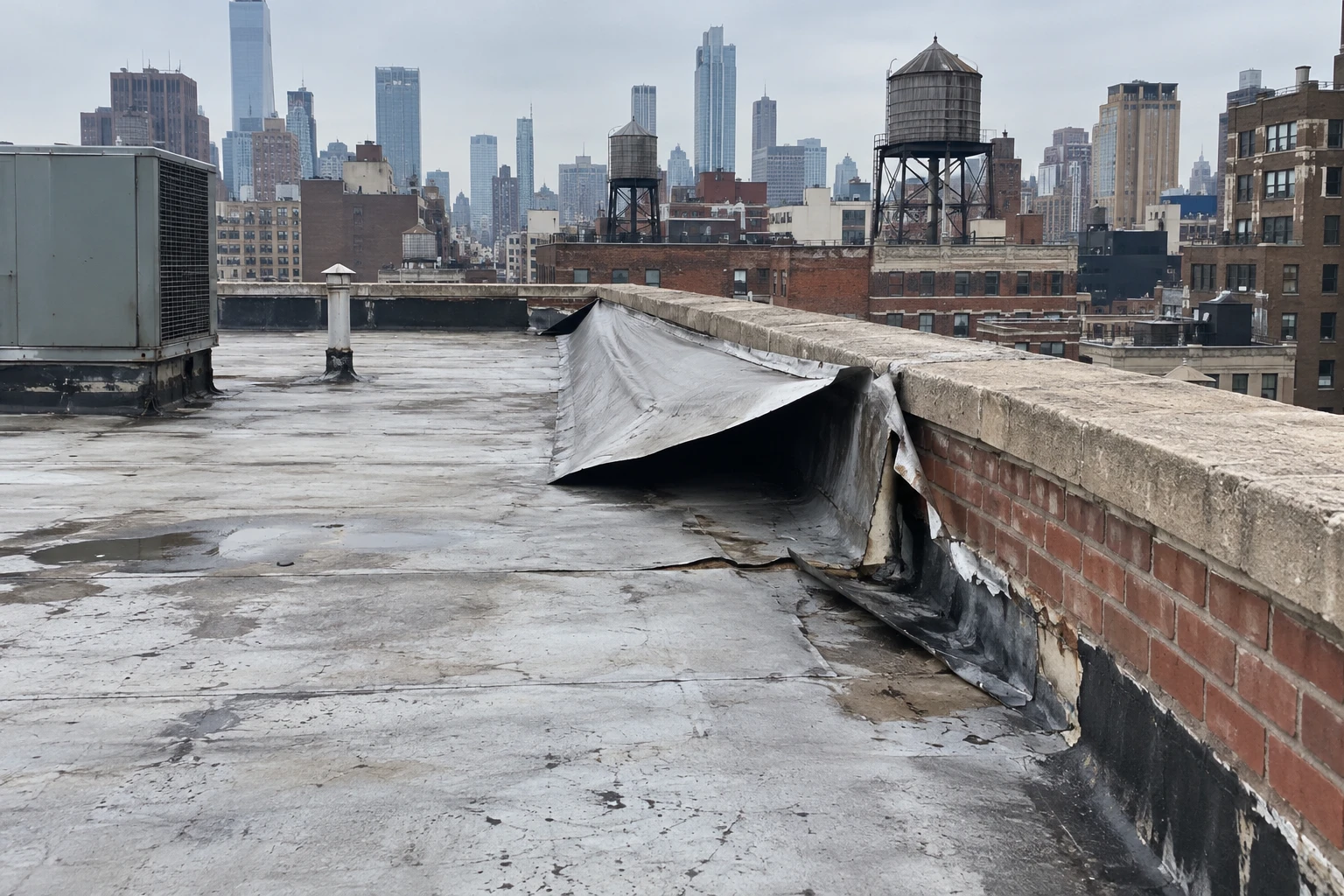
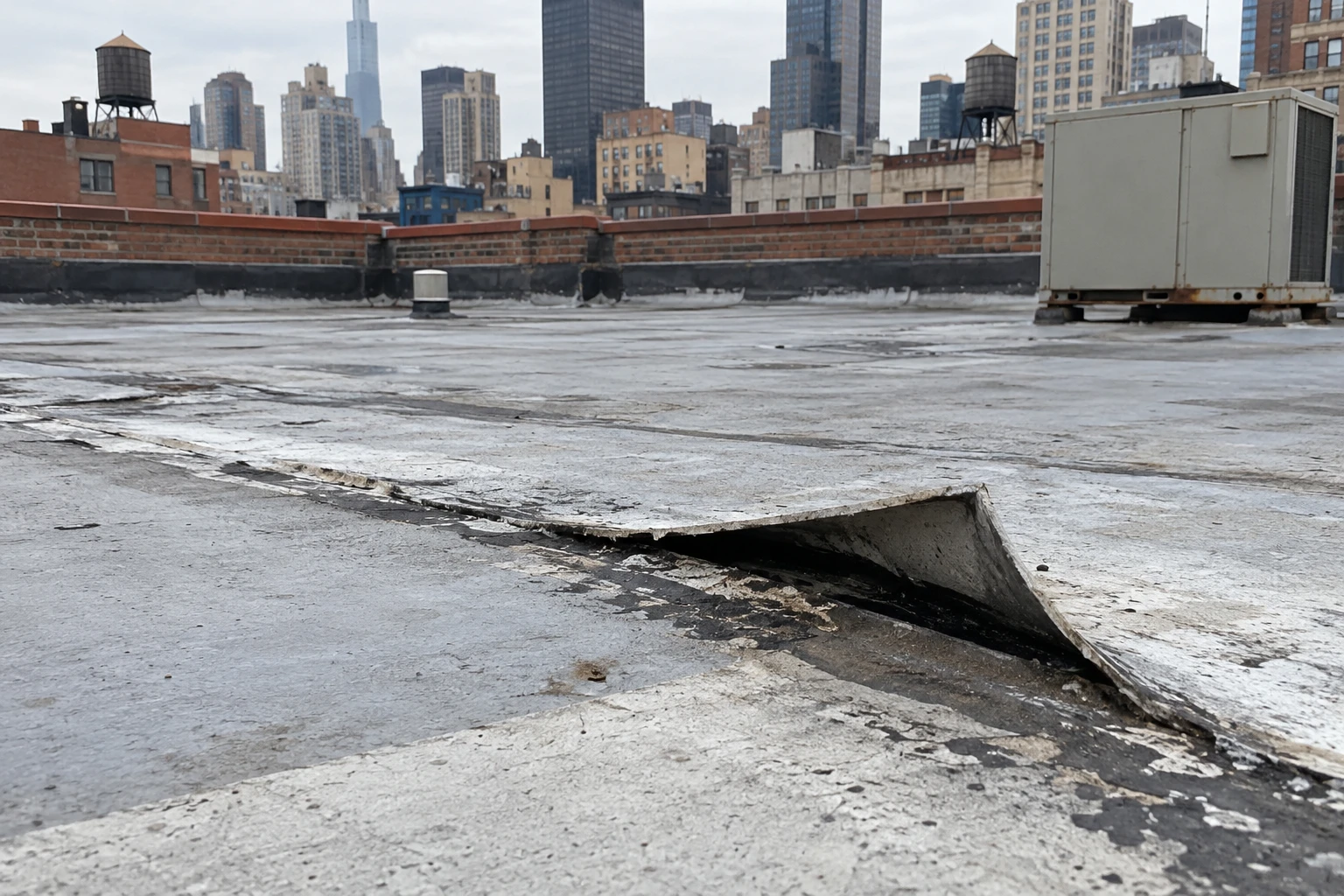
Every part has its own way of failing. In cold and sun the base flashing shrinks away from the wall; sealant dries out and splits; counterflashing corrodes through at its fasteners or works loose in the mortar, and a termination bar loses its grip when the wall behind it crumbles. On the roof the failure appears as a stain at the wall, a gap at a corner or a membrane that no longer lies flat at its base. The survey inspects and rates each part separately, and the photographs stay with the roof plan.
Movement sits behind most of these failures. Central Park has recorded 106 F and minus 15 F, and the roof and the wall expand and contract at different rates; a masonry wall moves little, a membrane moves a lot and the flashing absorbs the difference. After many cycles the bond at the wall weakens first, which is how a flashing that looks intact in summer can open in the first hard freeze, and why inspections follow winter. A wind event can start the same failure at once, as in wind damage repair, when a gust lifts the sheet at the wall.
Why do Manhattan walls make flashing harder?
Manhattan roofs are small and ringed with walls. Across the prewar five and six story blocks of Inwood, Washington Heights, the Lower East Side and the East Village, long parapets surround short roofs, and bulkheads, chimneys and tank supports add more wall per square foot of roof than a suburban building would have. The masonry is old, and weathered mortar cannot always hold a reglet or a termination bar.
SoHo-Cast Iron, with about 500 buildings, is among the landmarked districts that limit changes visible from the street, so a counterflashing on a front parapet may call for an in-kind repair and a review. The right fix often begins in the wall itself: repointing, replacing loose brick and setting a new reglet before flashing goes on, because flashing set into failing masonry fails again. Wall findings from the facade contractor should reach the roofing scope before it is final.
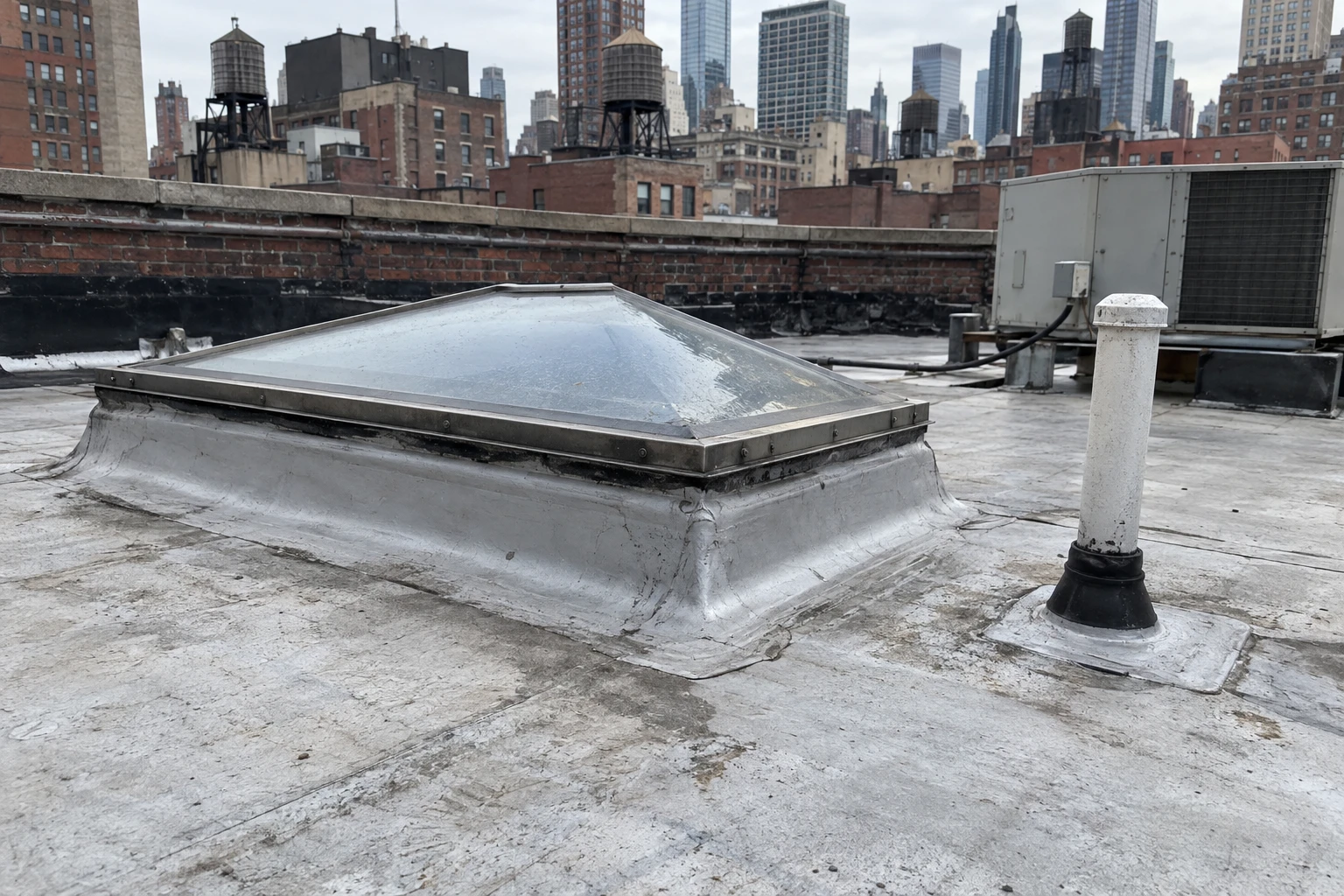
A penetration is a wall in miniature. A pipe, a curb or a skylight carries its own flashing under the same rules of height, termination and counterflashing, only smaller, and the work on skylight and penetration flashing follows that logic, so the survey rates the two together. With a dozen penetrations and a long run of wall on one roof, the joints to read add up, and the plan marks each.
What does a heavy rain hour do to a marginal flashing?
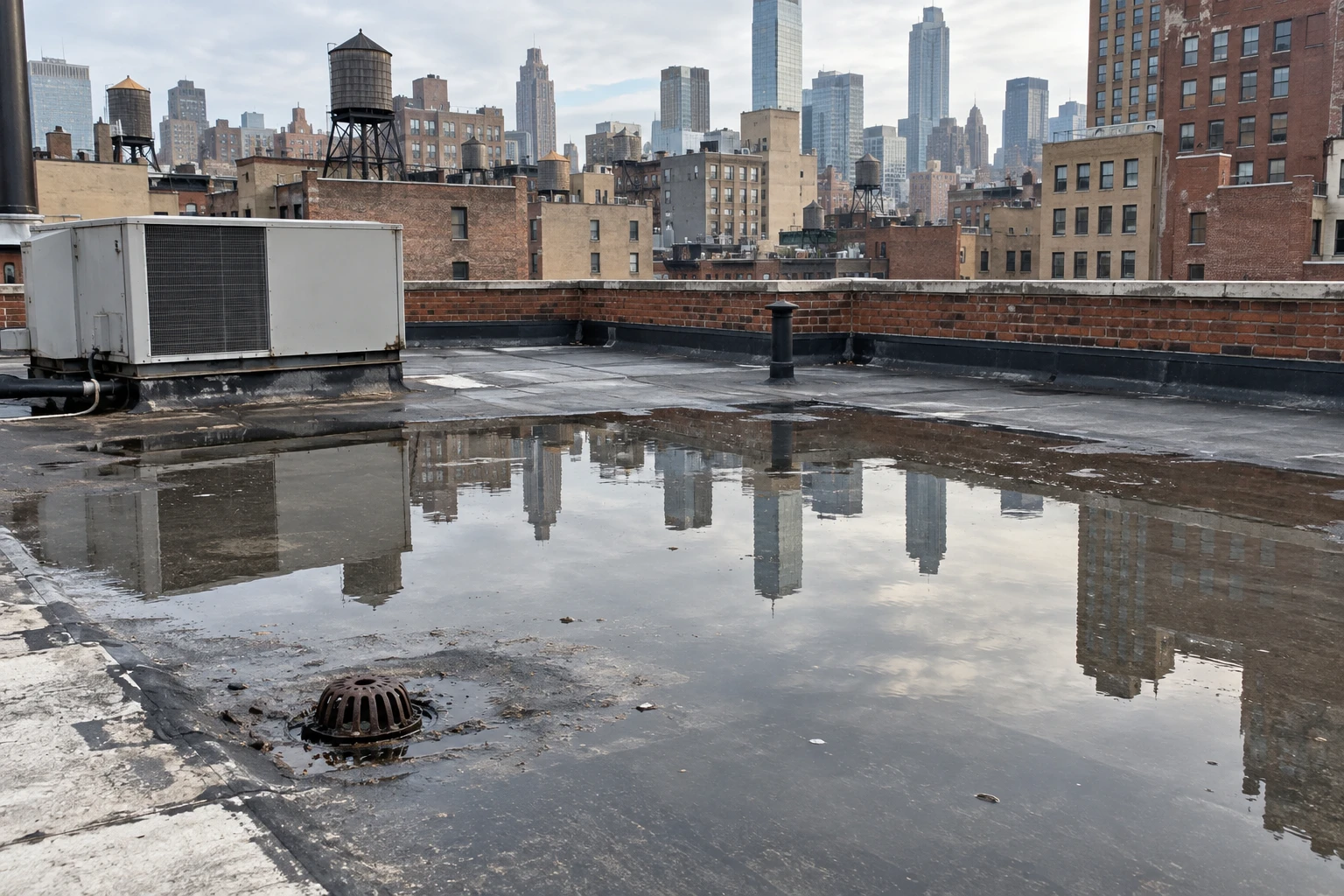
On September 1, 2021 Ida's rainfall hit 3.15 inches in an hour and put 7.13 inches into Central Park, and a flash flood emergency, the first the Weather Service had declared for New York City, followed. A roof with weak drainage ponds against its walls in such an hour, and a base flashing built for ordinary rain suddenly has to resist standing water, so any gap admits a flood.
The same rain exposes sealant joints, open laps and counterflashing that no longer sheds. A ceiling stain beside the wall after such rain points first at the flashing. A water test at the wall, run from the low point upward, and an infrared scan trace the entry. Where ponding is the cause, drainage is corrected as well, through ponding water repair. The rain total and the date of every leak belong in the log.
What does a proper flashing repair involve?
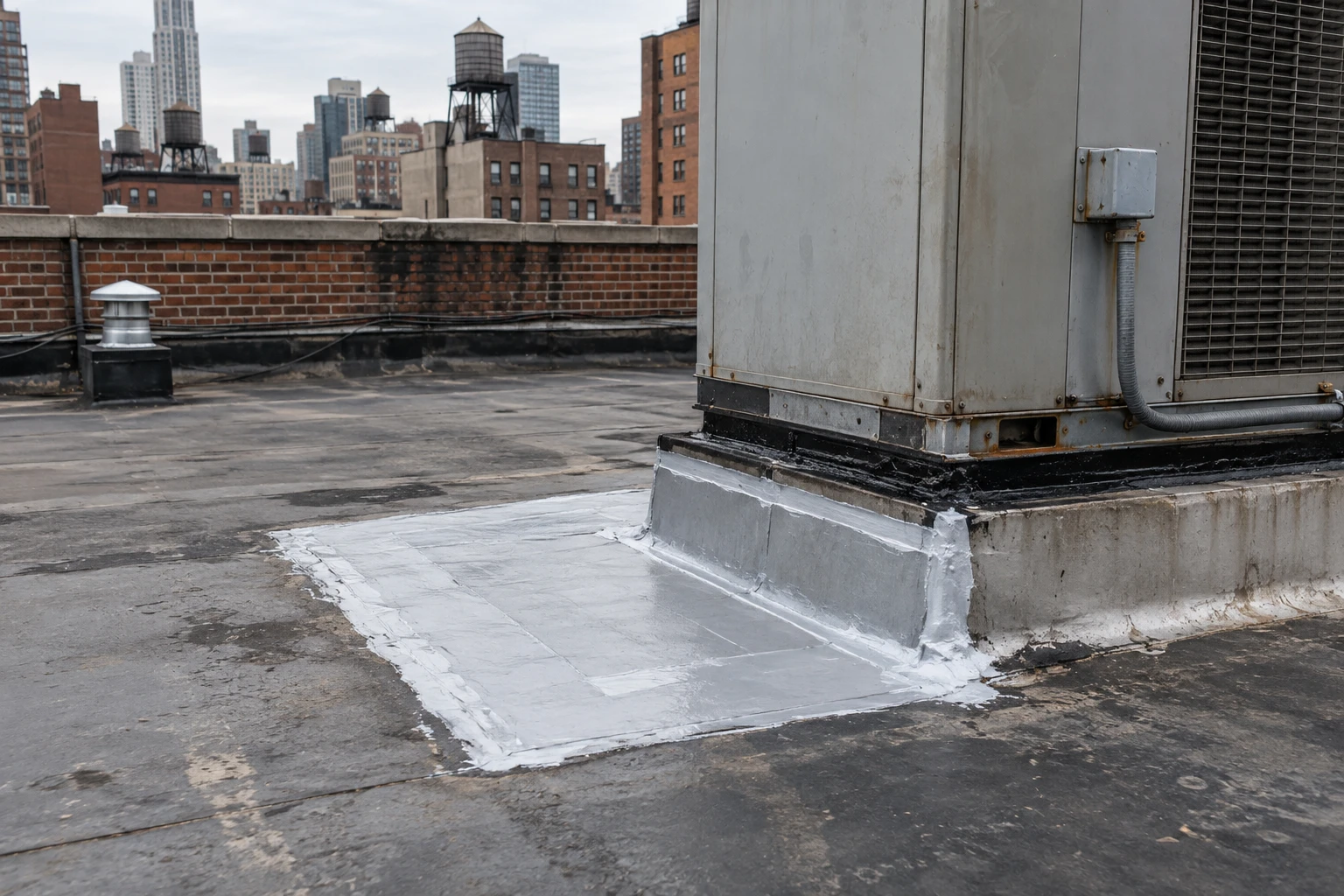
A proper repair removes the failed material and rebuilds the detail in sequence. The wall face is cleaned and, if needed, repointed; primer goes on; a new base flashing is adhered or fastened at a height that meets the system's requirement; a termination bar secures its top edge; and a new counterflashing laps over the bar. Sealant finishes the joints but is never the whole defense.
Corners and transitions get formed pieces, since a folded sheet is a future leak. Where the existing flashing sits on an otherwise sound roof, the work is a targeted commercial roof repair; if the membrane is also worn, the flashing is rebuilt inside a larger scope. The finished detail is tested with water before the crew leaves, each layer is photographed before it is covered and the photographs go to the closeout file.
Seams and flashings often fail in company. A seam failure near a wall often signals that the membrane has shrunk, and that shrinkage, which opened the seam, tugged at the flashing. Repairing one without the other leaves the roof half fixed, so every seam within several feet of a wall is probed during the flashing survey and the two are reported together, and the repair restores the whole joint rather than a single point.
How do flashing repairs fit into maintenance and budget?
Flashing is a recurring maintenance item. Sealant ages in a few seasons, and a visit that reseals joints before they open costs little next to the wet insulation that follows a neglected one. A preventive roof maintenance program checks every wall termination on each visit and logs the sealant's condition.
When a flashing repair grows into a replacement, the cost drivers are the length of wall, the state of the masonry, access and the height of the work. For owners in the East Village and similar districts, the parapet length per roof can drive the budget more than the roof area does. The repair is recorded in the condition report and checked at the next survey, and asking for wall findings alongside the roof findings lets both be priced together.
The closeout record for flashing is short and specific: the length of wall treated, the materials used, the termination height achieved, the sealant type and the results of the water test. With that record a later leak at the wall can be traced to a cause, and a lender reading the file sees that the weak points were found and fixed. The roof plan should show which walls have new flashing and the date, so the next survey starts from the right place.
Commercial Roofing Questions
What decides if flashing can be patched or must be rebuilt?
The wall behind it and the extent of failure. Patching suits a short crack in sound flashing on a solid wall; failed termination, corroded counterflashing or crumbling masonry calls for a rebuild.
Is sealant alone an acceptable repair?
Sealant may buy a season. It finishes a joint and cannot replace a mechanical termination plus a counterflashing that sheds water.
How high should base flashing rise above the roof?
The minimum comes from the system manufacturer, though a pond or snow line can justify extra height. The height is checked against the recorded ponding depth.
Can flashing be repaired in winter?
Sometimes, using cold-weather materials on a dry surface. Otherwise a temporary dry-in holds until conditions allow the permanent repair.
Who handles the masonry work behind the flashing?
A facade or masonry contractor usually does, and the sequence is coordinated so flashing is installed only once the wall is sound.