Commercial roof surveys, repair and replacement in the East Village, Manhattan, NY, for air-shaft tenements, landmarked halls and mixed-use buildings.
Water from a small roof has a short trip to a ceiling. A footprint of about 25 by 25 feet, the size of many 19th century East Village tenements, leaves almost no distance between the roof edge, the stair bulkhead and the shaft that lets light into the rooms below. A failed flashing at any of those points reaches an apartment fast, which is why surveys on these buildings concentrate on edges, shafts and penetrations rather than the open field.
In Manhattan, NY, we survey, repair and replace low-slope roofs on the district's walk-ups, mixed-use buildings and landmarked halls. The record we leave is built for an owner who may manage a single building or a dozen: a condition rating, a plan with every drain and penetration marked and a clear statement of what to fix first, what can wait and what each choice will do to the budget.
The first written report becomes the baseline for every decision after it.
What do air-shaft tenement roofs need that a plain flat roof does not?
The air-shaft Old Law Tenements came out of an 1879 law that required windows in every room, and their plan still shapes the roofs above. The shaft is a notch in the building that carries a wall of flashing around it, and the parapet around the notch is another edge where water can enter. Skylights over stairs, vent hoods and chimney remnants add to the count of penetrations on a roof that is only a few hundred square feet.
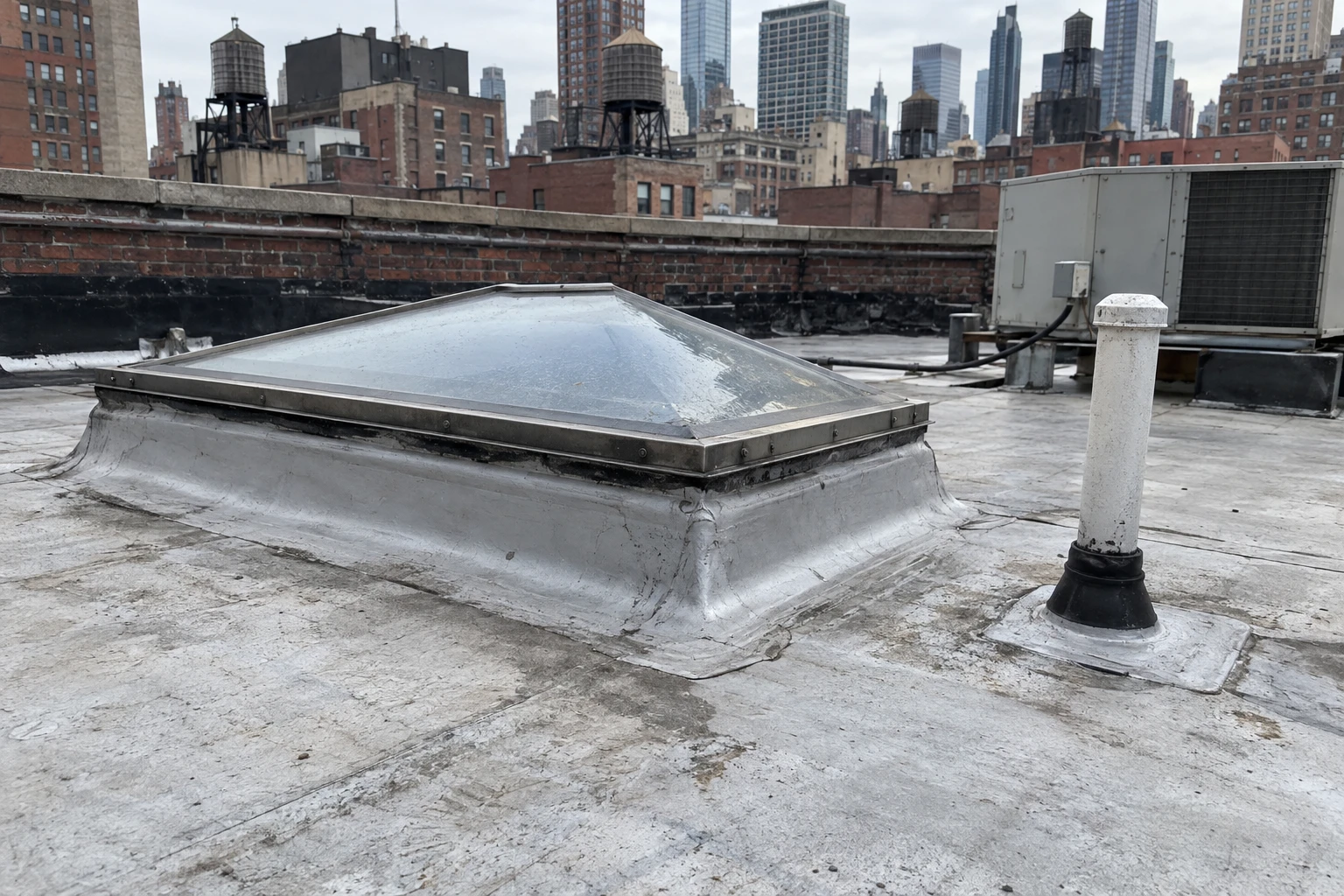
Our walk records each of these. We look at the flashing around the shaft, the height of the base flashing at the stair bulkhead, and the sealant and counterflashing at every penetration. The cheapest repair on a roof of this kind is usually flashing, not membrane, so skylight and penetration flashing is where many surveys end up spending the first dollars.
The shaft also collects debris. Leaves, litter and old roofing scraps fall into it and block the small drain at the bottom, which then backs up into the wall. We note the drain condition and recommend a screen or a regular clearing schedule where the shaft is open to the sky.
How do the historic districts and individual landmarks change the work?
The East 10th Street Historic District was designated in January 2012, and the larger East Village/Lower East Side Historic District followed in October 2012. Individual landmarks add to the pattern: Webster Hall, a Romanesque Revival hall designed in 1886, was designated in 2008, and the Van Tassell and Kearney Horse Auction Mart at 126 to 128 East 13th Street, built 1903 to 1904, was designated in 2012. Designation does not describe a building's roof, but it does govern what can change at the public face of the building.
For an owner inside one of these districts, the practical step is to confirm status before design. We photograph the street-facing edge, record the cornice and coping, and flag any element that may need review. Repairs that keep the exterior as it is tend to proceed without delay. Replacements and rooftop additions are where review enters the schedule, and a clear roof condition report shortens that conversation.
What matters on a roof over a large landmarked hall?
Buildings like Webster Hall and the old auction mart on East 13th Street were built for large rooms, and a large room under a roof means longer spans, more equipment and a higher cost for a leak. We do not assume what is on those roofs. We scan them, cut cores and record what the layers are, because a historic shell is often covered by a modern membrane that tells a different story from the facade.
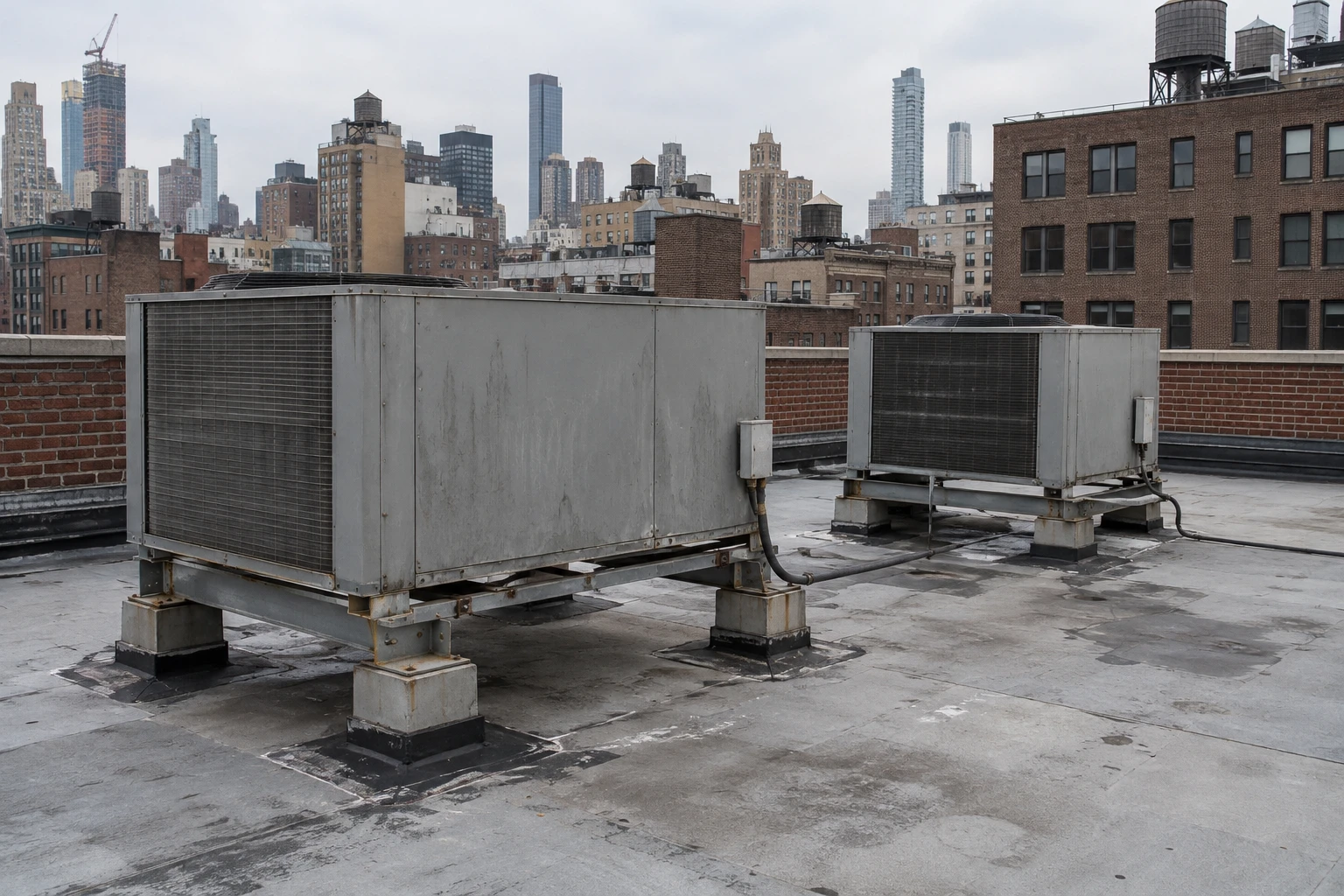
Where a hall hosts events, scheduling matters. Noise limits, load-in times and neighbors on a mixed block all enter the plan, so tear-off hours are agreed in writing. Rooftop mechanical equipment in such buildings is usually heavy, and the supports below it deserve their own check. The curbs and supports under rooftop equipment are checked for load path and flashing together.
Where a hall roof is shared with a residential or office floor above, the report names which area each leak belongs to, so costs can be assigned without argument.
What did Sandy and Ida show about this district's drains?
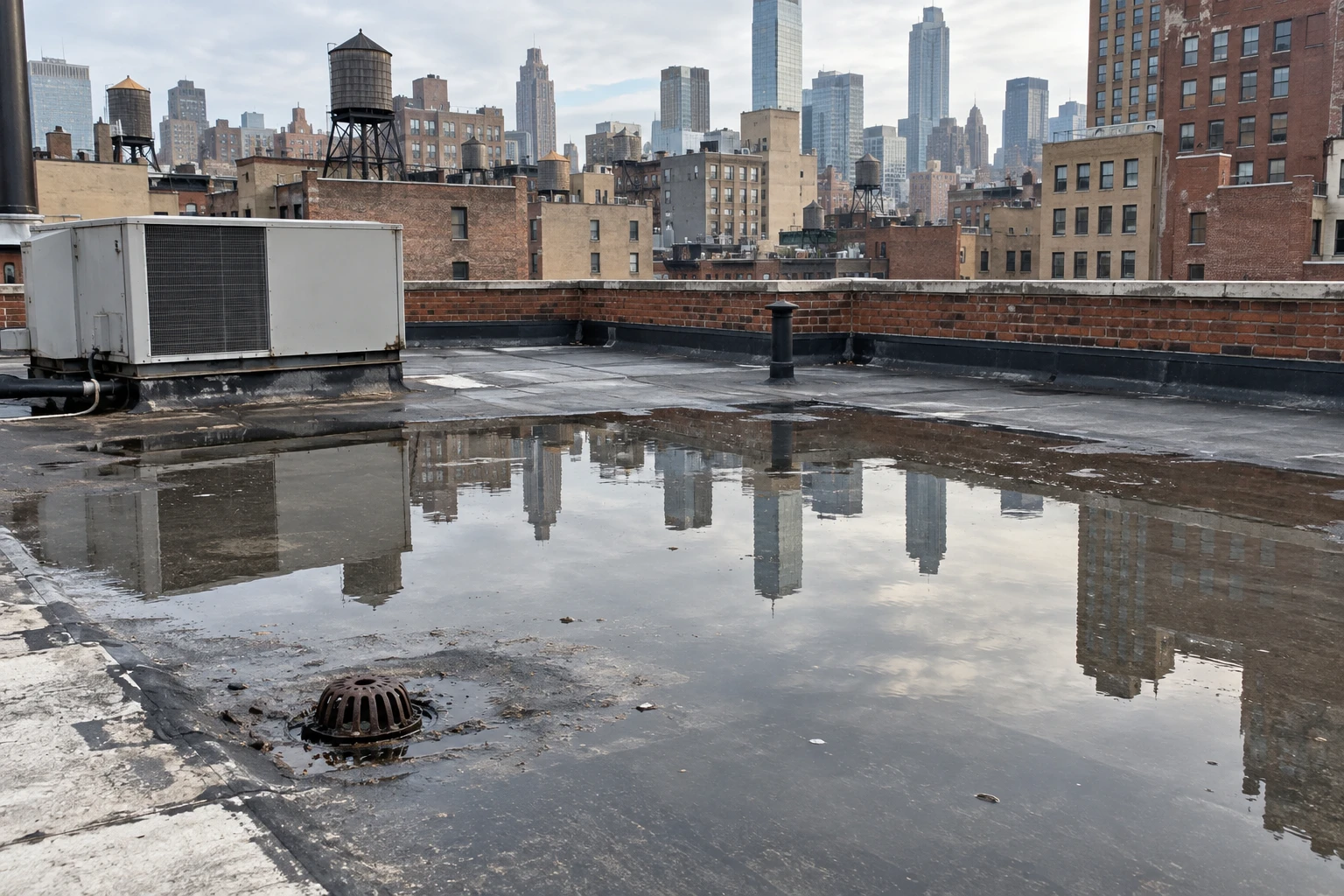
East River water flooded parts of the East Village during Hurricane Sandy on October 29, 2012, when the surge reached 14.06 feet at The Battery. Ida's hour of 3.15 inches on September 1, 2021 then showed how quickly a small roof can fill. On a roof this size, one blocked drain can pond the whole surface, and the water has few places to go but over the parapet flashing.
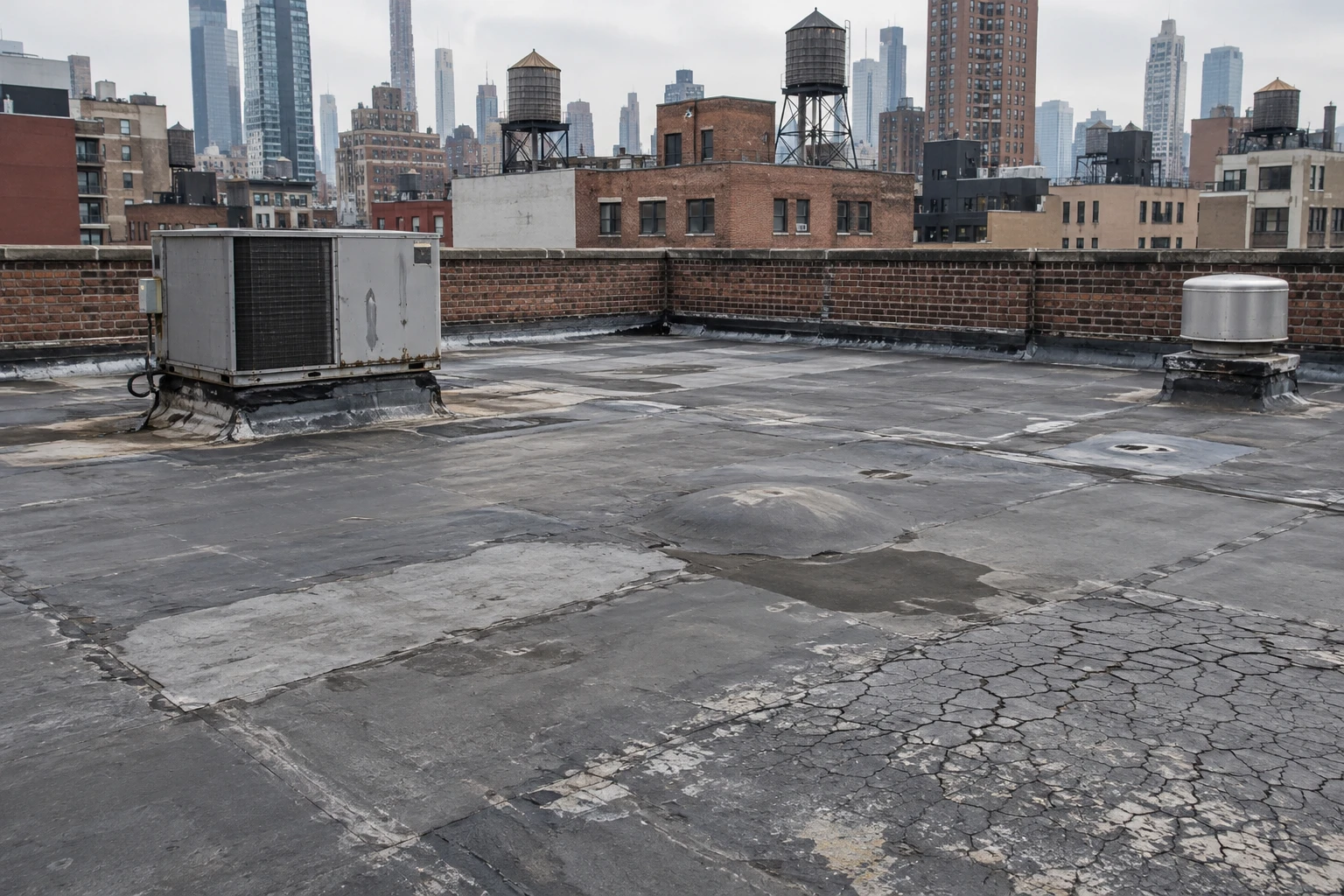
We measure ponding depth, check the drain strainer and clear debris on the first visit. Winter adds weight and ice: Central Park averages 29.8 inches of snow a year, and a frozen drain can hold water against the flashing for days. Monitoring ponding water across seasons shows whether the roof is settling or simply slow to drain.
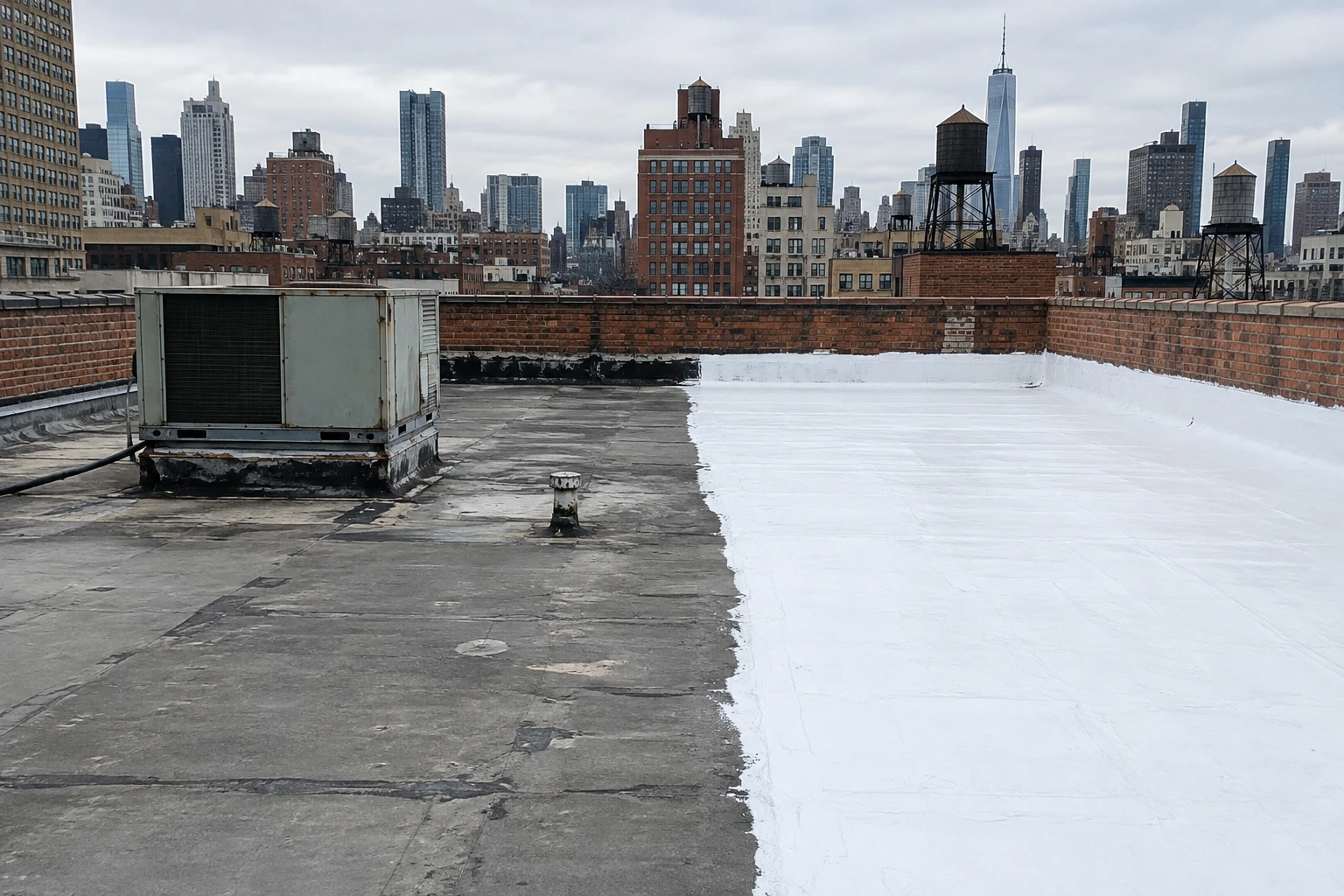
Summer heat matters as well. Central Park has recorded 106 F, and a dark roof on a small building sends that heat down into top-floor units, so reflective surfaces are worth pricing against the standard system.
How do repair, recover and replacement compare on a small building?
On a small roof, access dominates the price. A walk-up has no freight lift, so materials go up the stair or by hoist, and staging on a narrow street needs a permit and lead time. Repair costs less per visit but may repeat; a recover adds a layer if the old one is dry; replacement removes the old system entirely and restarts the service life.
The decision follows the survey. Dry insulation and a sound deck make repair or recover plausible. Wet layers point to removal. A full replacement draws in Local Laws 92 and 94, whose sustainable roofing zone calls for solar, a green roof or both and so affects structure and budget. Where a coating is appropriate, roof coating restoration can extend a dry, sound membrane at lower cost.
Weather windows and tenant notice periods set the calendar. We schedule each stage so the building is dried in at the end of every shift, and notices to residents go out with the dates and the noise hours.
What stays in the owner's file?
The file holds the rating, the scan, the cuts, the drain inventory, any review approvals and the warranty. Owners with holdings in the Lower East Side or Greenwich Village can rate those roofs on the same scale.
A short table works best: address, roof age, rating, open items and next action. Updating it after each visit keeps the reserve study and the repair list in step.
Commercial Roofing Questions
Why does a small tenement roof leak so quickly at the shaft?
The shaft wall sits close to the rooms below and carries its own flashing. A split in that flashing sends water straight down. Checking the shaft counterflashing and sealant is part of every first walk.
What decides whether a historic district review applies to my roof?
Visibility from the street decides it. Work behind a parapet that changes nothing visible is often simple, while changes to cornice, coping or visible equipment may need review. We confirm status before drawing the scope.
How is a roof surveyed above a large hall?
We schedule around operating hours, scan for moisture after dark if the building is quiet then, and confirm noise limits for any later repair work. The findings are written for the owner and the operator.
When is a coating a sensible choice on an old tar roof?
When the insulation is dry, the deck is sound and the surface needs protection, not replacement. Moisture mapping proves the first condition before any coating is priced.
Who should hold the roof records for a mixed-use building?
Whoever controls capital spending should hold them, with copies for the property manager. A single file with photographs and ratings avoids re-surveying at each ownership change.