Curb flashing, equipment supports and pipe supports on Manhattan, NY roofs: survey findings, load paths, drainage at the base and records for the file.
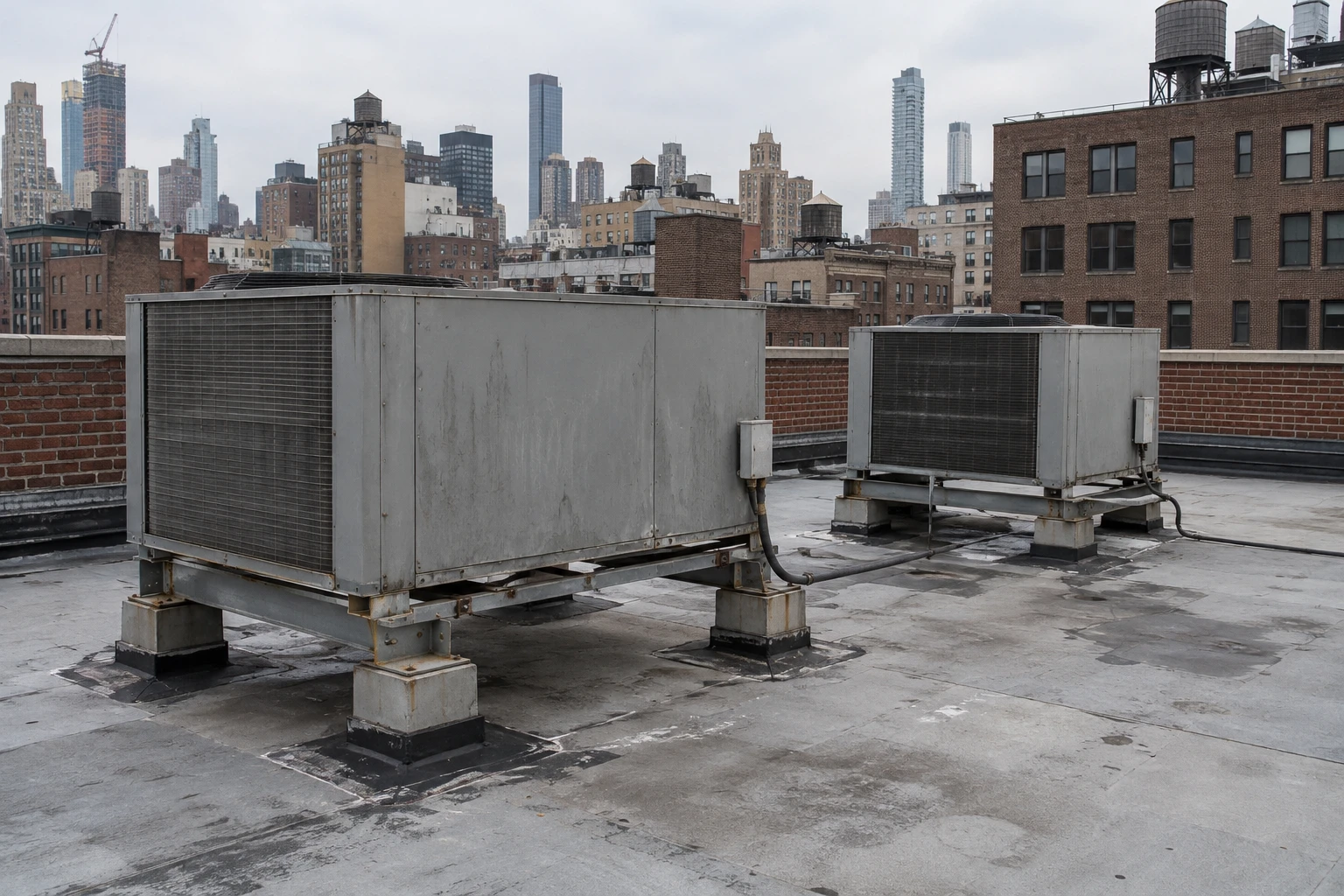
A moisture map that ends exactly at the edge of a mechanical curb is giving the owner a precise instruction. The water did not arrive across the field of the roof. It arrived at the one detail where a pipe, a duct or a unit penetrates the membrane. On Manhattan roofs, where space is tight and equipment is stacked around bulkheads and parapets, a curb or support is often the busiest few square feet on the building. It carries a load, it interrupts the waterproofing, and it changes how rain drains around it. Hurricane Ida put 3.15 inches of rain on the city in a single hour in September 2021, and the curbs that held water that night are the ones with a flashing, a slope or a drain leader that was not sized for the event. We survey these details first and write down what each one needs.
What does the survey find at a curb or support?
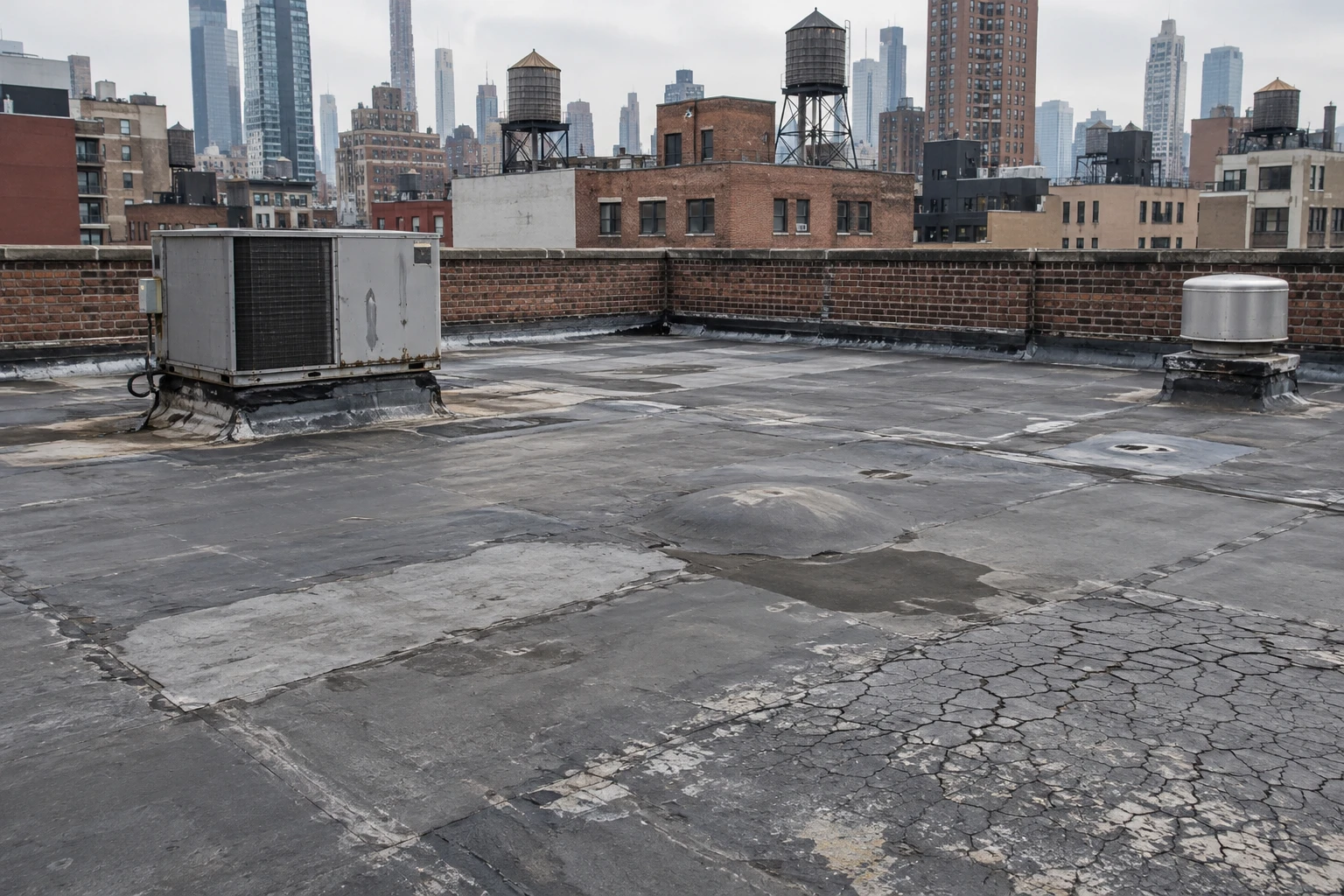
A curb survey records four things for every unit: the height of the curb above the finished roof, the condition of the base flashing and counterflashing, the state of the sealant at corners, and the slope of the membrane on the uphill side. A curb that sits too low lets water surge over the flashing. A curb with a cracked corner lets water in behind it. A curb whose uphill side ponds holds water against the flashing every time it rains.
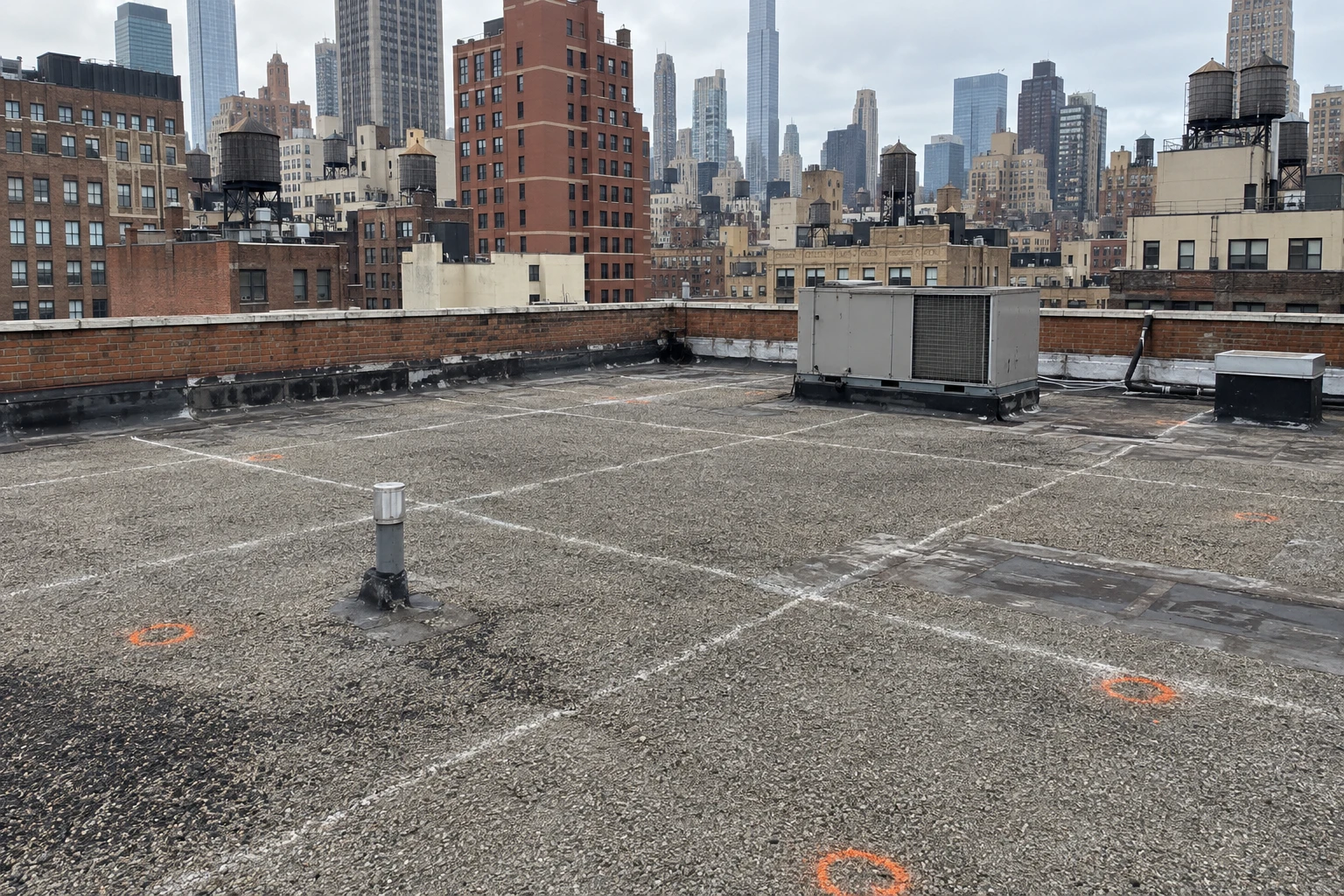
We also look under the equipment. Many units were set on a curb years ago and have since been joined by new conduit, refrigerant lines and condensate drains that cross the roof. Each is a separate penetration or an unsupported run, and each is logged. Where an infrared moisture survey flags a curb, the core cut goes beside it. The result is a plan of the roof marked with every curb, its condition rating and the work it needs.
How are equipment loads carried without damaging the roof?
A unit sitting on a membrane is a point load on insulation that was designed to carry people and light traffic. Over time the insulation compresses, the membrane stretches around the edge, and a low spot forms that holds water. The right answer is a support that moves the load to the structure: a curb framed to the deck, or dunnage that spans to the structural members, with a sleeper or pad that spreads the weight where the support must rest on the roof.
Pipe supports are a smaller version of the same problem. A pipe laid on the membrane wears it through, and a pipe clamped to a post that is bolted through the roof creates a penetration that must be flashed. We use supports with a base that is flashed as a unit and a post or roller that lets the pipe move without dragging the membrane. Before any new unit is set, the structural capacity of the deck has to be confirmed with the building's engineer, and the load is added to the file alongside the roof drawings.
What makes a curb flashing last?
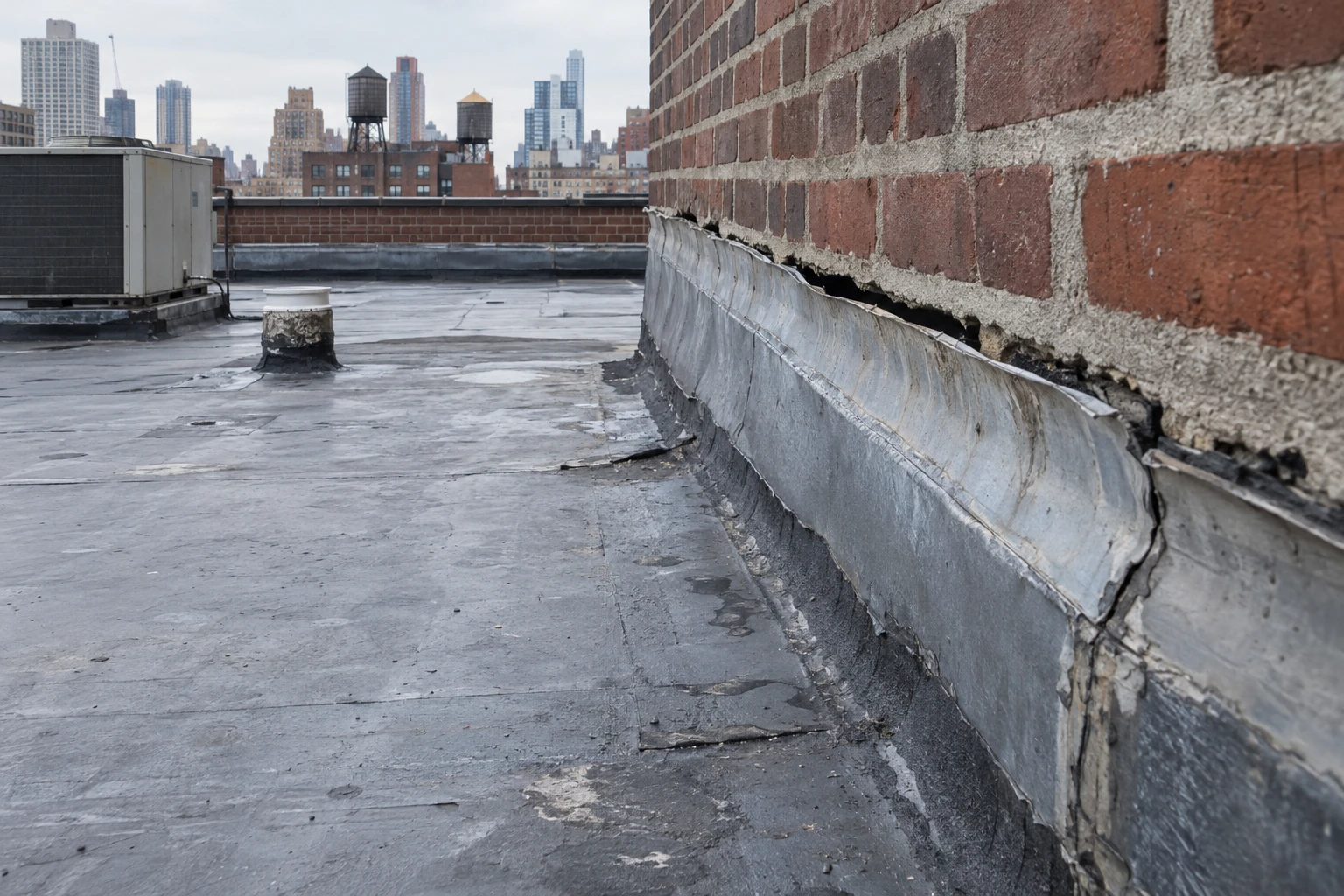
Most curb leaks come from the corners. The membrane has to turn up a vertical face, wrap an inside or outside corner and terminate at a height where water cannot get behind it, and every one of those transitions is a place where thermal movement concentrates. A corner formed from a field patch will crack in a few cold winters; a corner formed from a preformed piece, welded or adhered in a continuous run, holds.
We specify the termination height, the counterflashing detail and the sealant, and we record them. The cause of an older failure is often visible: a counterflashing nailed through the base flashing, a missing termination bar, sealant bridging a gap that should have a joint. Flashing failure repair at a curb is rarely a matter of adding sealant. It is a matter of rebuilding the corner correctly and testing it with water before the work is accepted.
How does a curb change drainage on the roof?
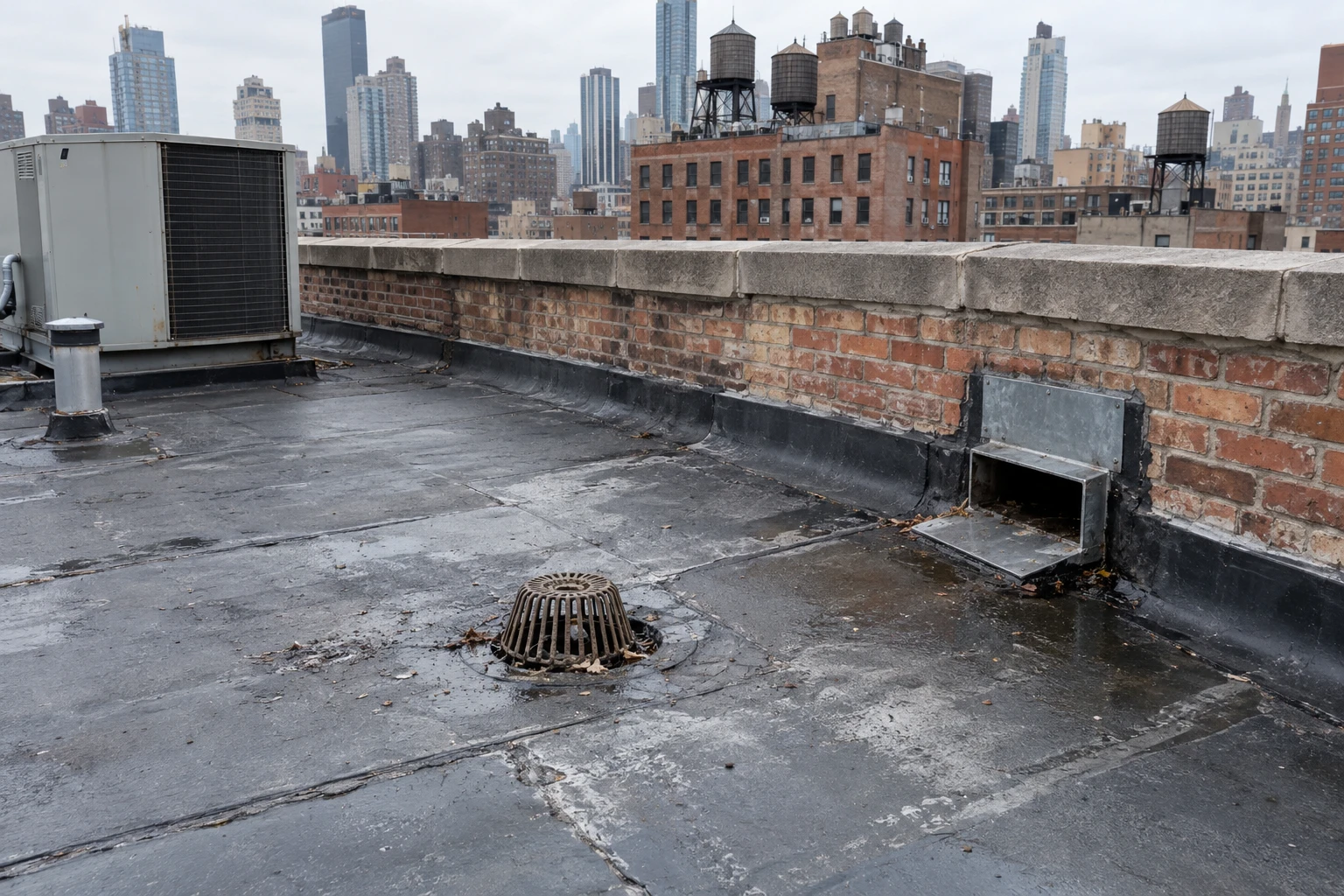
A curb is a dam. Water running across the roof meets it, slows, and either flows around it or pools behind it. On a setback roof with a modest slope, a row of curbs can cut the roof into basins with no path to a drain. That is how a roof that drained fine before the equipment arrived begins to hold water after a new unit goes in.
We map the flow paths with the curbs in place and measure ponding depth after rain or with a hose test. Fixes include a tapered insulation saddle behind the curb, a cricket that sends water around it, and a relocated drain or scupper close to the low point. A roof drain leader that cannot keep up will hold water against curb flashings for hours, and fixing it during curb work costs less than correcting it after a leak.
What does it take to work on equipment in a dense Manhattan block?
Access decides the schedule. Equipment is often reached by a stair to a bulkhead, a ladder through a hatch or a crane lift from a street that cannot be closed for long. A unit that must be lifted off its curb for flashing work needs a crane permit, a lift plan and a window when the street can be used.
We coordinate with the mechanical contractor so that the disconnect, the lift, the curb work and the reset happen in a planned sequence, with the roof dried in at the end of each day. In an office tower in Midtown, that sequence may run in the early morning hours. Tenants below should know the dates, since a unit that is off affects air handling on their floors.
What should the owner keep on file?
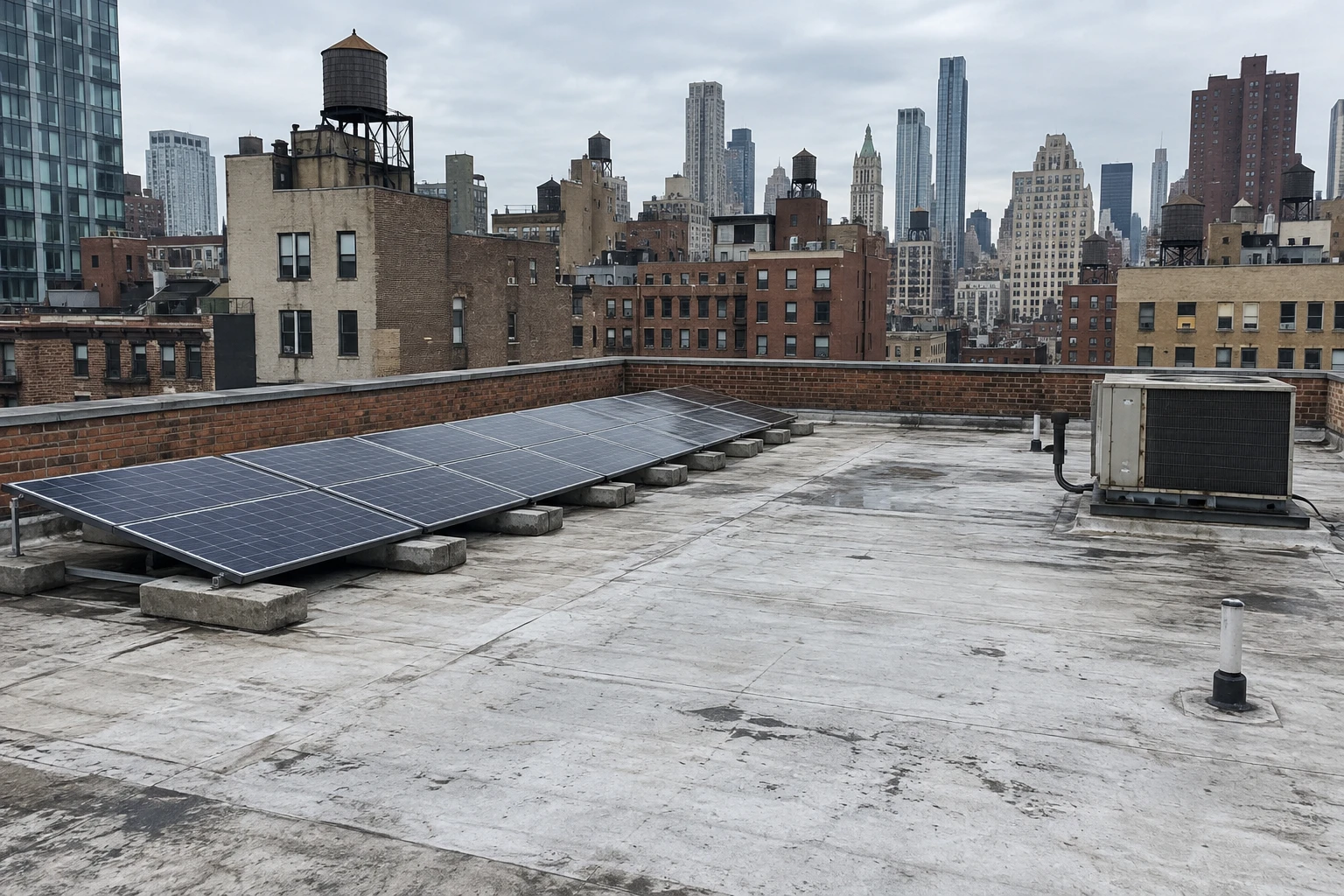
The file should include the curb plan with each unit numbered, the before-and-after photographs, the flashing details used, the load confirmation from the engineer, and the warranty status of each repaired area. If a solar array or a green roof is planned later, the plan shows where equipment stands and how much clear area remains. Local Laws 92 and 94 require the sustainable roofing zone on a full roof replacement to be covered by solar, a green roof or both, so equipment placement now affects how much roof is left for that zone later. The roof condition report carries these records into the next reserve study.
Commercial Roofing Questions
How tall should a curb be above the finished roof?
The manufacturer of the unit and the membrane system together set the minimum, and drainage on the roof adds to it. A low curb is overtopped by ponding or drifted snow, and Central Park's 29.8 inches of average snow makes that a real possibility. We compare the existing height with the system's requirement and with the expected water depth, and where it falls short we raise the curb or regrade the roof beside it.
Can a unit be replaced without redoing the curb flashing?
Sometimes, when the new unit fits the existing curb and the flashing is sound at the survey. The deciding factor is the condition of the corners and the counterflashing, not the age of the unit. A like-for-like swap that leaves a failing flashing in place only resets the clock on the leak, so we inspect the flashing before the crane arrives and price the repair as an option.
What happens if pipes are simply resting on the membrane?
They wear through it. Thermal movement drags the pipe across the surface, and a small puncture follows within a few seasons. The fix is a support with a flashed base and a roller or slider that carries the pipe above the membrane. We log each run, note which are unsupported and propose supports at the spacing the pipe requires, so the repair is complete in one visit.
Does adding supports affect the roof warranty?
It can, which is why the work is scheduled with the warranty holder's requirements in mind. Penetrations made by a party the warranty does not recognize can void coverage on that area. We confirm the terms before the work, use details the membrane system accepts and keep the inspection and photograph record the warranty holder asks for.