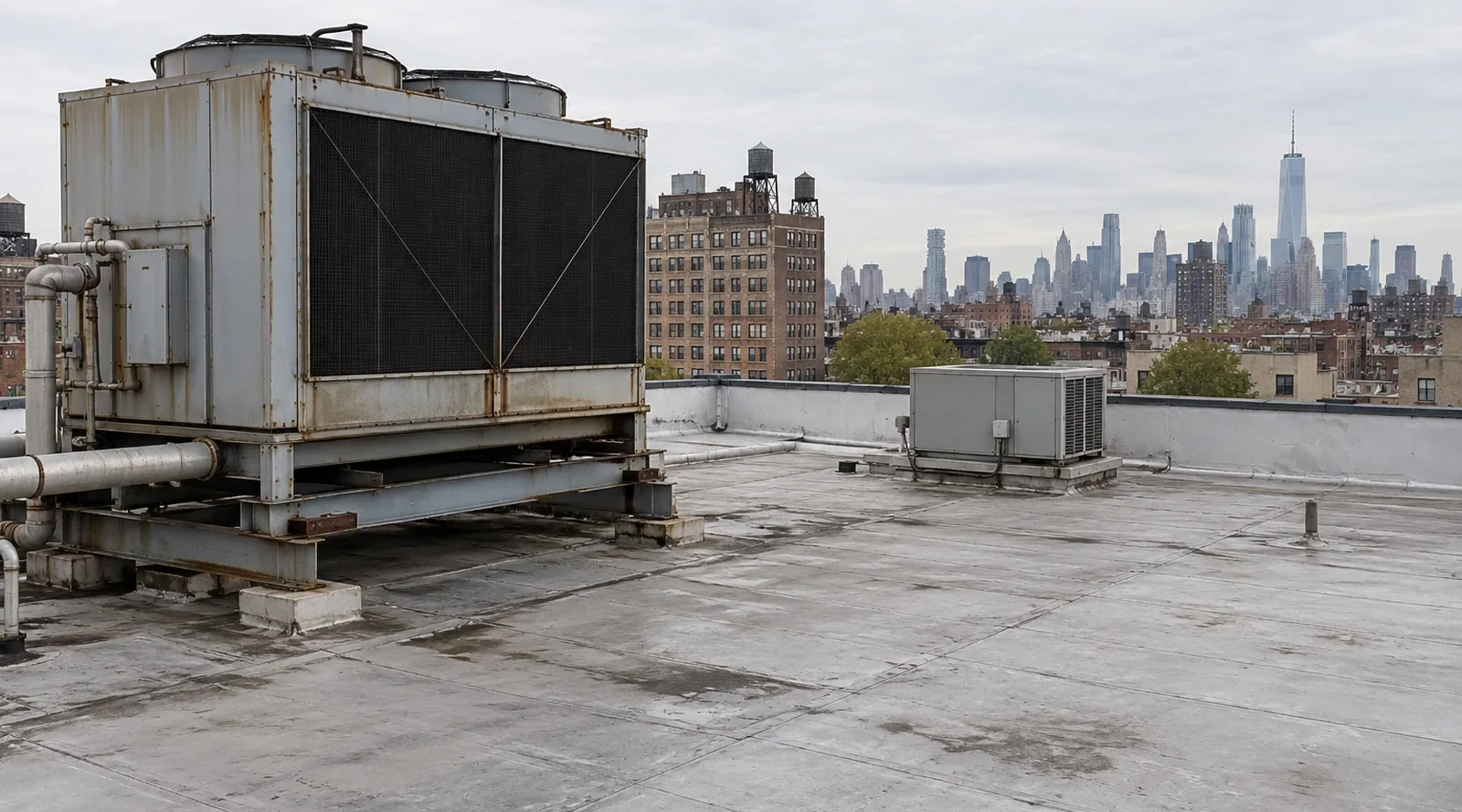
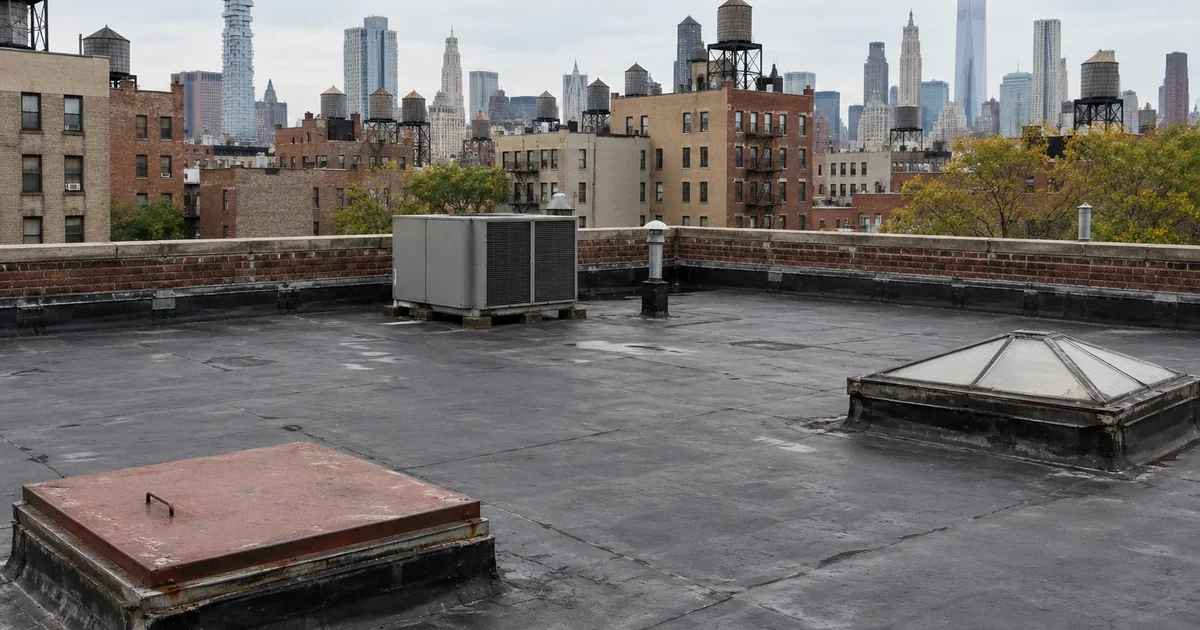
Cold storage and freezer building roofing in Manhattan, NY and the Hudson corridor: vapor control surveys, insulation cores and flood-aware replacement.
A core cut through the roof of a freezer building can show a thin lens of ice sitting inside the insulation, and the lens is the finding that explains years of rising energy use better than any bill. Cold storage reverses the usual roof logic. Heat and moisture push down into a cold room instead of up out of a warm one, and any gap in the vapor retarder lets humid air condense and freeze inside the assembly. In Manhattan, NY, with about 49.5 inches of precipitation a year and a strong urban heat island, and across the Hudson in Secaucus, Jersey City and North Bergen, that driving force is large for most of the year.
We survey, repair and replace roofs on cold and freezer buildings. Start the file with the last roof report, the building's age and any open violations; the survey scope and the condition rating are fixed before a number is discussed.
Why is the vapor retarder the first thing we check?
The retarder is a membrane near the warm side of the assembly, and it slows the movement of humid air toward the cold room. A seam that has opened, a penetration that was never sealed or a fastener that pierced it gives vapor a path. Over years, ice builds in the insulation, which loses its value and gains weight. The room works harder, and the roof above it stays cold enough to hold snow longer.
We cut cores at several points and look at each layer. We note the retarder type, the condition of its laps, the moisture content of the insulation and the thickness of any ice. An infrared scan from the roof surface shows the pattern, and the cores confirm it. A large cold zone is not always moisture, since the insulation may simply be sound and thick, so the core is the proof. The findings go into a condition rating for each area, and a short note explains in plain terms what the rating means for the room below: continuing to run, repairing within the year or planning a replacement.
How do heat, snow and surge exposure change the repair?
Snow in Central Park averages 29.8 inches a year and peaked at 27.3 inches on January 23, 2016, while temperatures there have swung between minus 15 F and 106 F. A cold-storage roof leaks very little heat through to melt snow, so a drift can sit and add load. In summer, the same roof sits in a hot field of other roofs and city pavement. The membrane over a freezer sees a wider temperature swing than one over a heated room.
Sandy's 2012 surge at The Battery measured 14.06 feet above average low tide, and Hoboken saw seawater across half the city, with 1,700 homes flooded. Secaucus sits at an elevation of 7 feet, which is why a hurricane damage review there starts with drains and edges. Surge floods the ground floor of a cold-storage building, where refrigeration plant often sits, and wind follows. After a storm we inspect the roof edges and the penetrations that carry refrigerant lines, because a pulled flashing there is a vapor path as well as a water path.
Which options fit a cold-storage roof?
If the survey finds a local breach, cutting out the wet insulation, drying the area and restoring the retarder is a sound repair. If the insulation is saturated across large areas, replacement is the answer, with a new retarder, new board and a new membrane. Where the deck is dry and the geometry is awkward, a spray foam roof can supply insulation and air seal in one pass; board insulation under a fused membrane is the other usual route.
Local Laws 92 and 94 of 2019 apply within New York City, and a full replacement there has to give its sustainable roofing zone over to solar, a green roof or both. A cold-storage roof carries condensers and lines, so the layout of equipment relative to the zone must be settled early, and the structural capacity for a green roof or an array has to be checked against the added weight on top of the roof's existing insulation and ballast. Thick insulation also raises the roof surface, which changes flashing heights and parapet details. The scope lists each change.
How does the work proceed while the room stays cold?
The cold room cannot warm up. We stage the work in sections, tear off only what can be dried in the same day and keep temporary seal material on the roof. Where the old assembly is removed to the deck, the new retarder and insulation go down as fast as the weather allows. Hot work has its own permits, and the fire watch continues after the last weld.
Access in the Hudson corridor shapes the schedule. With the Lincoln Tunnel carrying roughly 112,995 vehicles a day in 2016 and five intermodal freight facilities inside North Bergen, crane lifts and material deliveries move outside peak windows. A distribution building on the same site gets its own sequence. The plan names the delivery hours and the stop rule if weather changes.
What does the owner keep after the project?
Keep the core log, the infrared images, the retarder specification, the sketch of penetrations and the product submittals. For a site with a warehouse beside the cold rooms, each roof has its own file. The roof condition report carries the rating, the moisture map and the cost ranges.
Every new refrigerant line, conduit or support that passes through the roof should be reported to the roofer beforehand, sealed from both sides and logged with a photograph. A pierced retarder is a slow failure that shows up years later in energy use, and the log is how the cause is found. We update the rating after each repair, so the owner can show a lender or insurer how the asset has changed.
Commercial Roofing Questions
What decides whether a cold-storage roof can be dried and repaired or must be replaced?
The extent and depth of the ice and moisture in the insulation. Local wet zones can be cut out, dried and rebuilt. Widespread saturation or a failed retarder across the roof means replacement. The core log and the infrared map give the proportion, and the proportion sets the answer.
Why does snow sit longer on a freezer building than on a heated one?
Little heat leaves the cold room through the roof, so snow melts only from the sun and the air. A drift can stay for weeks, adding load against parapets and equipment. We check the deck from inside for deflection before clearing, and we clear with plastic tools.
Can a cold-storage roof be replaced without warming the rooms?
Yes, with staging. We work in sections, dry in each section the same day and keep the retarder and insulation going down as quickly as weather allows. The refrigeration contractor and the facility team agree on door and hatch schedules so no warm air enters.
What goes wrong with a penetration for a refrigerant line?
A sleeve that is sealed on the outside only lets vapor pass through the inside, and the pipe moves with temperature and breaks the seal over time. We seal both sides, use a flexible boot and inspect the penetration after every storm.
Does an insurer ask for anything specific after a cold-storage roof loss?
A dated condition rating from before the loss, photographs, core logs and the repair history. These separate long-term wear from storm damage. We keep the file for each roof and provide it on request.