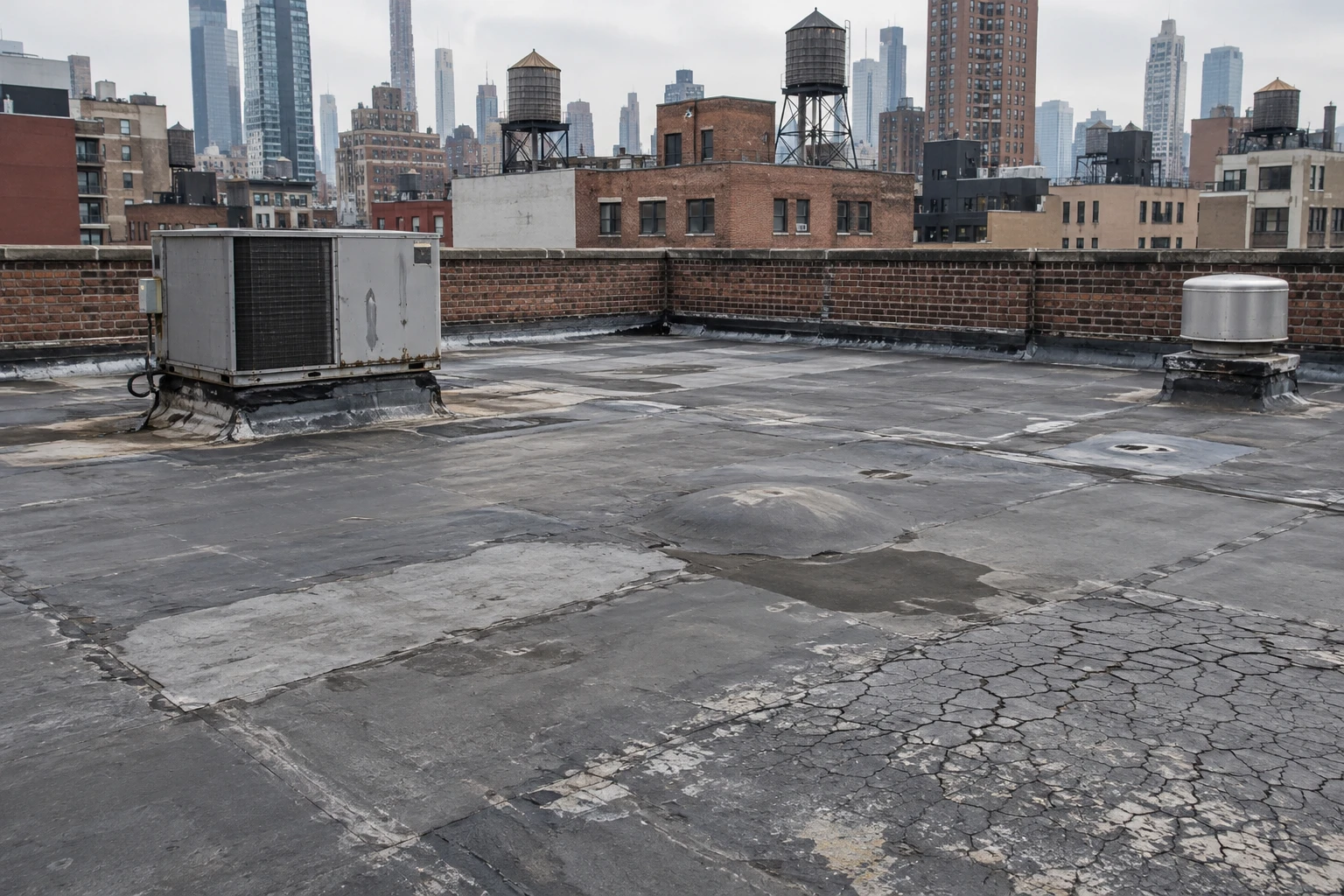
Roof surveys, ratings and maintenance schedules for Manhattan, NY property managers running several buildings, with records ready for owners and lenders.
A portfolio of twelve roofs, rated on twelve different scales by four different contractors, produces a budget meeting that runs on opinion. The same portfolio rated on one scale, with one moisture method and one photograph standard, produces a ranked list. That ranking is what a property manager takes to an owner, and it is the most useful thing a roofer can supply. Manhattan roofs are small, hard to reach and tightly regulated, so the cost of a surprise is high and the margin for error is thin. Gather the last report on each building before the first survey, even where it is old, because the gaps tell us where to start.
We survey, rate, maintain and repair roofs for managers who answer to owners, lenders and tenants.
How should one manager compare roofs on different buildings?
The comparison needs a common method. Each roof receives the same survey: a walk of the whole surface, an infrared scan, core cuts at set intervals, a drain flush and a perimeter check. Each finding is rated on a fixed scale for membrane, insulation, flashings, drainage and edges, and the ratings roll up into a condition rating for the roof.
A manager can then place a prewar five story walk-up in the East Village beside a Midtown office floor with a setback roof and see which one needs money first. The ratings carry dates, so they age accurately, and a rating from three years ago is flagged as such. Buildings in Washington Heights, Inwood and the Lower East Side share the low-slope flat roof form of prewar multifamily stock, and the scale treats them the same. Keep one master sheet of ratings, updated after every visit.
What does a maintenance calendar do for a multi-building owner?
Maintenance converts unpredictable leaks into scheduled visits. A calendar sets an autumn visit before the first freeze, a spring visit after the thaw and a post-storm check after any severe rain or wind. A visit after an event such as Ida, which dropped 3.15 inches in an hour in 2021, is part of the plan, in a city where Central Park gets about 49.5 inches of precipitation and 29.8 inches of snow in an average year.
The same calendar covers every building, which lets a manager assign one superintendent liaison and one reporting format. Findings move to a list of repairs, and repairs move into the budget. A preventive roof maintenance program at portfolio level runs more efficiently than separate contracts, because one crew moves between buildings. Ask for the visit report within a week of each visit, and file it in the building record.
How is the work kept from disturbing tenants and neighbors?
A manager answers to the people under the roof. We give notice of the days and hours of work, protect entrances and stairwells, and keep noisy tasks away from sensitive hours. Hot work gets a permit and a fire watch. Materials go up by hoist or stair at scheduled times so as not to block access.
The Midtown office market holds about 400 million square feet of office space, and an office floor needs quiet and clean air at its own hours. Residential buildings have their own: the quiet hours, the freight lift use, the sidewalk. We write these constraints into the scope, so the superintendent and the crew read the same page. For larger repairs, occupied building reroofing methods stage the work in sections, with temporary protection overnight. Send the tenant restrictions with the first request.
What goes into a capital plan the owner can use?
A capital plan lists each roof with its condition rating, remaining service life, recommended action and rough cost drivers, ordered by priority. Repairs, coatings and replacements sit in separate columns, and the plan flags where Local Laws 92 and 94 of 2019 apply, because a full replacement must put solar, a green roof or both over that zone. A replacement scheduled in the plan carries that added scope from the start.
The plan feeds the reserve study and the owner's budget meeting. It also helps with refinancing and sale, when a lender or buyer asks for roof history. Our roof capital planning work produces the document and revises it after each survey. Buildings in the SoHo-Cast Iron district face landmark review, and the plan notes the added time. Update the plan yearly, even where nothing has changed. Owners who hold several assets, including the real estate investors and REITs that share a manager, often ask for the same plan in a format that rolls up across properties.
Healthcare tenants add another layer. A clinic or medical office suite in a managed building brings infection-control rules, and the healthcare systems that run them may require their own approval for roof work above their space. We ask early which tenants have such requirements and write them into the scope.
Which records should a manager keep for each roof?
Four documents matter: the latest survey with its map, the core log, the repair and maintenance history, and any warranty or manufacturer paperwork. The set should sit in one folder per building, with dates and photographs. A claim, a violation or a sale draws on all four.
We deliver them in a format a manager can forward without editing. A roof condition report for each building, plus a summary page for the portfolio, answers most of the questions owners and lenders ask. For buildings in the East Village and other neighborhoods with older stock, the history often starts with old patches, and we note them on the plan. A manager who changes buildings or firms leaves the records behind for the next person. The same folder also supports multi-site roof programs, where one schedule and one report format cover every building.
Access records belong in the folder as well: where the roof hatch is, who holds the key, what the freight lift limit is, and which neighbors share a wall or a fire escape. A new manager or a new crew should be able to reach the roof on the first visit without calls to three people. We add these details to the plan at the first survey, and we confirm them on every later visit.
Commercial Roofing Questions
What decides which building's roof is funded first?
The condition rating, the amount of wet insulation and the consequence of failure decide it together. A roof with a poor rating over a medical suite ranks above one with the same rating over storage. The survey supplies the first two, and the manager supplies the third.
Can one contract cover several buildings with different roof systems?
Yes. The visit checklist adapts to each system, while the rating scale and reporting stay the same. The schedule and the pricing are set per building and rolled up for the owner.
Who handles the violation notices that mention the roof?
We supply the survey and repair scope that answers the notice, and the manager or filing representative handles the filing. Send the notice with the first request so the scope addresses it directly.
How quickly does a post-storm survey happen?
We respond around the clock to emergencies, and a follow-up survey is scheduled as soon as access is safe. Send photographs and the time of the event so the first call can set priorities.
What should we send before a portfolio survey?
The building list with ages and addresses, the latest roof reports, any open violations and the access contacts.