Roof asset management in Manhattan, NY: a roof register, condition ratings, inspection calendars and remaining-life estimates for owners and managing agents.
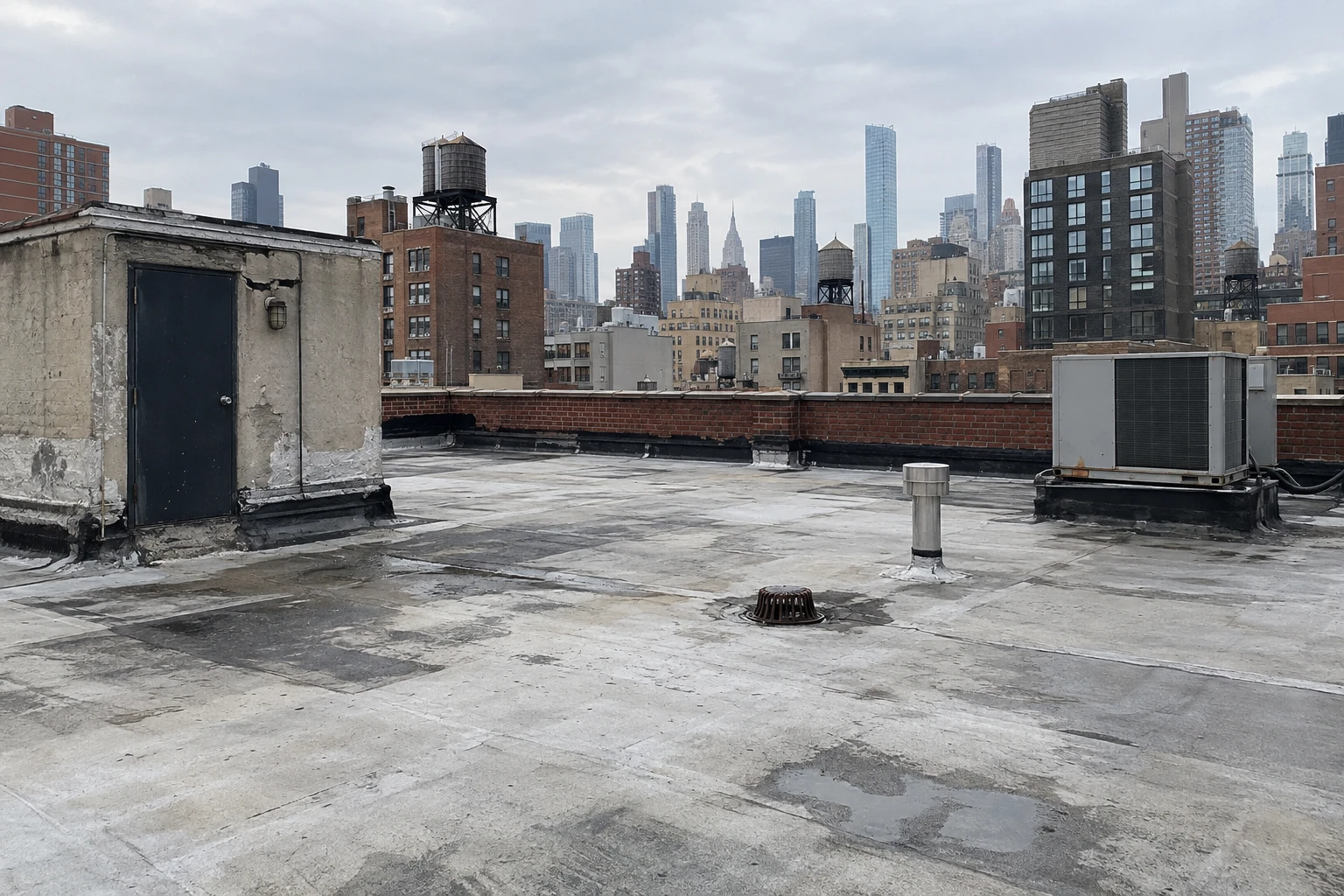
A roof register entry with no date for the last core cut is a roof nobody has measured, and the entry beside it, with a core log, an infrared image and a ponding depth, is a roof the owner can plan around. That difference is what asset management means for a roof. In Manhattan, NY, where Midtown alone held about 400 million square feet of office space in 2018 and prewar tenements and apartment buildings put low-slope flat roofs across much of the housing stock, the roofs on a portfolio differ in age, size, access and regulation. Without a single record, each decision starts from zero.
We build and maintain that record. It lists every roof, its system, its age, its last survey, its condition rating and its estimated remaining life. Once the last roof report and the age of each building arrive, with any open violations, the register structure and first survey scope are set ahead of any price.
What does a roof register contain?
One row per roof, not per building, since a building may have a main roof, a setback, a bulkhead roof and a terrace. Each row carries the roof's location, area, system type, approximate age, attachment method, drainage type, equipment list and access route. It carries the dates of the last survey, the last repair and the next inspection. And it carries a condition rating, a moisture map reference and an estimated remaining life.
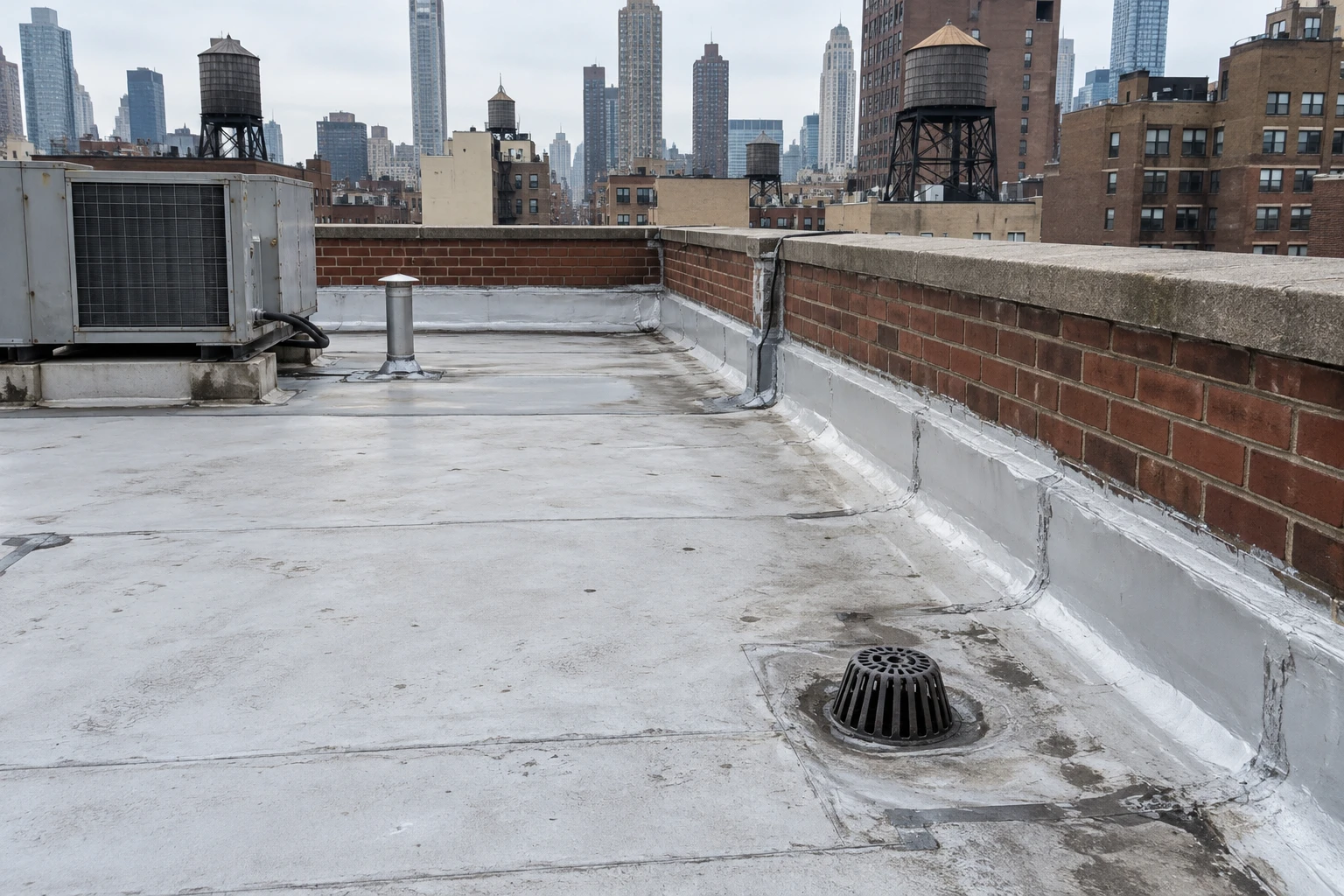
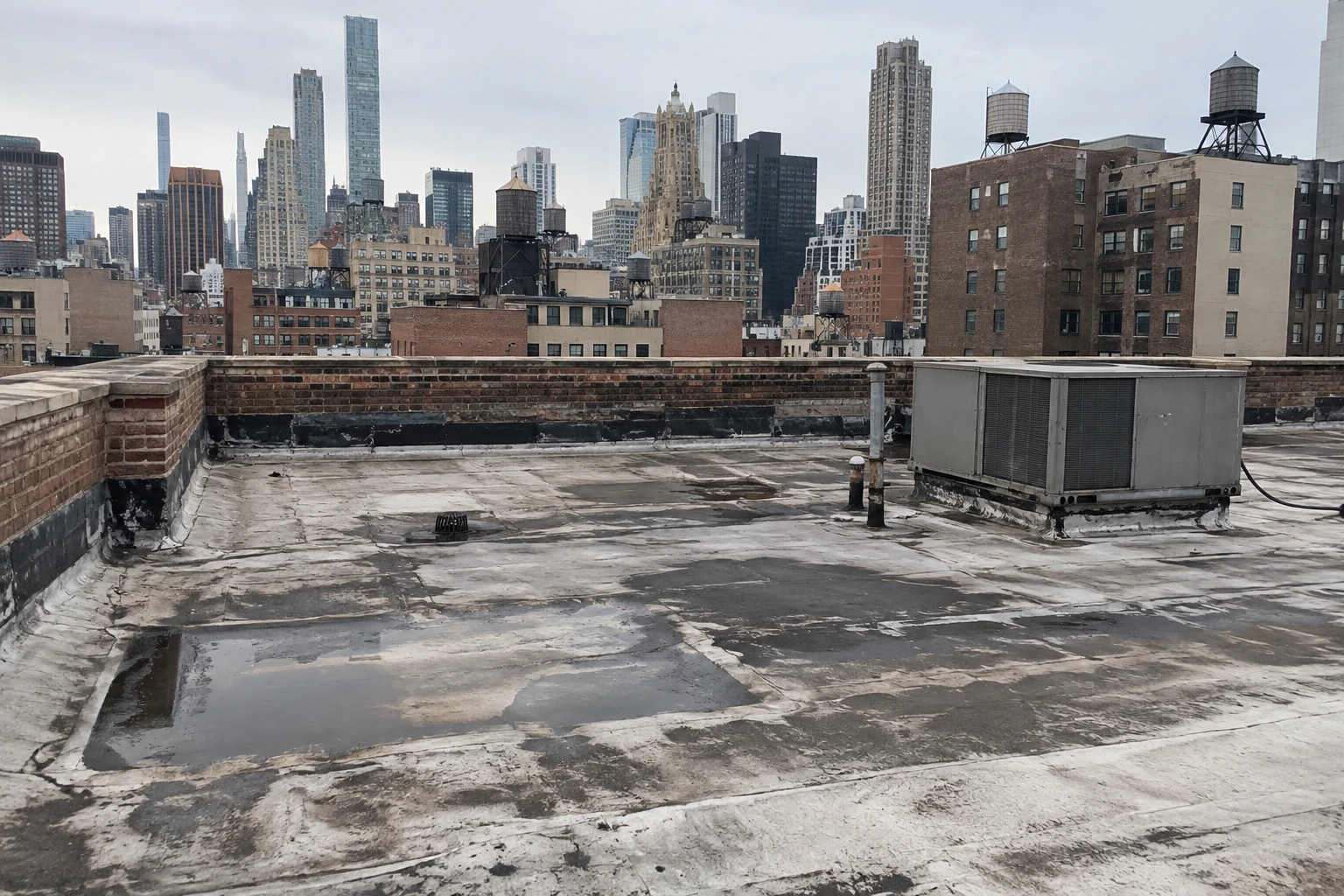
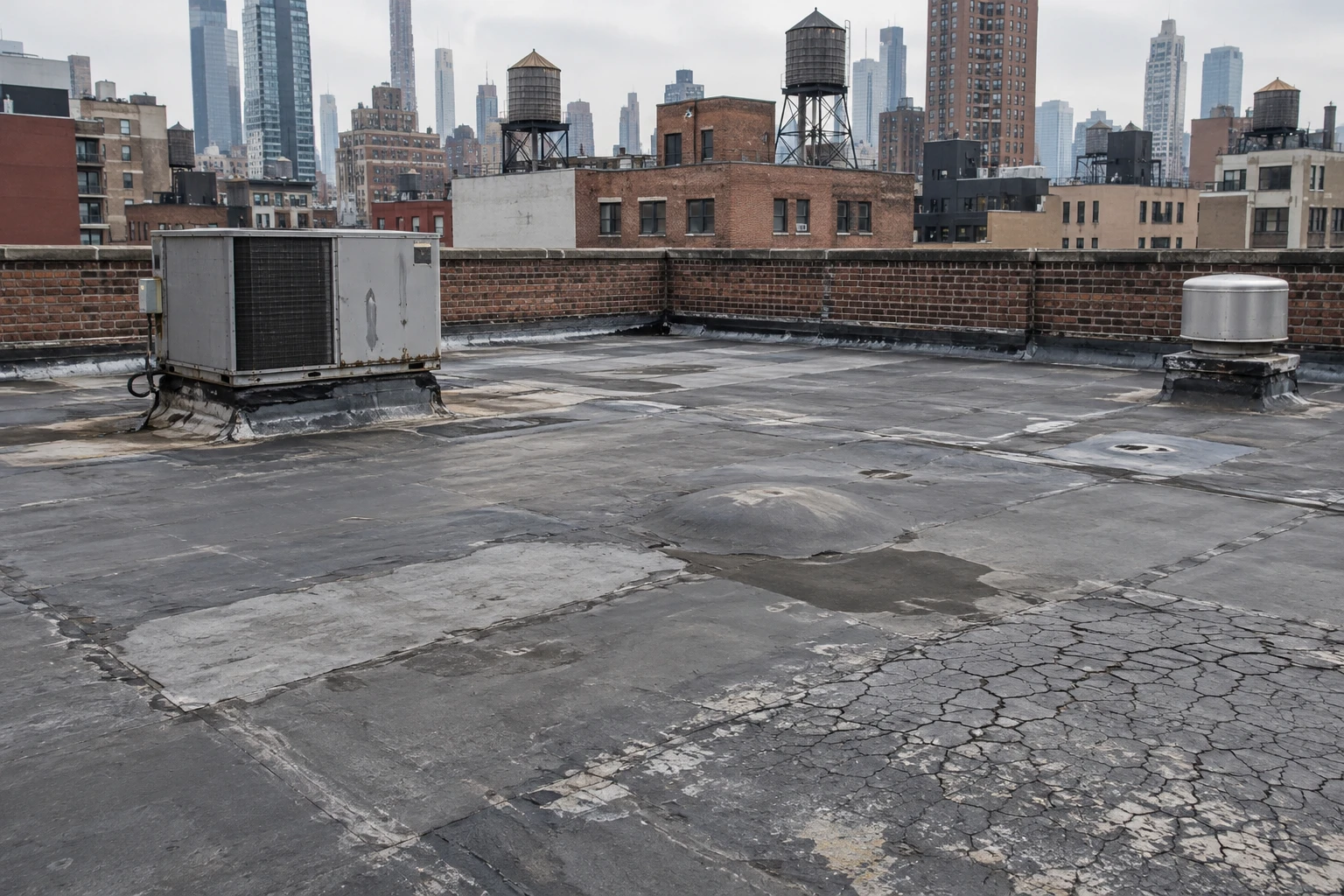
Photographs and core logs are filed with the row. A reviewer can open an entry and see the roof as it was on the day of the last survey. Because each entry stores dated photographs of the same spots, a viewer can flip between two surveys and see whether a bulkhead flashing has opened, a coping joint has widened or a pond has deepened, and the change is documented in images instead of recalled from memory. Regulatory facts go in too: whether the building sits in a historic district, whether violations are open and whether a full replacement would bring Local Laws 92 and 94 of 2019 and their roofing zone requirement into play.
How is a condition rating assigned?
From measurements, not impressions. An infrared scan at dusk shows warm zones. Cores at those zones and at control points show whether insulation is wet. Ponding depth after rain shows slope failures. A detail inspection of curbs, bulkhead bases, parapet coping and drain leaders shows where flashing has aged. The numbers feed a rating scale applied the same way to every roof.
The scale needs to be simple enough that a board can read it and strict enough that two surveyors would reach the same number. We describe each level in plain terms: sound, sound with maintenance items, repair needed within the year, replacement planned, replacement now. The rating comes with a short note stating what drove it. If a roof scores low because of one wet curb, the note says so, and the owner sees that a rebuilt flashing could raise the rating a full level. If it scores low because the insulation is wet across the field, the note says that too, and the owner sees that the rating will not recover without replacement. The note keeps the number honest. A rating without its evidence invites argument, and a rating with evidence invites a decision.
How often should each roof be inspected?
The calendar depends on the rating. A roof near the end of its life is looked at twice a year and after storms. A roof in the middle of its life gets a spring and fall visit. A new roof gets a first-year walk and then an annual one. Leaf fall brings a drain check on every roof, and heavy weather brings another look.
The calendar assumes the extremes on record: Ida's 3.15 inches in one hour on September 1, 2021, Central Park's 29.8 inches of snow in an average year and its swing between minus 15 F and 106 F. Each visit updates the rating and the remaining-life estimate, and the update records not only what changed but what stayed the same, and our preventive maintenance visits feed the register directly.
What decisions does the register support?
Which roof to repair this quarter. Which to replace next year. Which to leave alone. How much to reserve. When to refinance. What to disclose to a buyer. With a current register each decision is a quick lookup, and without one each becomes a research project.
For an owner with buildings in Midtown and the Financial District, where nearly 200 buildings moved to residential use between 2013 and 2021, the register shows which roofs are affected by conversion work. For a managing agent, it replaces a drawer of reports with one table. The roof capital planning work reads the register to set replacement dates and budgets, and the roof condition report is the document that fills each row.
How does the register stay current?
Every visit updates it. Every repair is logged with a date, a location, a cause and a photograph. Every equipment change is recorded. Every storm is followed by a perimeter check, and the result is entered. At least once a year the full table is reviewed with the owner or the managing agent, and the ratings are compared with the prior year.
A register that is not updated becomes a historical document. A lender asking for current roof conditions or an insurer asking for the last documented survey will find a dated gap, and the gap itself becomes a finding. Keeping the dates continuous is cheap compared with the cost of explaining why they stopped. We schedule the updates with the inspection calendar so they happen as a matter of course. For a multi-building owner, multi-site roof programs carry the same register across many properties, and the property management companies that run them can export it for lenders and insurers. Each entry carries a last-surveyed date, so a manager can tell which roofs are overdue for a walk and which have a recent baseline.
Commercial Roofing Questions
What decides how detailed a roof register needs to be?
The number of roofs and the decisions it supports. A single building needs a simple record with dates and ratings. A portfolio used for lending, insurance or sale needs core logs, moisture maps and photographs. We start with the decisions the owner faces and build the register to answer them.
Can a register be built from old reports?
Partly. Old reports provide system types, ages and past repairs. They rarely contain current measurements, so the first survey fills the gaps. We import what exists and mark entries that need a new survey.
How do we handle roofs that cannot be reached safely?
We use a drone for the overview, plan access with the building engineer and take cores only where access is safe. The register notes which roofs were surveyed from the air and which were walked, so the confidence in each rating is visible.
Does the register include New Jersey buildings?
Yes. The method is the same. The regulatory fields differ: Local Laws 92 and 94 apply to New York City buildings, and a New Jersey building follows state and municipal codes. The register notes the applicable code for each building.
Who owns the register?
The owner. We build it, maintain it on request and deliver it in a format the owner can open without us. The data, photographs and core logs belong to the building file.