Tracing and stopping active leaks on Manhattan, NY commercial roofs with moisture mapping, flood testing and a written cause for every entry point.
The first record of a leak is usually a ceiling tile, and the second record should be a moisture map. The tile shows where water arrived inside the building. The map shows where it entered the roof, how far it traveled across the deck or the insulation, and how much of the assembly is now holding water. On a Manhattan roof, the two points can sit a long way apart, because water follows a deck seam, a conduit or a sloped insulation board before it drips. We treat every leak call as a finding to be documented: a location, a cause, an extent, and a repair boundary. Only then does the crew open the roof, and the work is limited to what the evidence supports.
How is a leak traced when the stain is far from the entry point?
We start with the interior record: where the water appears, when it appears, and what the weather was doing. A leak that shows only in a wind-driven rain points toward a vertical surface, such as a parapet or a wall flashing. A leak that appears hours after a storm points toward a ponded area or a drain that drains slowly. A leak that appears in a dry spell points toward condensation or a mechanical source.
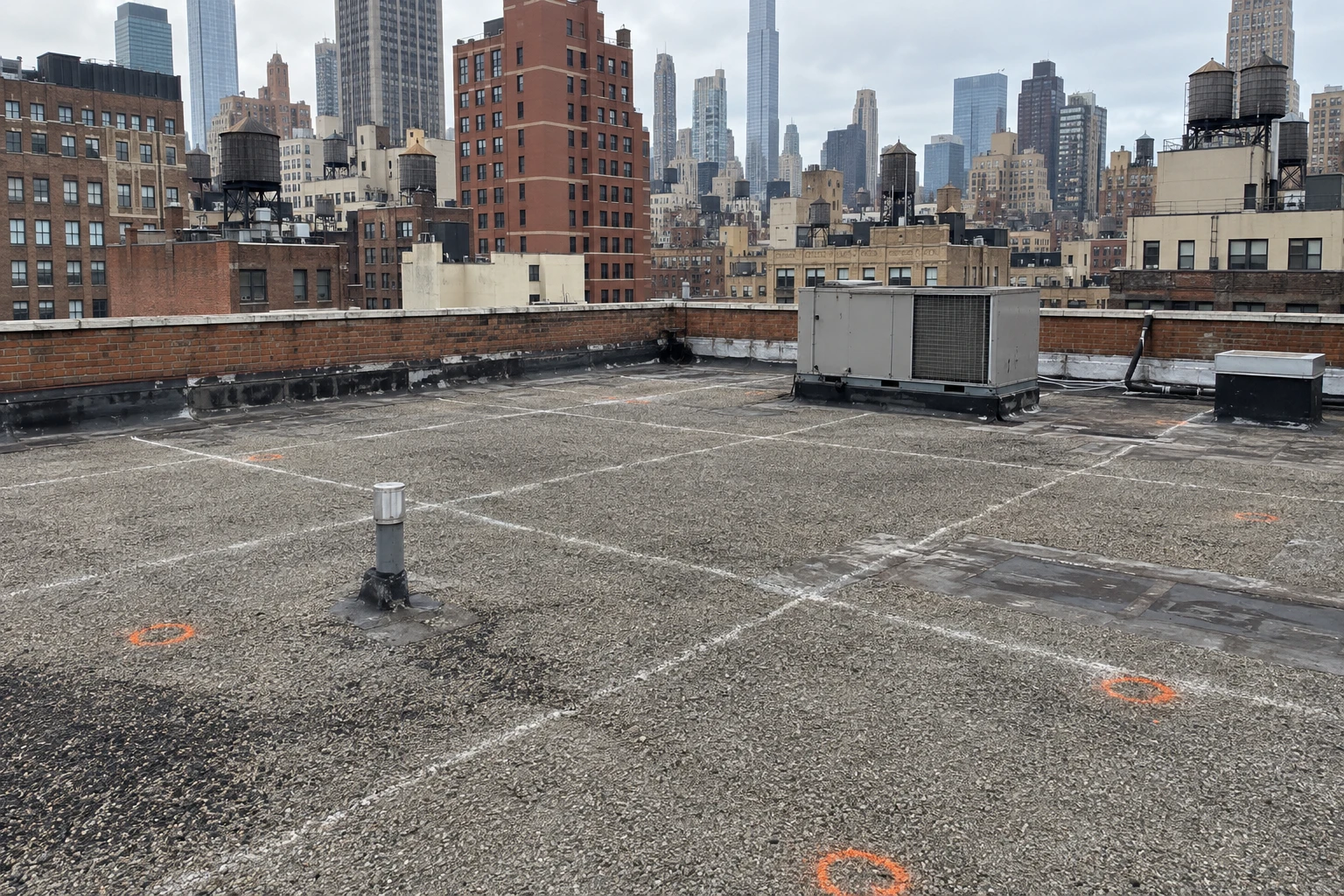
On the roof, an infrared scan identifies wet insulation, and a moisture survey maps its edges. Where the scan is inconclusive, a controlled water test isolates one area at a time, starting low and working up so the entry point shows itself. Core cuts confirm the extent. This sequence takes longer than sealing the nearest crack, and it is the reason the repair holds. A sealed crack that was never the entry point only moves the stain.
Where do leaks on commercial roofs usually begin?
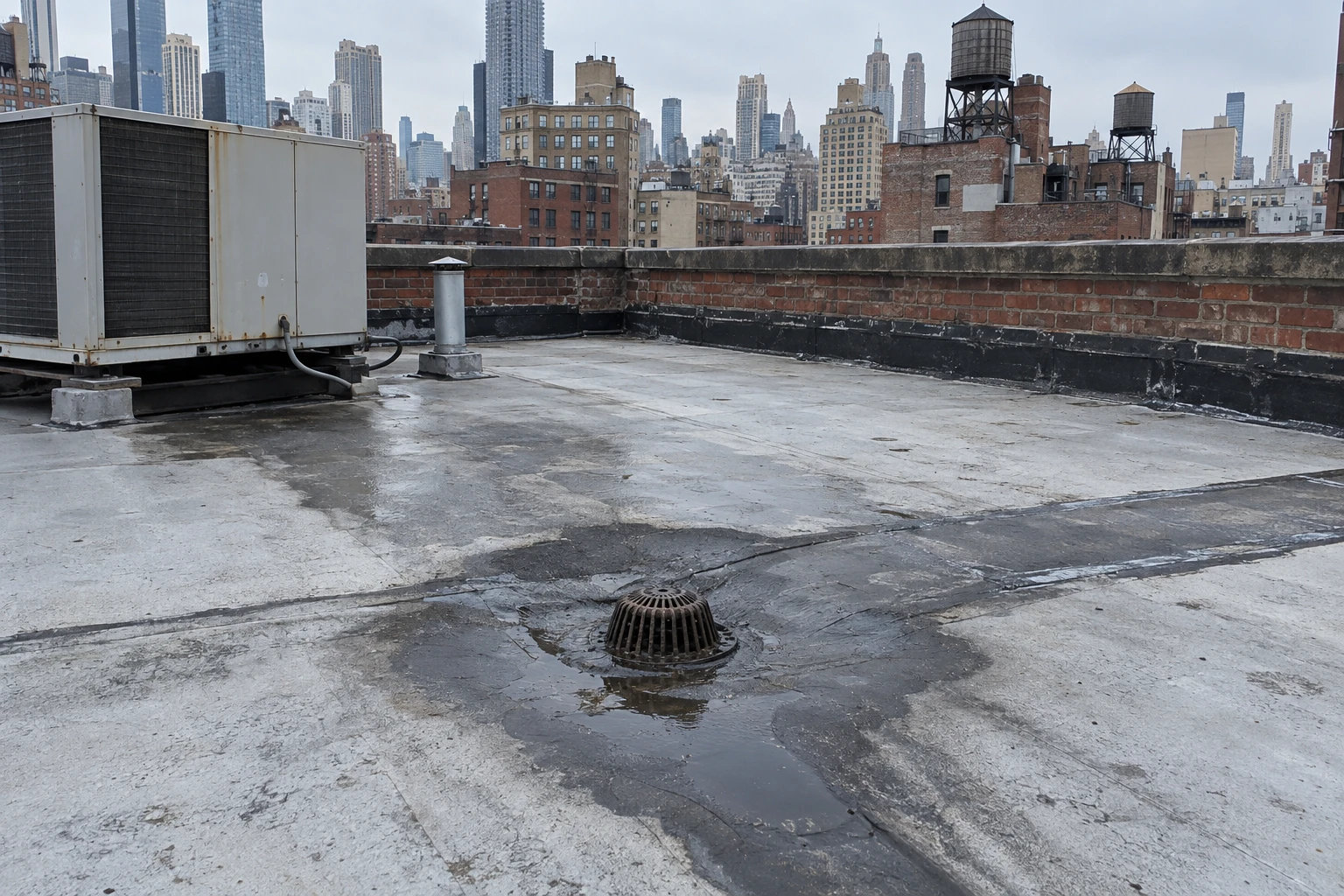
Most begin at details, not in open membrane. The usual list includes drain sumps and drain leaders, wall and parapet flashings, pipe and conduit penetrations, mechanical curbs, skylight and hatch curbs, expansion joints, and the transitions where one roof level meets another. The open field of a well-installed membrane is rarely the culprit unless it has been punctured or has reached the end of its life.
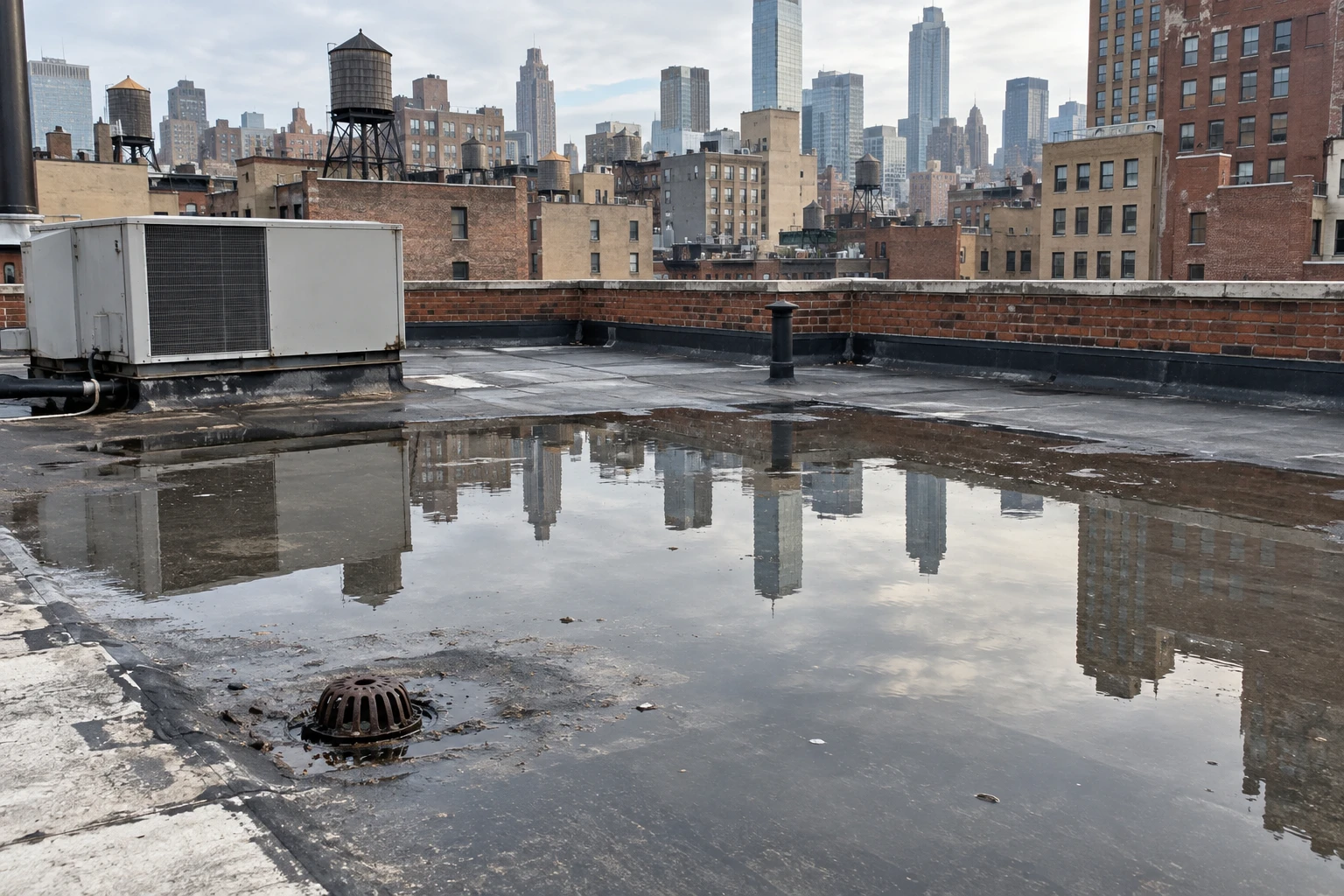
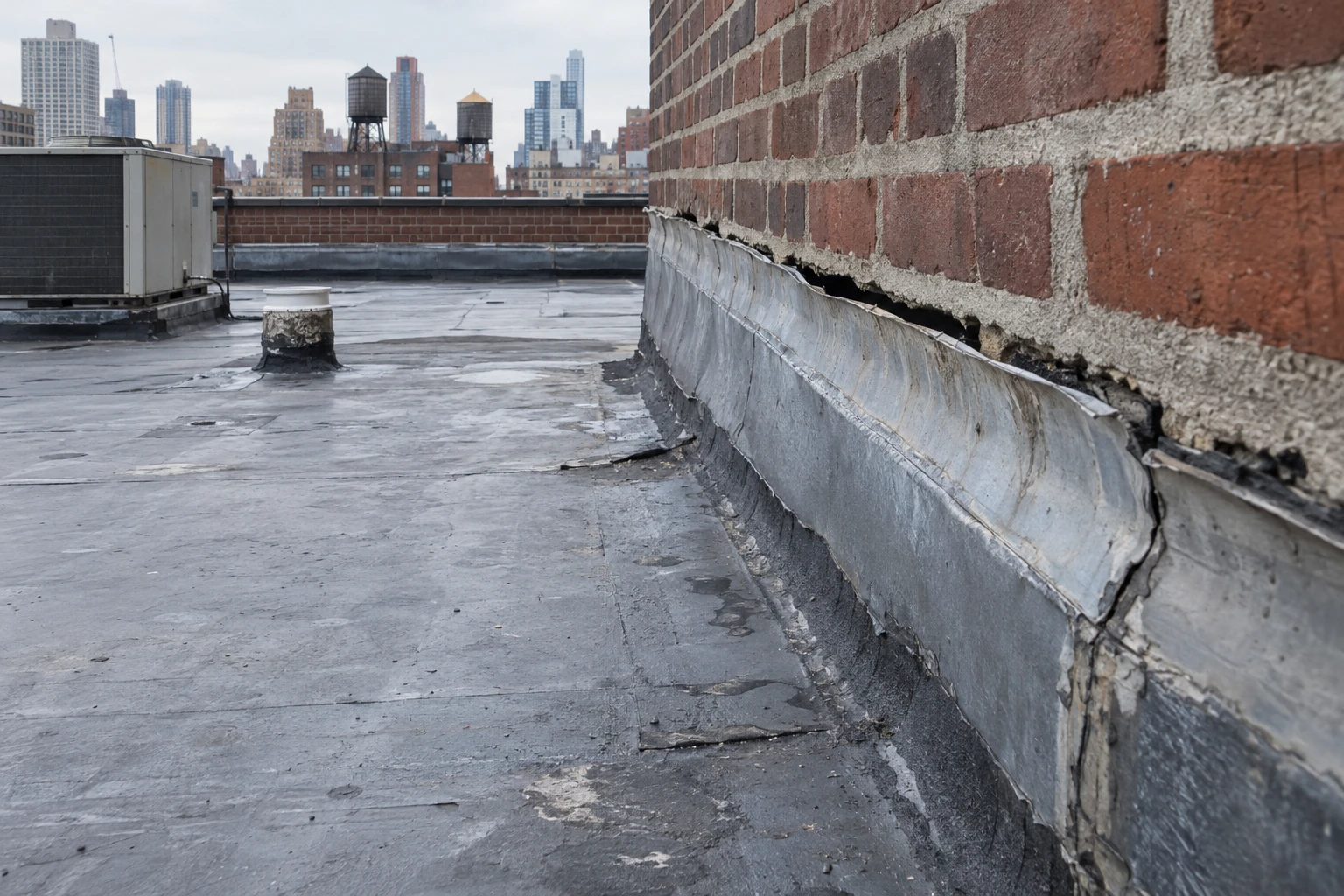
Drain failures are the most common single source. A strainer blocked by debris causes ponding, and ponding loads every lap and flashing with a standing head of water. The correction for ponding water may include re-sloping with tapered insulation. Flashing problems are the second group: a base flashing that has pulled away from a wall, or a counterflashing that no longer overlaps it. Those call for a flashing failure repair and a look at the wall behind.
What does an extreme rain hour do to a roof?
Hurricane Ida showed the borough's roofs what an extreme hour looks like. On September 1, 2021 the city recorded 3.15 inches of rain in one hour, Central Park measured 7.13 inches for the day, and the Weather Service issued its first flash flood emergency for New York City. Drains designed for ordinary storms were overwhelmed, and water backed up against laps and flashings that would be dry in a normal rain.
After a storm like that we recommend a walk of every roof the owner manages, focused on drains, sumps and flashing heights, because defects that were harmless in ordinary rain reveal themselves in extremes. Hurricane Sandy, which drove a 14.06 foot surge above average low tide at The Battery in October 2012, and flooded Lower Manhattan streets, left a different lesson for rooftop equipment near the water: units and their curbs are exposed to wind-driven water and to debris, and their flashings need to be inspected afterward.
What changes for hospitals, residential towers and waterfront buildings?
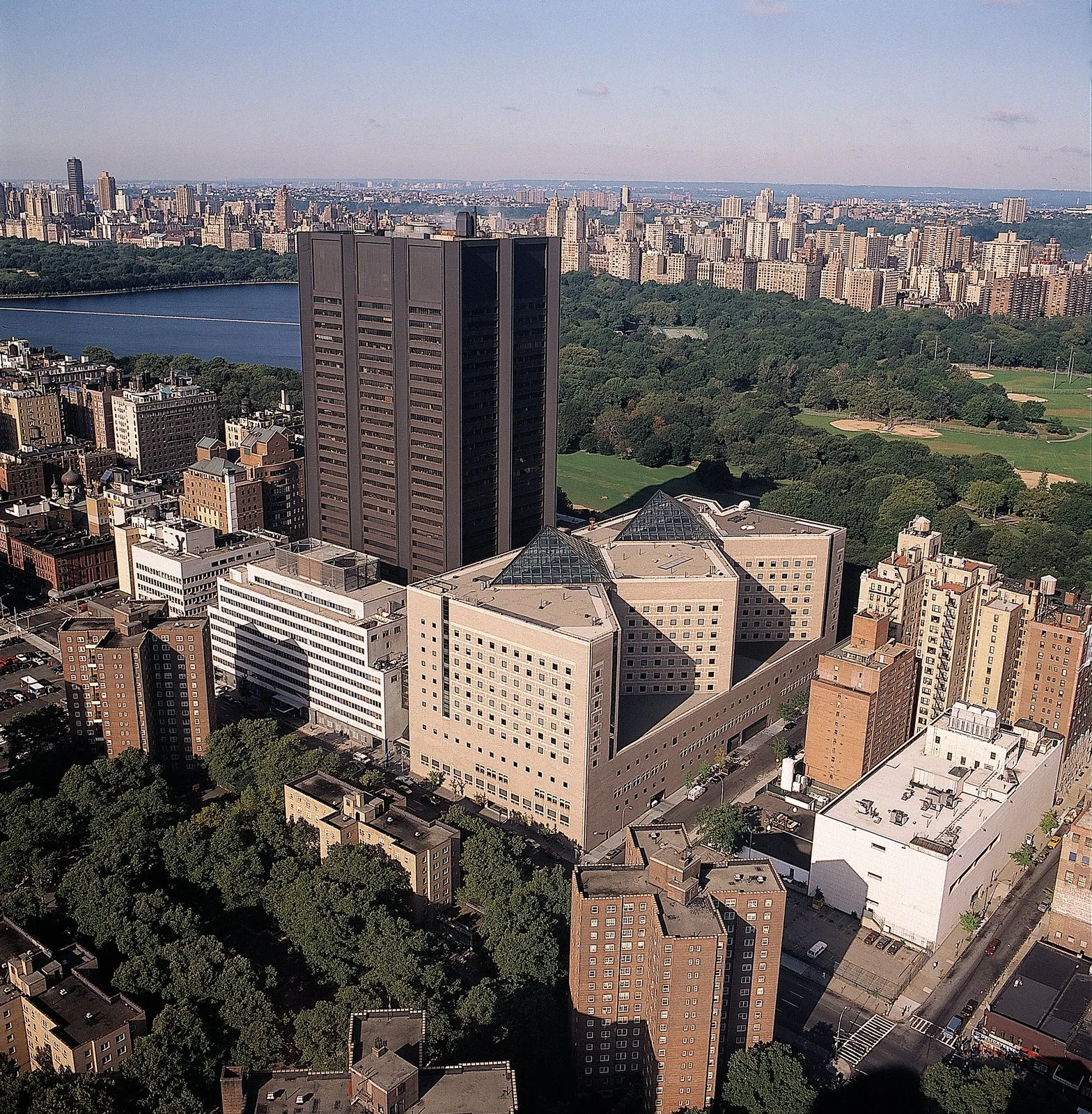
The consequences of a leak depend on what lies below. Kips Bay holds Bellevue Hospital Center and NYU Langone Medical Center, and the Manhattan VA Medical Center on East 23rd Street had its basement flooded in Sandy and took about six months to fully reopen. A roof leak above clinical space can interrupt care in ways that a leak above a storage room cannot, so the repair plan covers containment, infection-control rules and access limits. Work on hospital roofing starts with those rules.
Kips Bay Towers, a 1,112 unit apartment complex completed in 1963, and Waterside Plaza, built on a pier above the East River, sit close to those institutions and put residential roofs in the same area. In Battery Park City, which covers 92 acres and was flooded in parts during Sandy, the neighborhood's resiliency project is scheduled between 2026 and 2031, so access and staging near the waterfront edge have to be planned around it. Each building has its own leak tolerance, and the repair schedule reflects it.
What is done before the full repair begins?
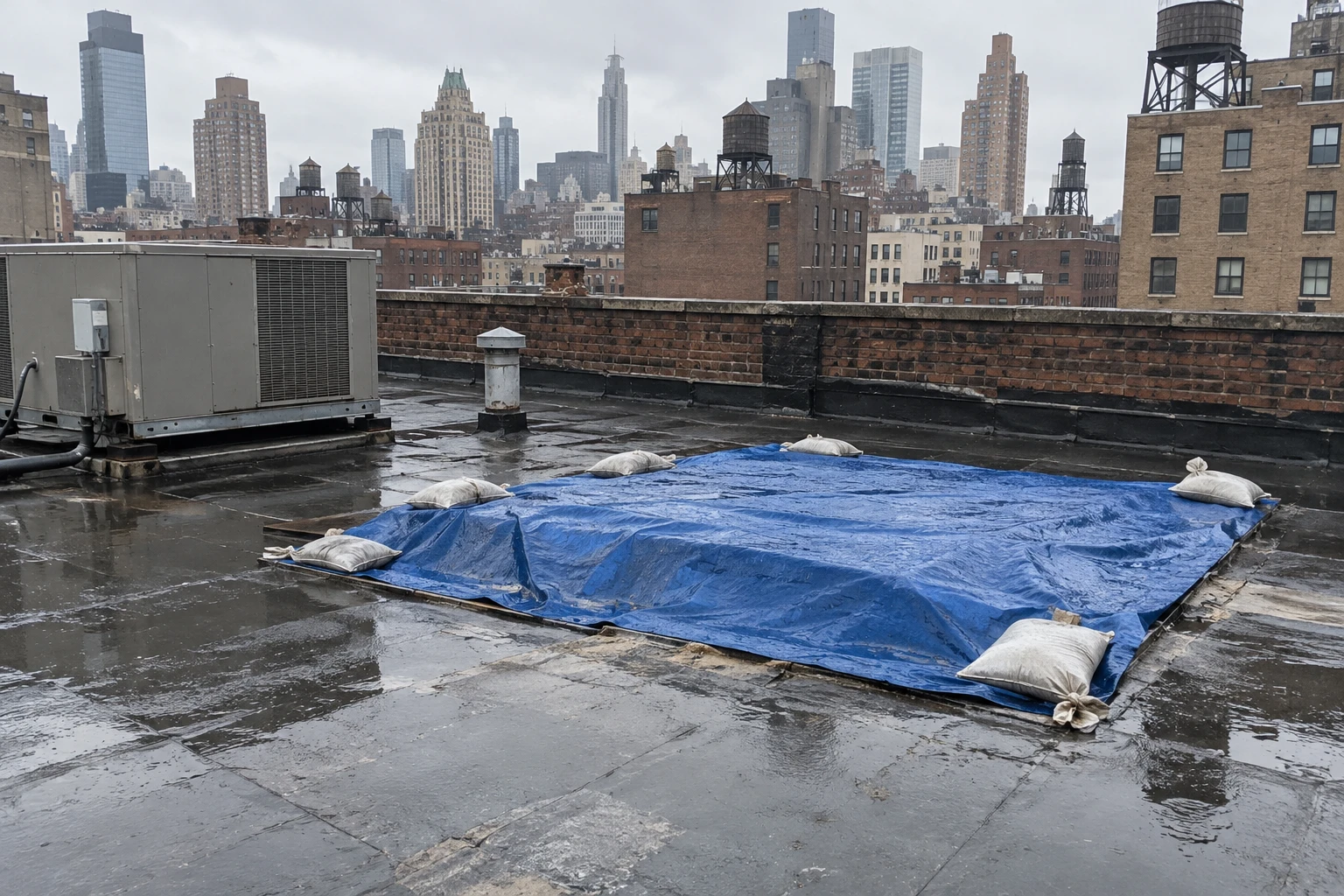
If water is entering now, the first job is to stop the damage, not to finish the repair. A temporary measure, such as tarping, a patch or diverting flow from a drain, protects the interior and buys time to trace the cause. We document the temporary work so it can be removed or integrated into the permanent repair, and we respond at any hour when the situation calls for it.
The permanent repair follows the evidence. The crew removes the wet insulation within the repair boundary, restores the deck if needed, rebuilds the flashing or the sump, and ties the new material into the old with compatible laps. A modified bitumen roofing repair, for example, uses heat-welded or adhered laps matched to the existing sheet, while a single-ply repair uses welded patches. Every step is photographed, and the owner receives the before and after record.
How do we know the leak is really gone?
We check after the next significant rain, and when possible, after a controlled water test of the repaired area. If the interior stays dry, the record shows the date and conditions. If it does not, the cause was not fully understood, and the repair reopens with the new information. Quiet intervals are not proof of success, since many leaks appear only in specific wind directions or rain intensities, so the follow-up looks at the conditions that produced the leak in the first place.
Commercial Roofing Questions
How long does it take to find a leak?
Simple leaks at visible details can be found in one visit. Leaks that travel through insulation or along a deck may need an infrared scan and a controlled water test, which stretch the process across more than one visit. The speed of the first temporary measure does not depend on the trace.
Can a leak be fixed from inside the building?
Interior sealants sometimes slow the water, but they leave the wet insulation, the deck and the real entry point in place. The repair belongs on the roof where the water enters, and the interior work is limited to protecting ceilings and equipment until that is done.
What should a property manager document when a leak appears?
Photographs of the stain, the date and time, the weather, and whether the leak is intermittent. That information narrows the cause before anyone is on the roof. Tenants should be asked to note when the leak starts and stops.
Will insurance cover the repair?
That depends on the policy and the cause. Sudden storm damage is treated differently from long-term wear. We provide dated photographs and a written cause for every repair, which gives the adjuster and the owner a clear record.
Do leaks mean the whole roof has failed?
Not necessarily. Leaks at a few details point to a repair. Leaks across many areas with wet insulation throughout point toward a plan for replacement, which the survey will state plainly.