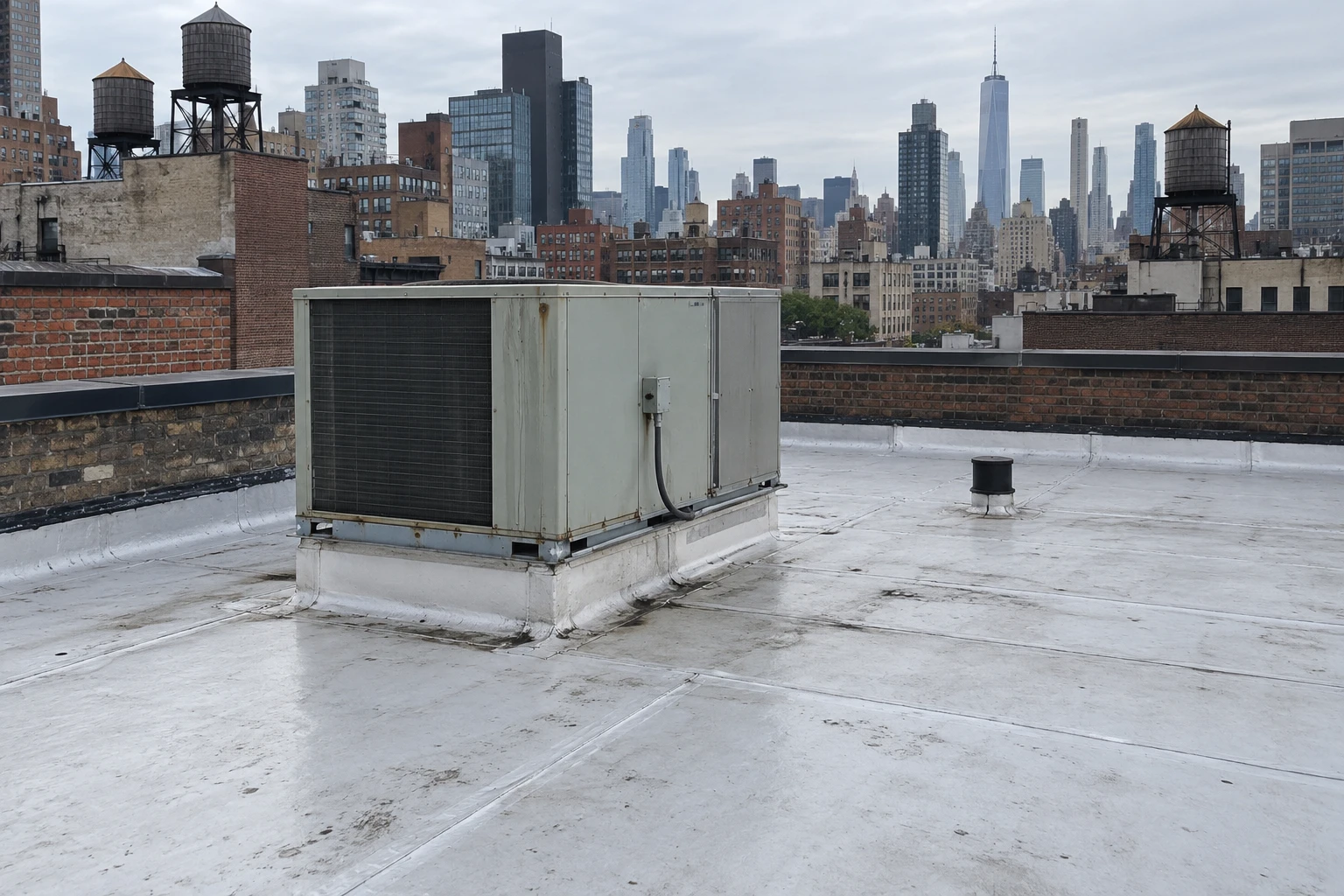
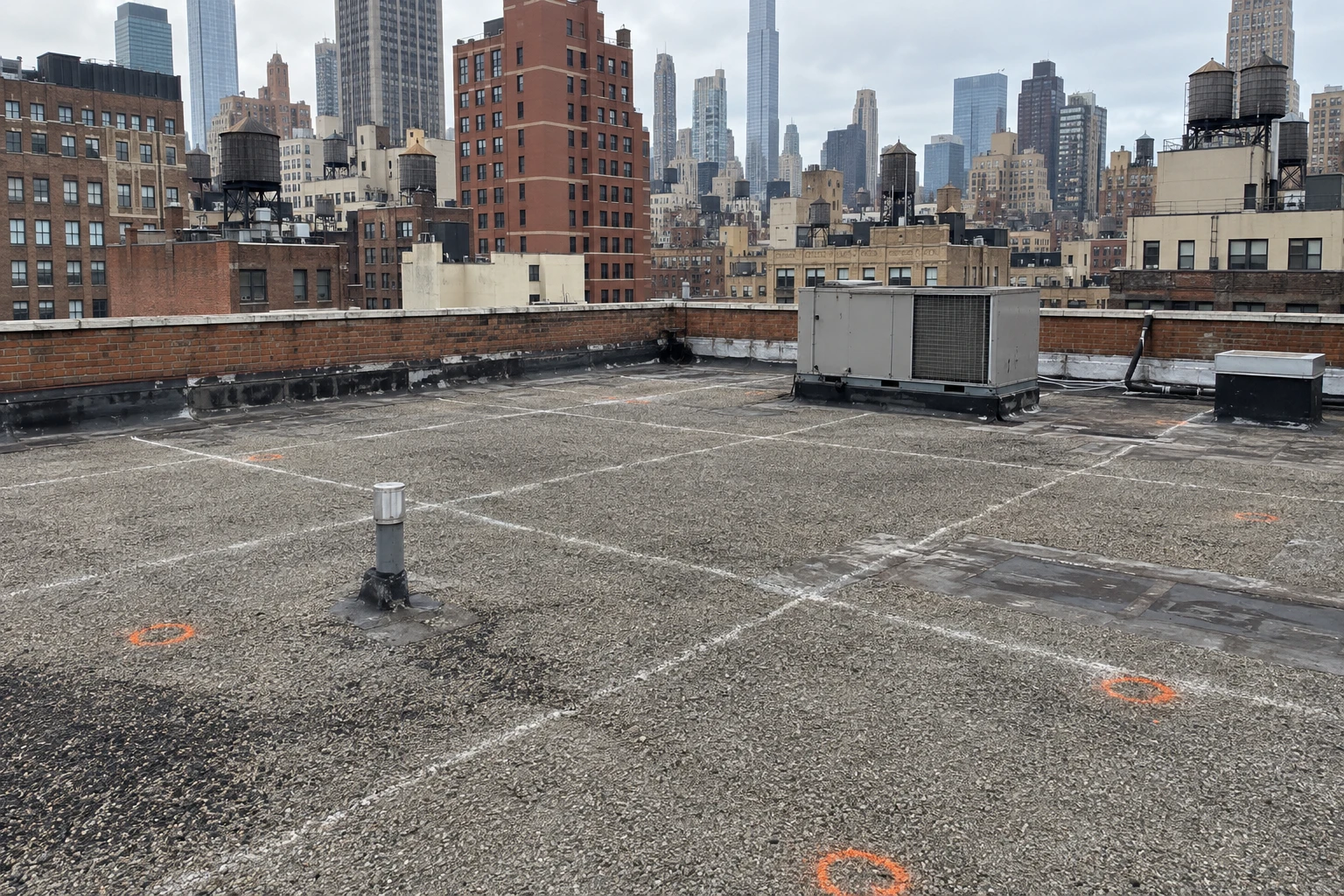
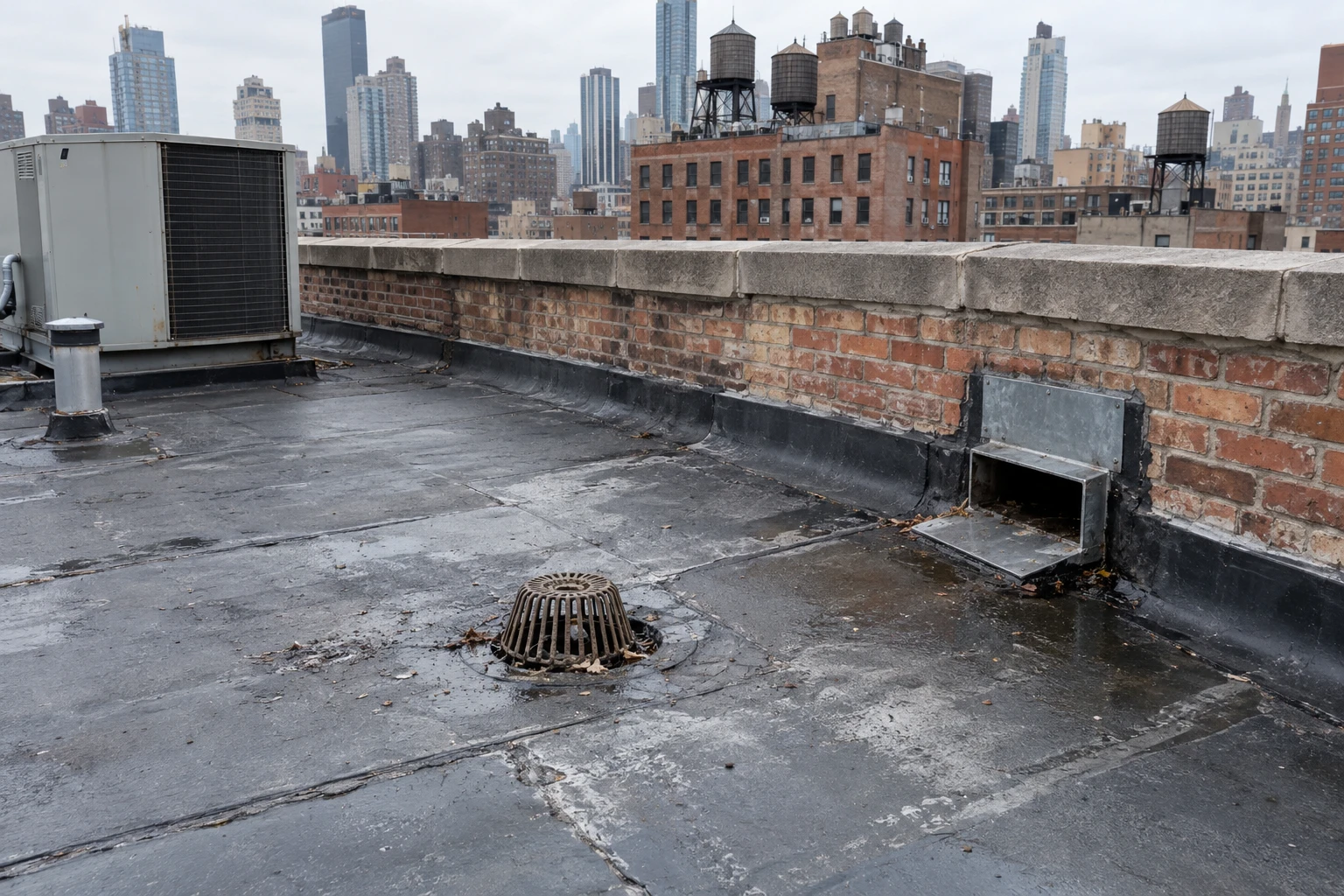
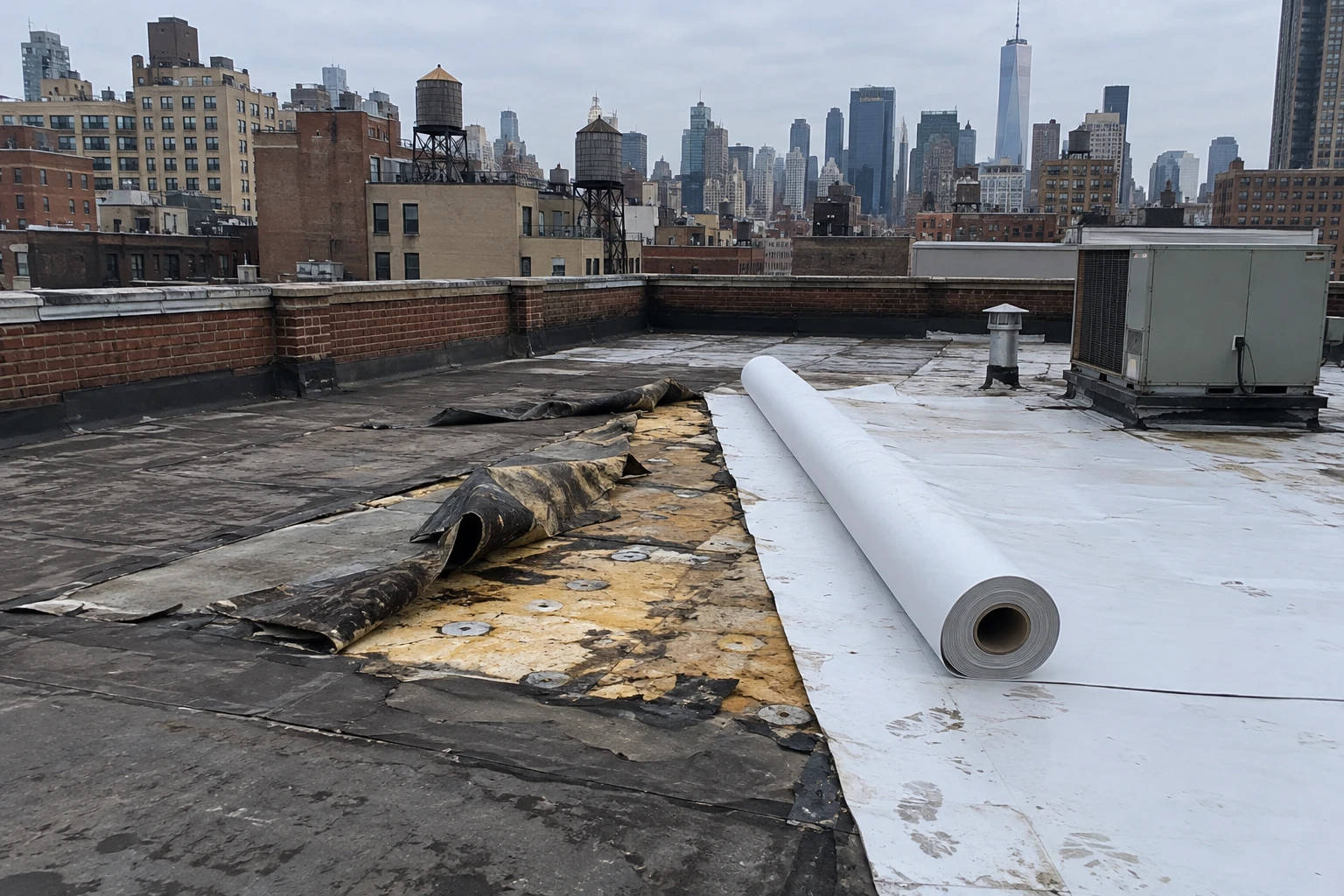
PVC single-ply roofing for Manhattan, NY roofs exposed to grease, chemicals and heavy traffic: survey findings, welded seams, flashing details and records.
A strip cut across a fresh PVC weld and pulled apart should tear the sheet before it splits the seam, and when it does, the weld is stronger than the membrane around it. That test is part of why PVC is the single-ply chosen where fats, oils and chemical residue settle on a roof: it is a thermoplastic sheet, welded with hot air at the seams and formulated to resist what softens other membranes. In Manhattan, NY, restaurants, hotels, hospitals and laboratories put exhaust on roofs that are only a few feet apart, so the question for an owner is not whether the roof will be exposed but how much, and what the survey says about the existing membrane.
Why choose PVC over another single-ply?
The reason is exposure. PVC resists animal fats and cooking oils, many solvents and the airborne residue that builds up around exhaust stacks. It also carries inherent fire resistance, which can matter on a roof close to cooking equipment. Its seams weld into a single sheet, and the welds are stronger than the membrane at the seam in a properly made joint.
The trade-offs are cost and a little flexibility in extreme cold, so the material is chosen where the exposure justifies it. A quiet office roof with no chemical exposure may be well served by TPO, and a roof that wants a rubber membrane for a low-traffic setback may suit EPDM. A roof with rooftop restaurant exhaust, a hospital with laboratory vents or a hotel kitchen discharge is a stronger candidate for PVC. Restaurants and bars line Broadway and Amsterdam Avenue on the Upper West Side from 67th to 110th Street, and the roofs of buildings above them are the kind a survey checks for staining and softening. A kitchen vent on an exposed roof can carry residue farther than one in a sheltered well, so we note the layout around each stack.
What does the survey check before PVC is specified?
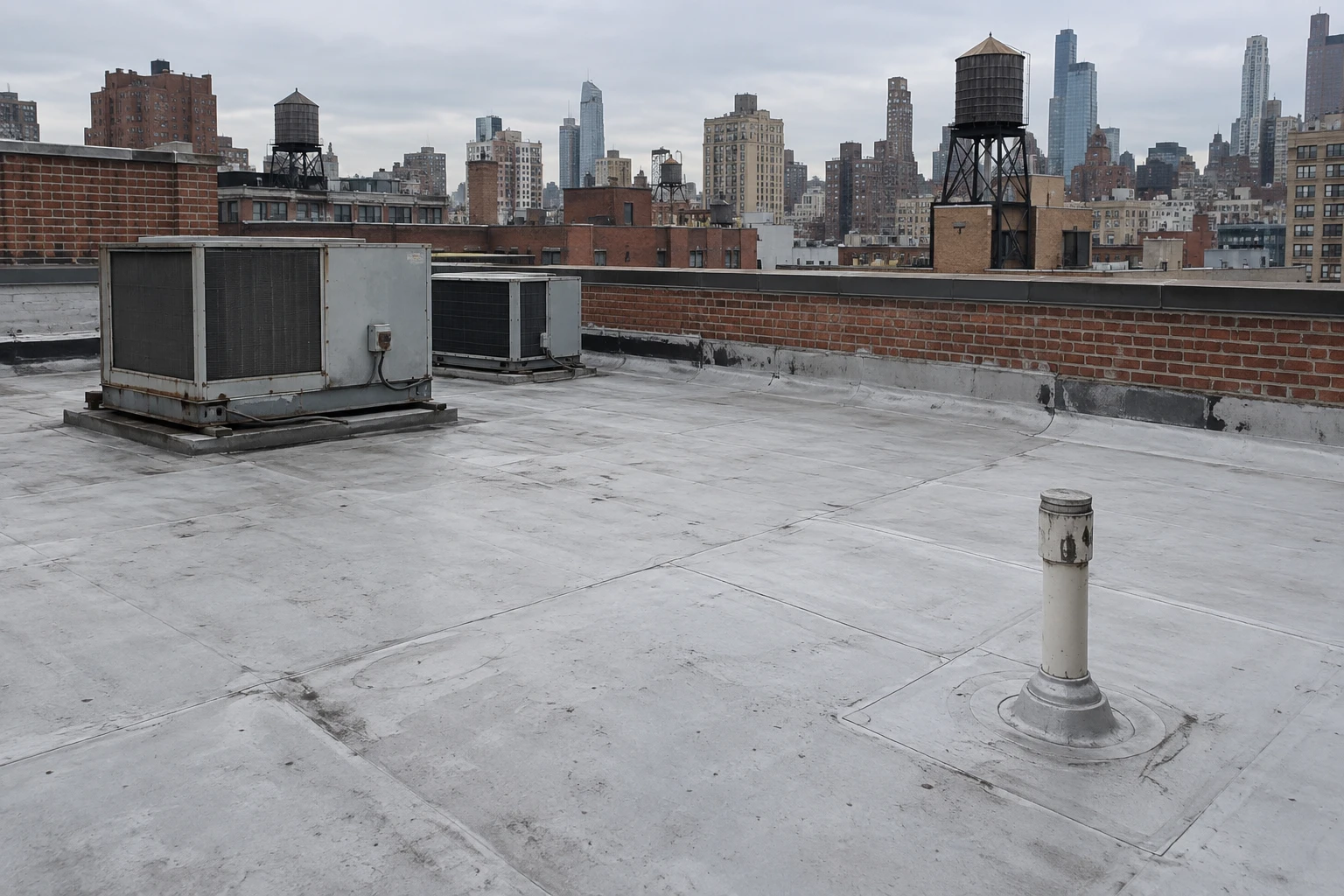
We begin with the exposure map. Every exhaust fan, vent stack and discharge point is marked, along with the prevailing wind direction on the day of the walk, and the surface around each is checked for staining, softness and tackiness. If the existing membrane has softened near an exhaust, we note how far the effect extends. That distance sets the area where PVC or a protective pad is needed.
Then comes the substrate. An infrared scan with core cuts checks for wet insulation, and a view of the deck confirms attachment. A compatible separation layer is needed between PVC and some insulation types or old asphalt, because certain materials migrate into the membrane and make it brittle. The survey records which materials are under the roof, so the specification includes the right barrier. A moisture survey before any decision keeps the budget aimed at what is failing.
How are PVC seams and details made reliable?
Hot-air welding fuses two sheets with controlled temperature, speed and pressure. Our crew welds each seam, probes it, and checks a sample of cut test strips to confirm that the bond is as strong as the sheet. Details are prefabricated where possible: corners, pipe boots and curb flashings come as molded pieces welded into the field membrane, which avoids hand-cut corners where leaks start.
The edges matter in a city that has recorded high gusts. Uplift concentrates at parapets and corners, and Central Park's strongest recorded gust, 78 mph on December 2, 1974, is the kind of load they face. We use perimeter attachment patterns or full adhesion there, with edge metal that is fastened and sealed. Termination bars at walls and curbs are fastened at close spacing and sealed, and we photograph each detail before it is covered by coping or counterflashing. The record shows exactly what lies behind each cap.
How does PVC perform through Manhattan summers and winters?
A white PVC surface reflects sunlight and sheds heat, which helps with an urban heat island that, in Central Park, has seen 106 F. In winter, with an average of 29.8 inches of snow and a recorded low of minus 15 F, PVC stays workable when installed within the manufacturer's temperature limits, and welds made in cold weather need extra checks. Seam work is scheduled for conditions in which the weld is reliable, and the ambient temperature during welding goes into the record.
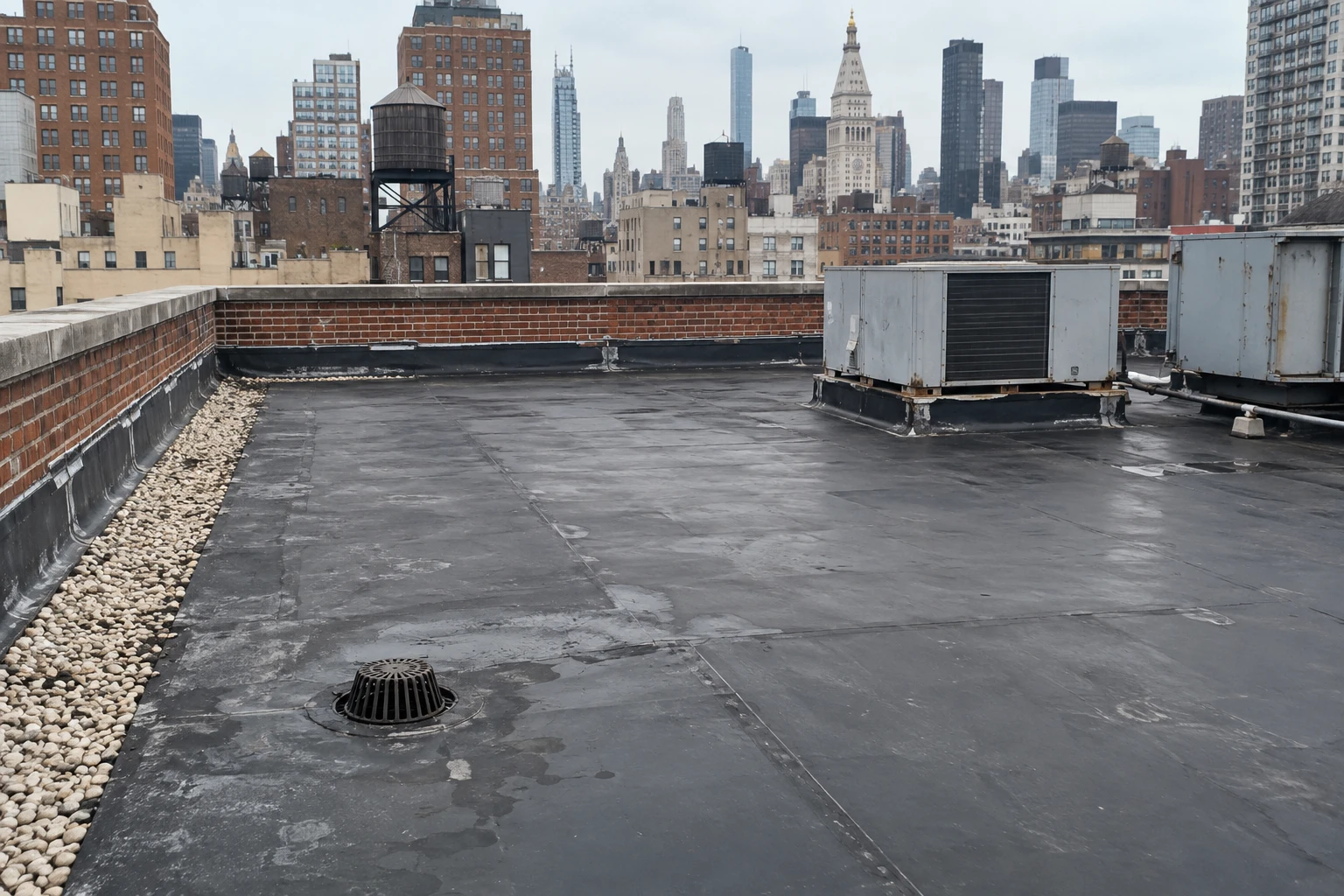
Ida's 3.15 inches in a single hour on September 1, 2021 is the drainage test. PVC tolerates wet conditions, but ponding for days degrades any membrane over time, and standing water around a grease-stained area can carry oils across the roof. The survey records low spots, and roof drains and scuppers are sized or added so water leaves the roof rather than sitting on it.
Can an existing roof be converted to PVC in sections?
Yes, when the exposure is local. If the grease or chemical exposure covers only the area around an exhaust fan, the affected membrane can be removed and replaced with PVC, and tied into the existing roof with a compatible joint. This costs less than reroofing the whole surface and addresses the area at risk. The tie-in is documented, and we note the compatibility of the old and new materials, since mixing incompatible sheets at a joint can cause failure. For a larger conversion, a full replacement may be more economical.
What should the owner keep on file?
The exposure map, the substrate findings, the product data for the membrane and the barrier, the seam test results, the detail photographs and the warranty terms. If the building's roof is subject to Local Laws 92 and 94 on a full replacement, the sustainable roofing zone layout goes into the same file. A hospital roof or a kitchen-heavy building will add cleaning intervals for the surface, since grease buildup can reduce reflectance and slow drainage even on a resistant membrane. We also record the date of each cleaning and a photograph of the same reference patch, so a drop in reflectance or a new stain shows up as a trend and not as a surprise at the next survey. If an exhaust fan is replaced or moved, the exposure map is revised, and the protective pad under the discharge is checked for wear. Roofs in Chelsea and Tribeca with many penetrations are typical candidates for a welded sheet.
Commercial Roofing Questions
How do we know whether grease has damaged our current membrane?
The signs are a soft, tacky or swollen surface near the exhaust, discoloration that spreads downwind and blistering where the sheet has absorbed oil. We press the area, scrape a sample for hardness and compare it with membrane away from the exhaust. A core cut can show whether the damage has reached the insulation below.
Is PVC more expensive than TPO?
It generally costs more per square foot, and the premium buys resistance to fats and chemicals and, in some formulations, added fire resistance. Where there is no such exposure, the premium may not be worthwhile. We price both options against the survey and show the difference.
Can PVC be placed over an old asphalt roof?
Not directly. Asphalt and some insulation materials interact with PVC and can make it brittle. A separation layer or a cover board is placed between them, or the old surface is removed. The survey identifies what lies beneath so the barrier is chosen correctly.
How often does a grease-exposed roof need cleaning?
Often enough to keep the surface from building a film that holds dirt and sheds water poorly. The interval follows the exhaust volume and the wind, and the first season sets it, once the surface is compared with a clean reference patch. A gentle low-pressure rinse and a cleaner the membrane maker has approved do the work.