Roof surveys and repairs for Union City, NJ mixed-use buildings and Bergenline Avenue storefronts, with staging planned for one of the state's densest cities.
The measurement that matters first in Union City is the staging footprint: how many square feet of street, sidewalk and roof a crew can actually use. Its 2020 census density of 53,293.7 residents per square mile is second in New Jersey, and it leaves little room to stage materials. Its 26,455 housing units are historically brownstones and two-family homes, and its main commercial corridor, Bergenline Avenue, runs the full length of the city. A roof survey here begins with access and ends with a plan that fits the block. Photographs of the street frontage and the last roof report are the first items to gather.
Emergency response runs around the clock for Union City roofs that need survey, repair or replacement.
What roofs sit above Bergenline Avenue and the blocks around it?
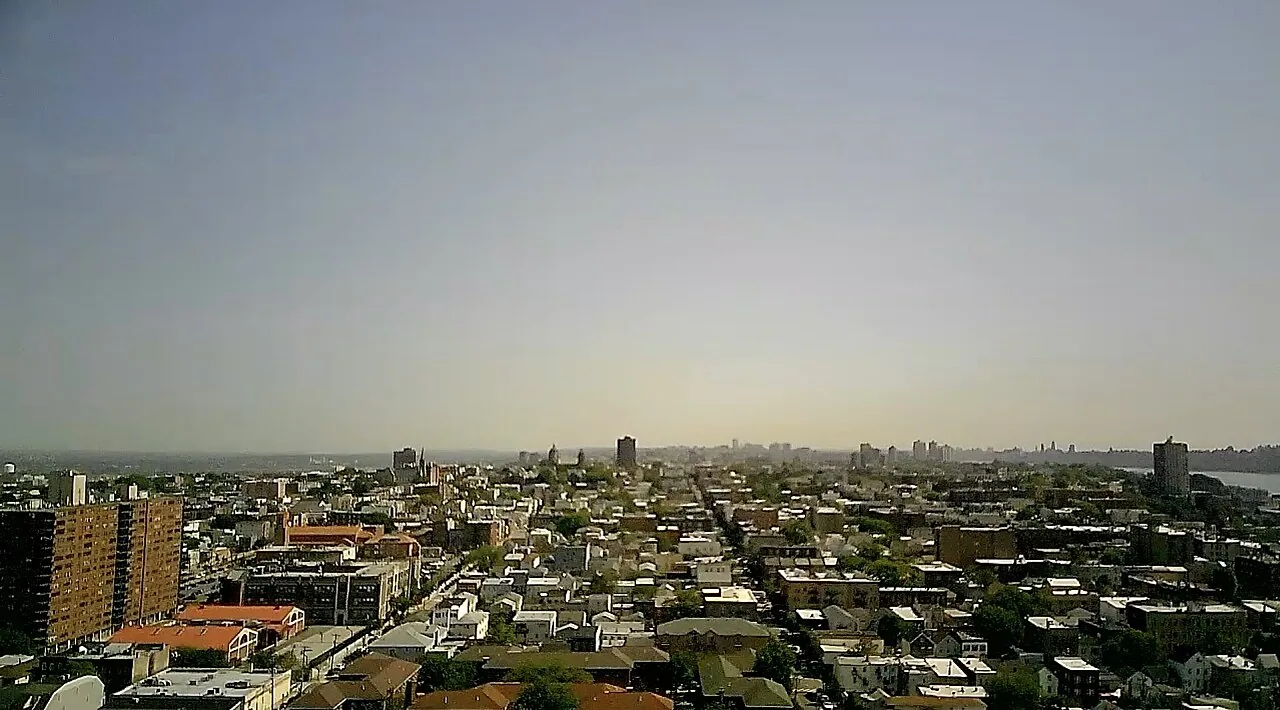
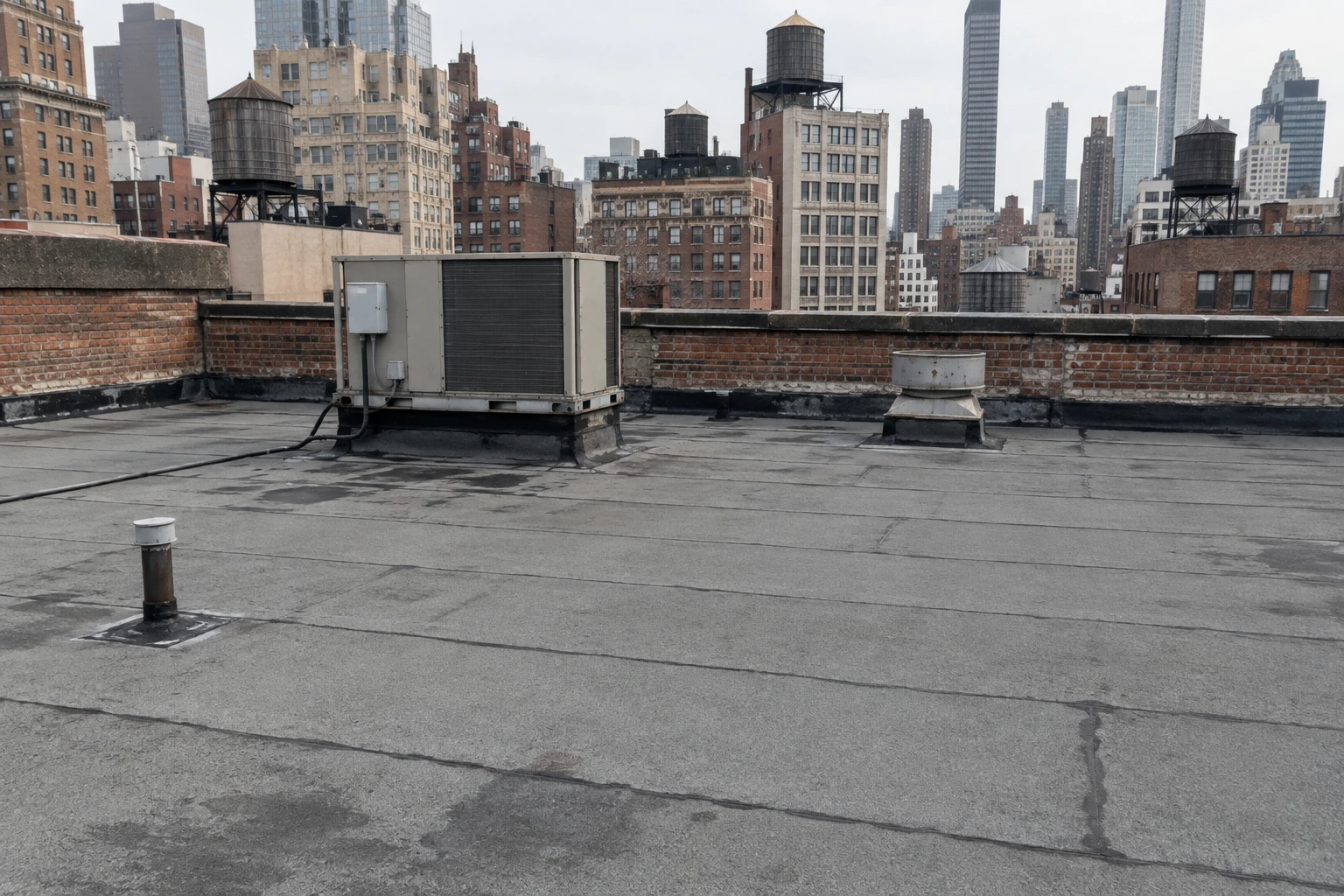
Bergenline Avenue is the main commercial corridor, and the buildings along it combine storefronts at street level with apartments or offices above. Their roofs are typically small, low-slope and shared by tenants, with vents, chimneys, stairwell bulkheads and rooftop equipment on a limited surface. The surrounding blocks hold the brownstones and two-family homes that the city is historically made of, and some of those carry commercial ground floors.
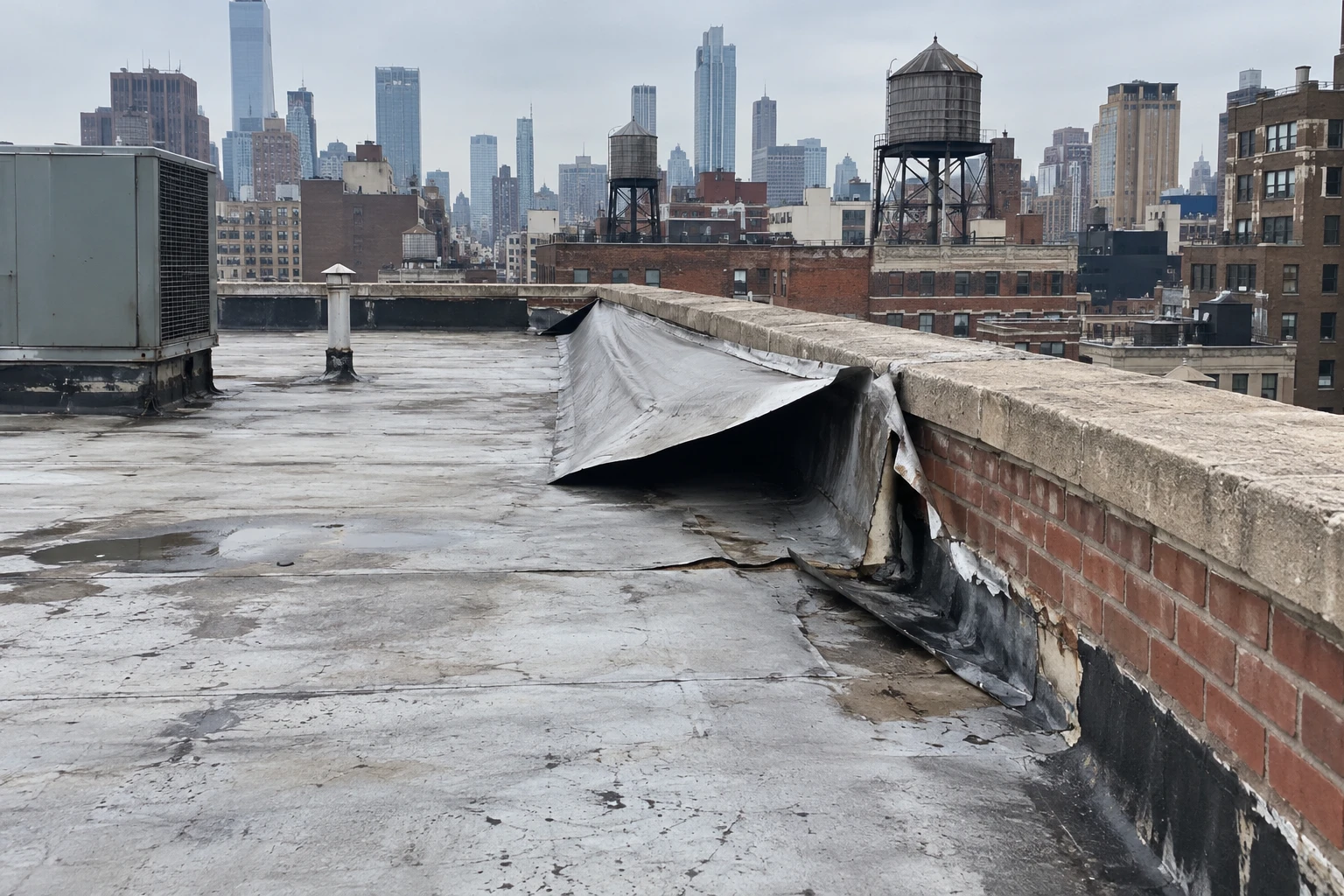
On a roof of that type, the failure points are the parapet, the bulkhead flashing, the drain and the old patches around penetrations. A mixed-use building also has a lease question: who owns the roof, and who pays when a tenant's exhaust stains it. The survey rates the roof, identifies the system and maps the penetrations. Send the list of tenants and the equipment each one added.
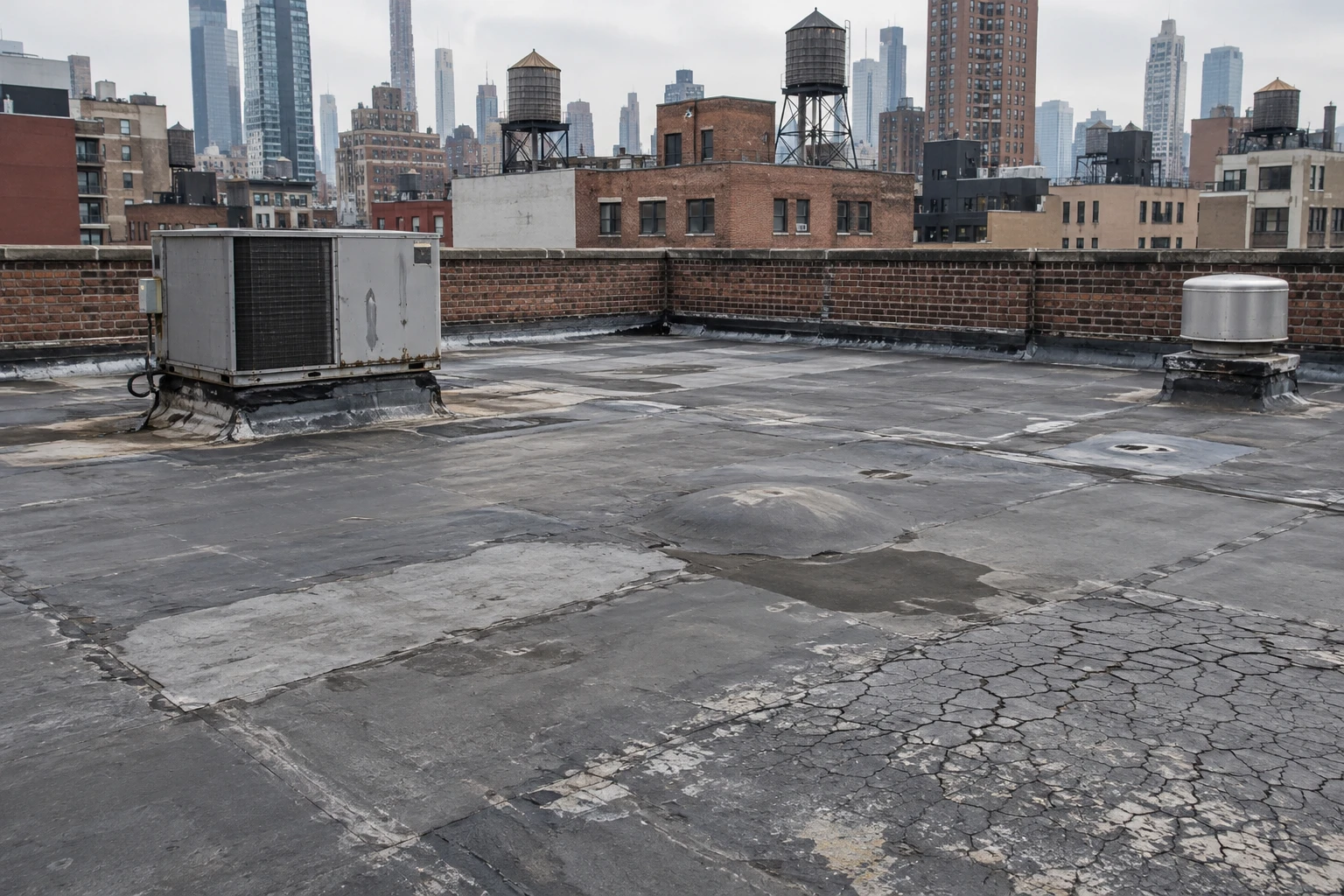
Brownstone-era buildings carry roofs of their own character. Where a brownstone or a two-family house has a commercial ground floor, the roof is usually a low-slope flat or a shallow pitch with a masonry parapet, a skylight or a stair hatch, and a tin or membrane surface patched over many years. We read the layers from a core, check the party wall flashing and probe the parapet for loose brick. Because a party wall is shared, the neighbor's roof matters too, and we note where two roofs meet and who maintains the joint.
How is a crew staged where there is almost no room?
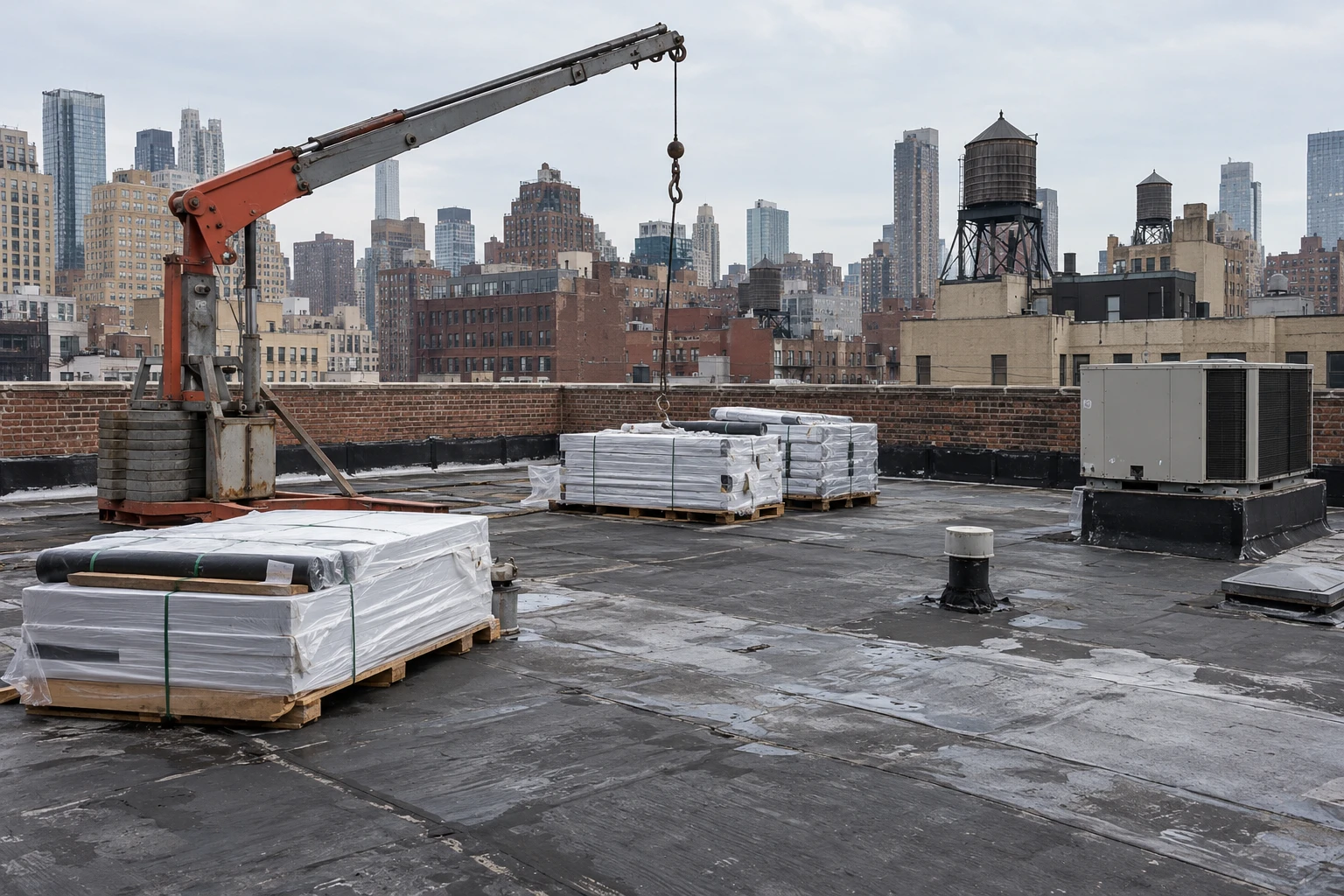
Density turns logistics into the main design problem. A hoist may need a street permit and a position that does not block a driveway or a hydrant, a debris chute needs a clear drop and a dumpster needs space that the block may not have. Material arrives in small loads, timed for the day it will be installed, and anything left over is covered or carried back.
We lay out the route from the street to the roof before mobilizing. If the building has an interior stair, materials may go up by hand, in rolls and bundles a worker can carry, which limits the pace and shapes the system choice. A lighter membrane or a restoration coating is easier to stage than a heavy built-up system. Our occupied building reroofing approach sets working hours, protects entrances and gives tenants notice. Tell us about street parking rules, the stair width and whether the roof hatch fits a roll of membrane.
Notice to neighbors is part of the plan in a place this dense. Buildings touch, sidewalks are busy and a falling object has little room to land safely. We post the work hours, fence the drop zone, use debris chutes with covered ends and keep a spotter at the street when material moves. A written notice goes to adjacent owners through the property manager. The result is fewer complaints and no stoppage, and the crew spends its time on the roof.
What does the Palisades edge do to a roof?
The Troy Towers, a 22 story twin-tower apartment complex completed in 1966, sit on the Palisades cliff edge at 19th Street and Mountain Road. A building on the edge of a cliff sees wind that rises from the river side with no obstruction. Gusts reached 78 mph in Central Park on December 2, 1974, and weather of that kind crosses the river to both banks.
For any roof near the cliff, the edge metal, coping and corner fasteners carry the most load, and the survey checks them first. Tall buildings also shed wind-driven rain differently, forcing water sideways into flashings and sealants. We test the wall terminations with water, from the low point up, and we check the parapet for cracked mortar. Our wind damage roof repair restores what moved. Photograph the edge after every strong storm.
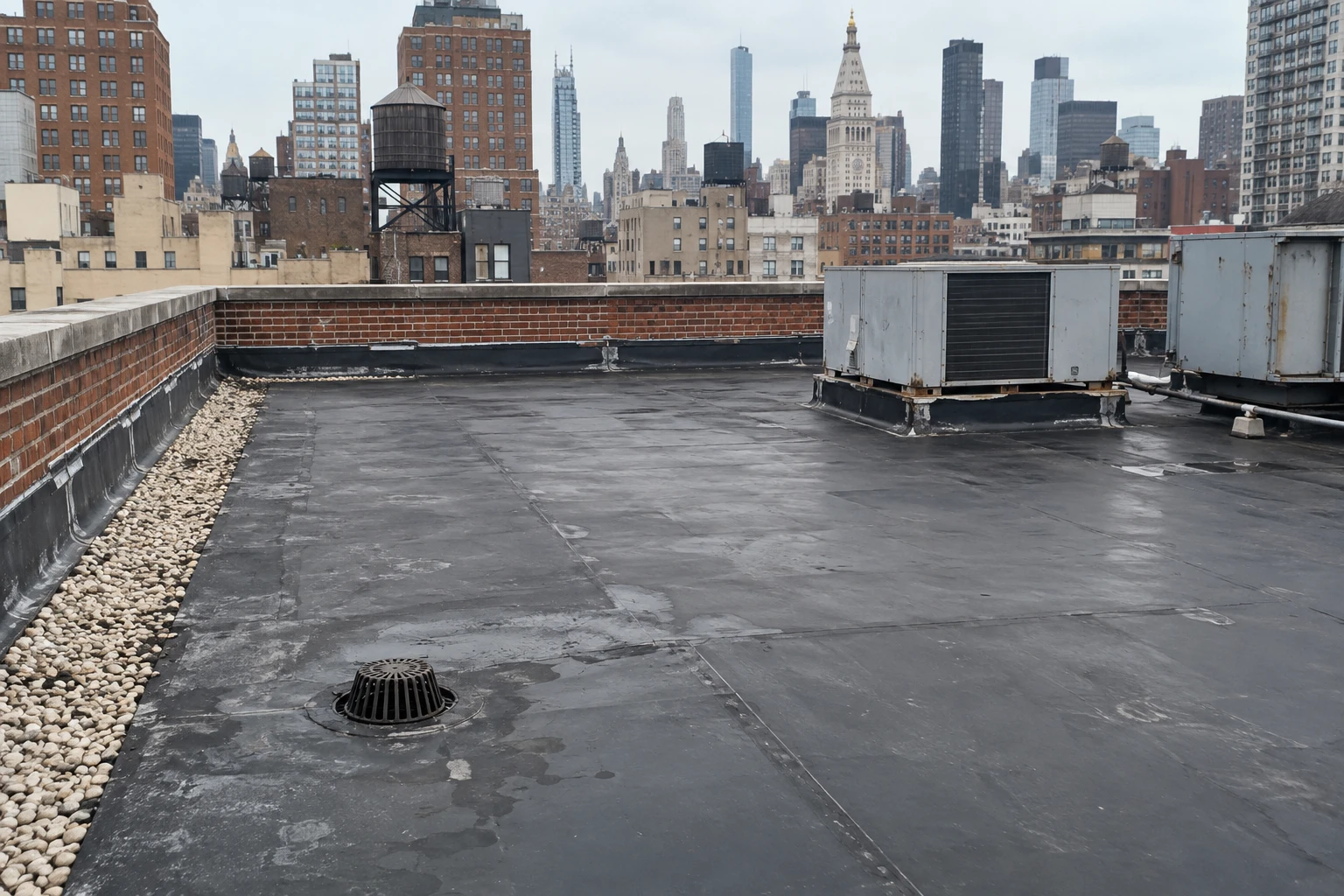
Drainage on a small roof is simple and unforgiving. One drain serves the whole surface, and a basket packed with leaves turns the roof into a pond within an hour of heavy rain. On September 1, 2021 Ida dropped 3.15 inches in an hour on New York City, a rate that shows what a small drain can face. We clear and flush the drain, check the overflow, and measure any ponding. Where a roof has no overflow, adding one is a small repair with a large effect.
Which roof systems suit small, shared, hard-to-reach roofs?
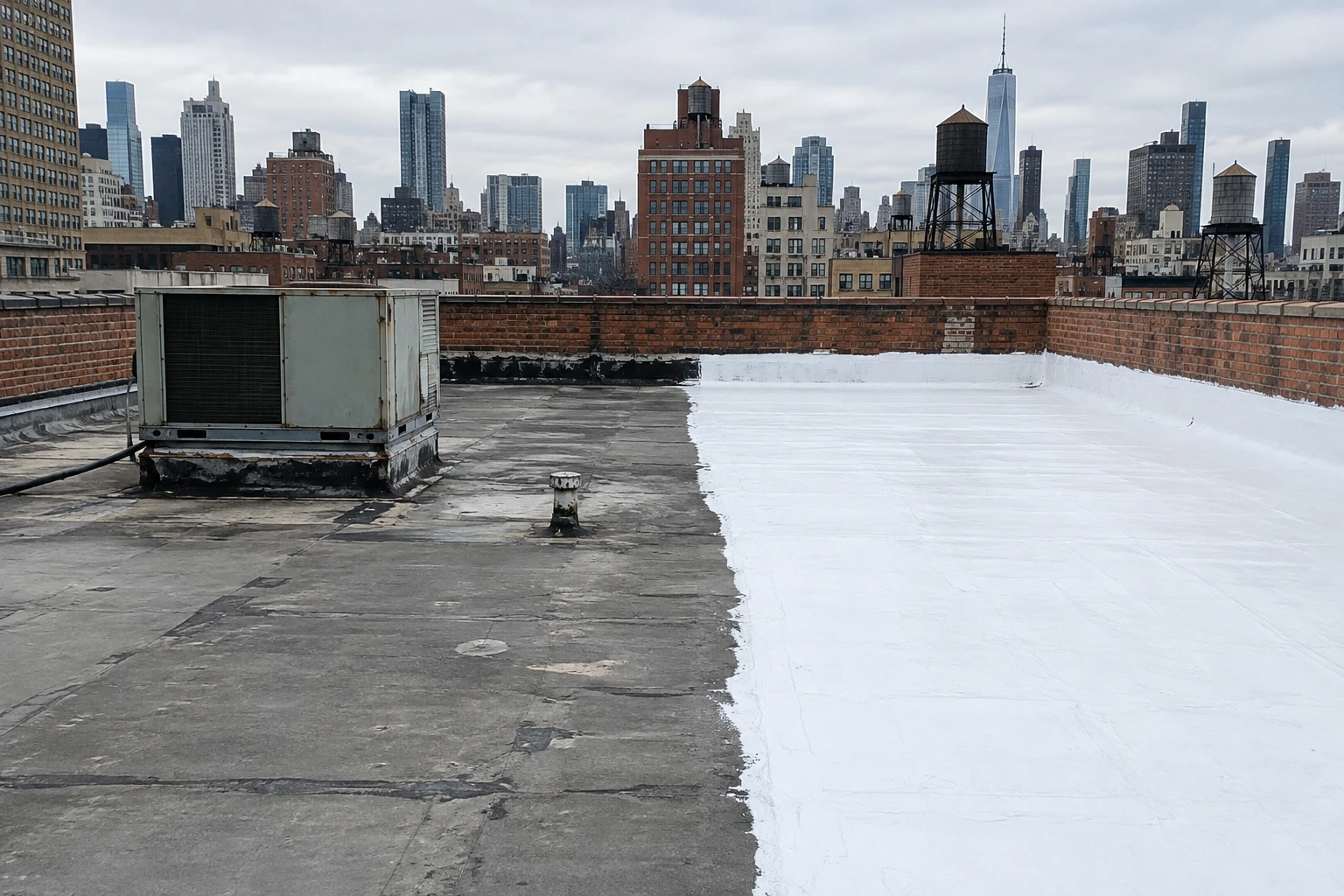
A small roof with many penetrations suits an adhered single-ply or a modified bitumen system, because both conform to details and can be installed in short runs. Modified bitumen tolerates foot traffic and repairs easily. EPDM roofing offers a long record on low-slope roofs. A restoration coating, as in roof coating restoration, extends life where the insulation is dry.
The moisture map decides. If the insulation is wet, replacement follows, and the cost drivers are the area of tear-off, the access and the number of penetrations. Union City follows New Jersey's code, and the survey confirms which edition and energy provisions apply. The proposal should name the code basis.
Winter and summer each leave marks. Central Park averages 29.8 inches of snow a year, and the park has recorded minus 15 F and 106 F, so a small roof sees freeze and thaw at its parapet and heat at its surface. Cracks at the parapet cap admit water into the wall, and sealants at the bulkhead dry and open. A spring and an autumn visit catch both, and a record of each visit shows an owner or a lender that the roof was kept up.
How does an owner plan roofs for several small buildings?
An owner of several small buildings benefits from one rating scale. A survey of each roof ranks them, and the plan assigns repair, coating or replacement with cost drivers. A roof condition report for each building gives a manager something to hand a lender.
Owners with buildings in North Bergen or Fort Lee can add them to the same plan. Update the ratings after every storm.
Commercial Roofing Questions
What decides if a small mixed-use roof is repaired or replaced?
Start with the moisture map and the count of leaks. A dry roof with a few failed details takes repairs. A roof with wet insulation across much of its area calls for replacement.
Can the work happen with tenants upstairs?
Yes. We work from the roof, give written notice, protect entrances and close each section before the end of the day.
How do you handle a roof hatch that is too small?
We stage material in sizes that fit, or use a hoist from the street where the permit allows. The plan states the method before the first day.
Who is responsible for a roof stained by a tenant's exhaust?
Look to the lease. We record the cause and the equipment, and the owner and the tenant settle responsibility.
What does a first survey need?
Address, building age and use, the last report, and photographs of the frontage plus the worst drain and parapet.