Apartment and multifamily roofing in Manhattan, NY: prewar tenement flat roofs, bulkhead and coping repair, replacement and reserve study planning.
On a prewar apartment roof, the core cut beside a party wall corner often decides the report: a dry field and a wet corner mean the details, not the membrane, are what failed. The open roof is small, and the details around it carry the water. Prewar five and six story tenements and apartment buildings fill Washington Heights, Inwood, the East Village and the Lower East Side, which makes the low-slope flat roof on a multifamily building a defining roof type in Manhattan, NY. A board or a managing agent reading a roof report wants three things from it: which details failed, what a repair costs against a replacement, and what the reserve study should carry.
We survey, repair and replace apartment roofs, and we write the findings for a board package. Send the last roof report, the building age and any open violations, and we will set the survey scope and the condition rating before a number is discussed.
What is different about a prewar tenement roof?
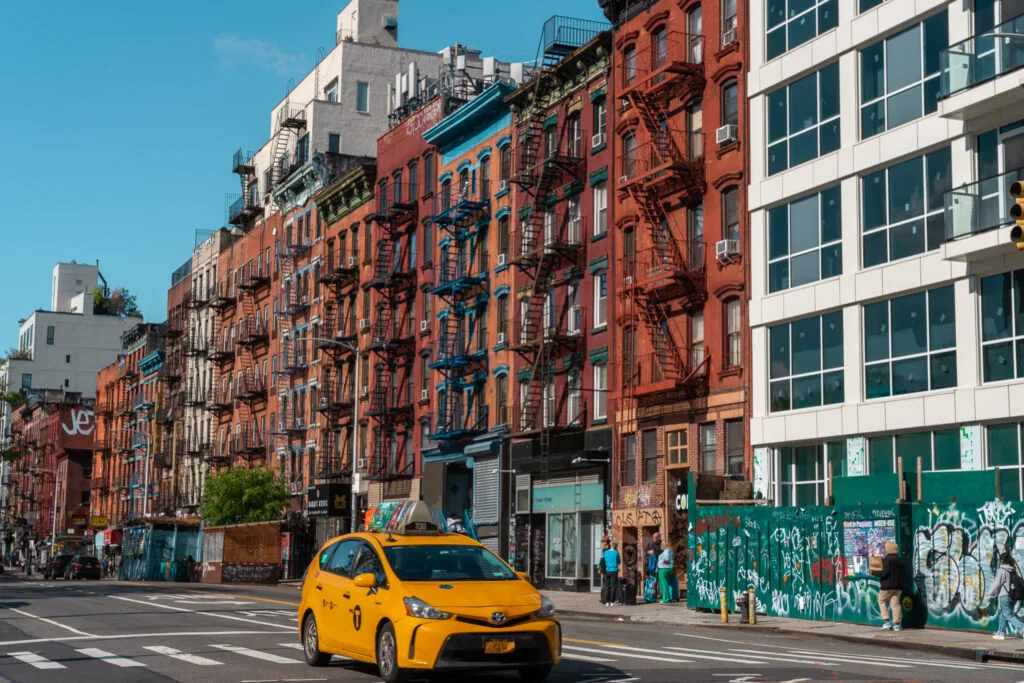
Many 19th century East Village tenements had footprints of about 25 by 25 feet, and an 1879 law requiring windows in every room produced the air-shaft Old Law Tenements. Much of Washington Heights' prewar housing is five and six story New Law Tenements from the pre-World War I construction boom, and the vast majority remain. A roof on a building like this is low-slope and can carry a bulkhead, a stair skylight, shaft openings, chimneys and other rooftop items, and we do not assume which ones are present until we have walked it.
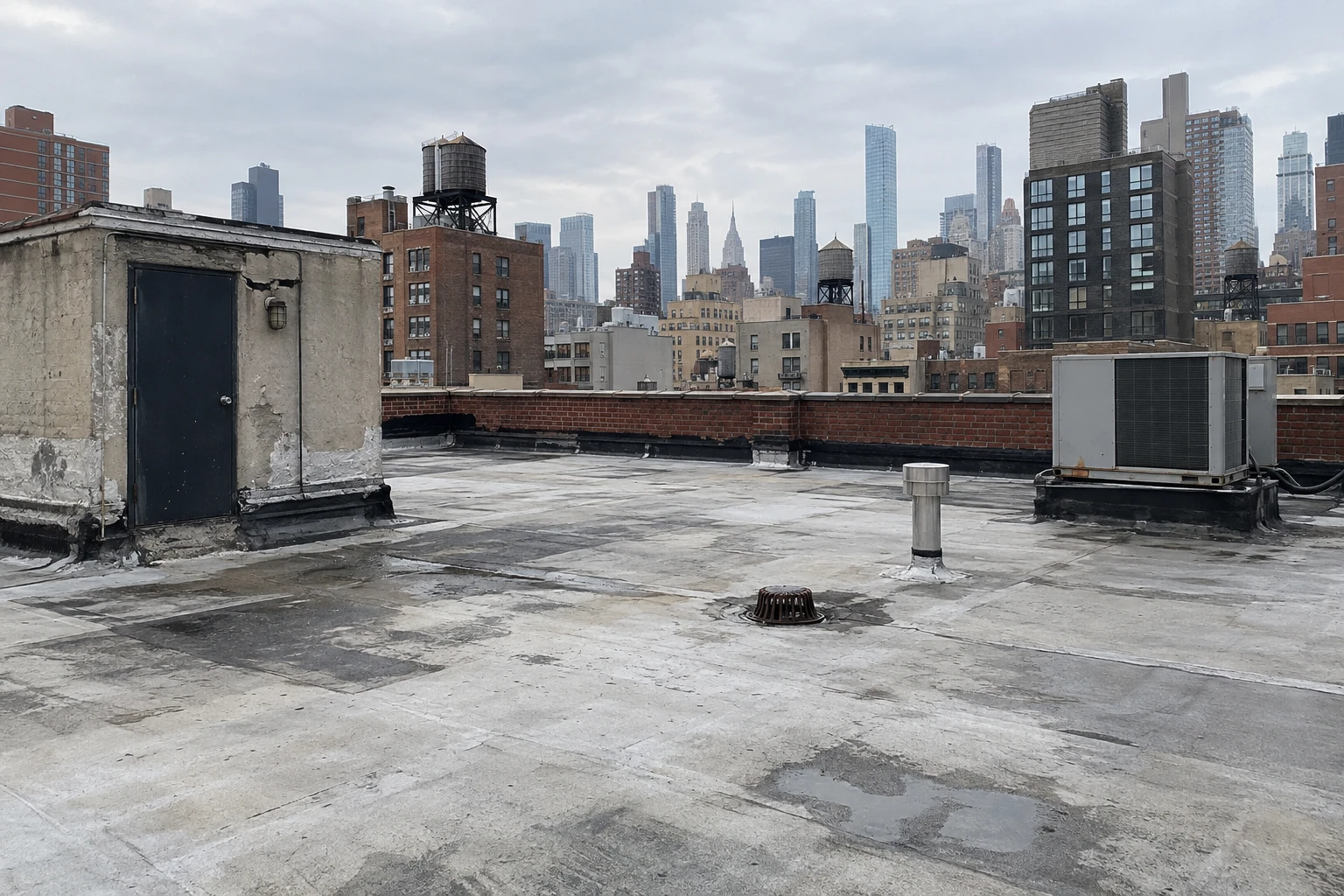
Each of those is a detail that carries water. We inspect the skylight curb, the bulkhead base, the shaft coping and every chimney, and we cut a core beside the worst of them. A small roof has few feet of membrane and many feet of flashing, so the survey spends its time on the flashing. The rating lists each detail separately, which lets a board fund the worst one first and plan the rest. A skylight curb with a cracked corner may need a rebuilt flashing; a chimney with open mortar needs a mason before the roofer; a shaft coping with open joints needs sealant and a cap. The report names the trade for each item, so the managing agent can order the work in the right sequence.
How does a small, hard-to-reach roof change the work?
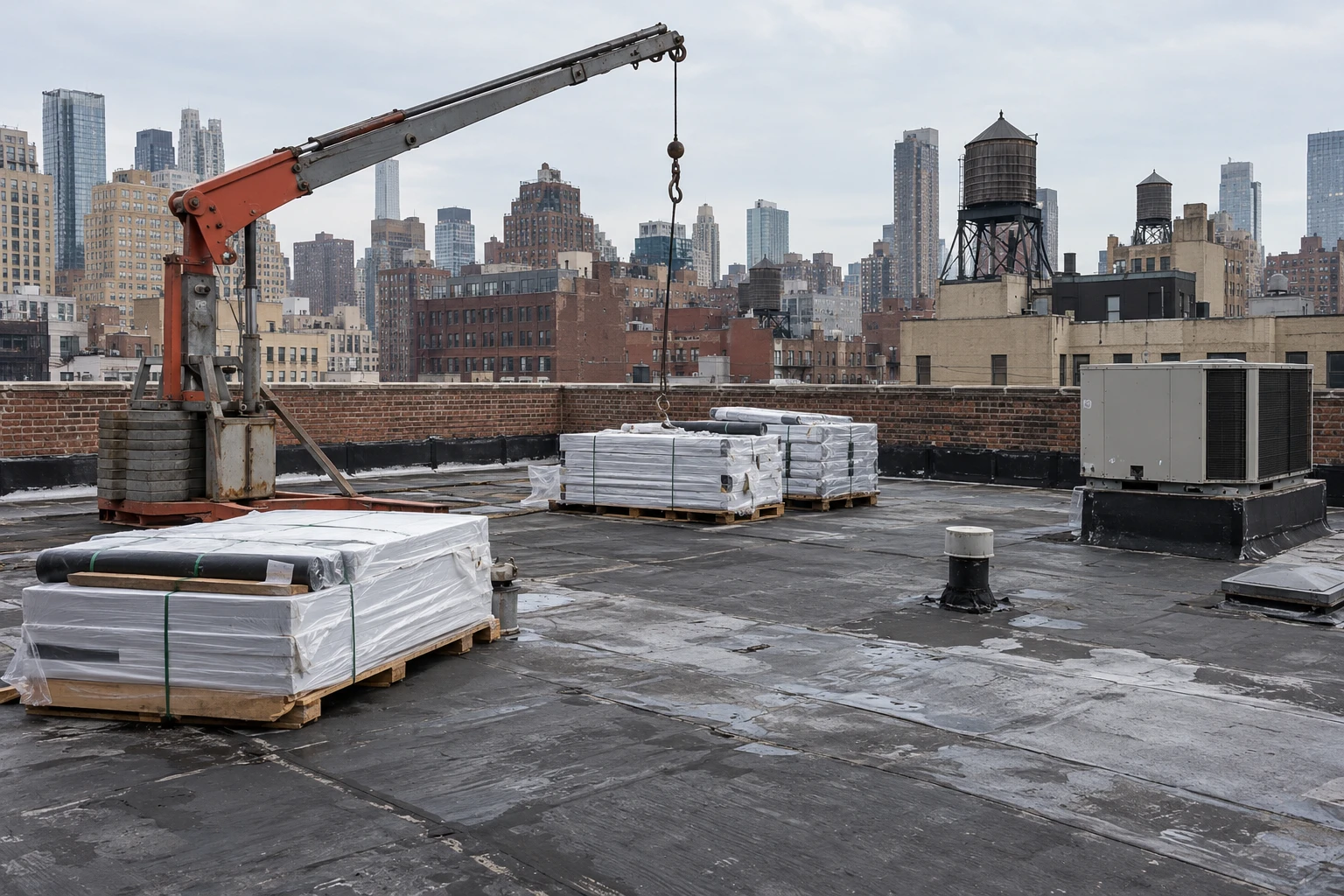
Access is usually through a stair bulkhead, and materials reach the roof by hoist, crane or hand carry up the stair. A crane on a narrow street needs a permit, a closure and a lift plan. In Union City, which had 53,293.7 residents per square mile in the 2020 census, the second densest municipality in New Jersey, there is little room to stage materials, and the same attention to tight sites applies across the river.
We write a staging plan that names the crane location, the delivery windows, the debris route and the protection for the stair. Residents are told the dates and the noisy steps. Hot work needs a permit, and the fire watch continues after the last weld. Because a small roof is quickly finished, the best schedule is a dry week with a firm start date and a stop rule for rain. We confirm the forecast three days ahead and again the evening before, and if the window closes we move the whole job, not half of it, so the roof is never left open over a top-floor apartment. Our occupied building reroofing plan names a resident contact, usually the superintendent.
How do larger apartment complexes differ?
Kips Bay Towers is a 1,112 unit apartment complex designed by I. M. Pei and completed in 1963, and Taino Towers at East 122nd Street and Third Avenue has four 35 story towers with 656 apartments and opened in 1979. East Harlem has 24 New York City Housing Authority developments. Tall buildings have mechanical roofs, setbacks and parapets exposed to wind, and their roof work is as much a hoisting and access problem as a roofing one.
Newer buildings include the Carmel Place microapartment building, with 55 units of 260 to 360 square feet built from modular units prefabricated at the Brooklyn Navy Yard. We do not assume a roof's type from a building's age or design. We survey it. A complex with many roofs gets the same format on each, and the roof asset management plan ranks them by risk and remaining life.
What do storms and freeze-thaw require of the roof?
Ida's September 1, 2021 storm peaked at 3.15 inches in an hour, left 7.13 inches in Central Park and brought the first flash flood emergency the Weather Service had ever declared for the city. A small roof with one drain has no backup if that drain clogs. Winters in Central Park deliver 29.8 inches of snow on average, summers have reached 106 F and the lows have touched minus 15 F, so a roof here cycles through a very wide range.
Freeze-thaw works every coping joint and every flashing. We check the drain leader, the strainer and the overflow, then the coping and the flashing at each wall. In the East Village and on the Lower East Side, where tenement blocks sit beside new towers like the 16 story Blue Condominium on Norfolk Street, the survey records party wall conditions and the tie-in where roof levels differ. Hurricane Sandy on October 29, 2012 set a 14.06 foot surge, and East River water flooded parts of the East Village.
What does a full replacement trigger in New York City?
Three code books matter to a roof here, the Building Code, the Existing Building Code and the Energy Code, all part of the 2022 NYC Construction Codes. Local Laws 92 and 94 of 2019 oblige any new building, enlargement or complete replacement to cover its sustainable roofing zone with solar, a green roof or both. On a small tenement roof crowded with a bulkhead and a skylight, the zone may be a fraction of the area, and the layout study decides what is possible.
We map the zone, the equipment and the structure before a design is fixed, and we tell the board whether a repair or partial recover avoids the rule. Landmark and historic district status can add review for a visible change. A hotel or a school follows the same survey method. The roof capital planning work puts replacement dates and cost ranges into the reserve study.
Commercial Roofing Questions
What decides whether a tenement roof is repaired or replaced?
The core logs. If the wet insulation is confined to details, rebuilding those details is sound. If it spreads across the field, replacement belongs in the plan. A small roof makes the choice quick because the whole surface can be surveyed in one visit.
How does a board decide how much to reserve for the roof?
Start with the condition rating and the estimated remaining life. The reserve study then funds replacement at the end of that life and repairs between. A dated report from a survey gives the study a firmer base than an age-based guess.
Can residents stay in the building during a roof replacement?
Yes. The work is exterior, and loud steps run during the day. We give residents the dates, protect the stair and keep a named contact on site. Top-floor units may hear more, and we flag them in the notice.
What do we do about a leak into a top-floor apartment right now?
Move belongings, place a catch and photograph the stain with the time. Call us with the address and the unit. We find the entry point from the roof and apply a temporary seal. The permanent repair follows in dry weather.
Are New Jersey apartment buildings subject to the New York City solar and green roof rules?
No. Local Laws 92 and 94 apply to buildings in New York City. A New Jersey building follows state and municipal codes, which we confirm with the local building department. The survey method is the same.