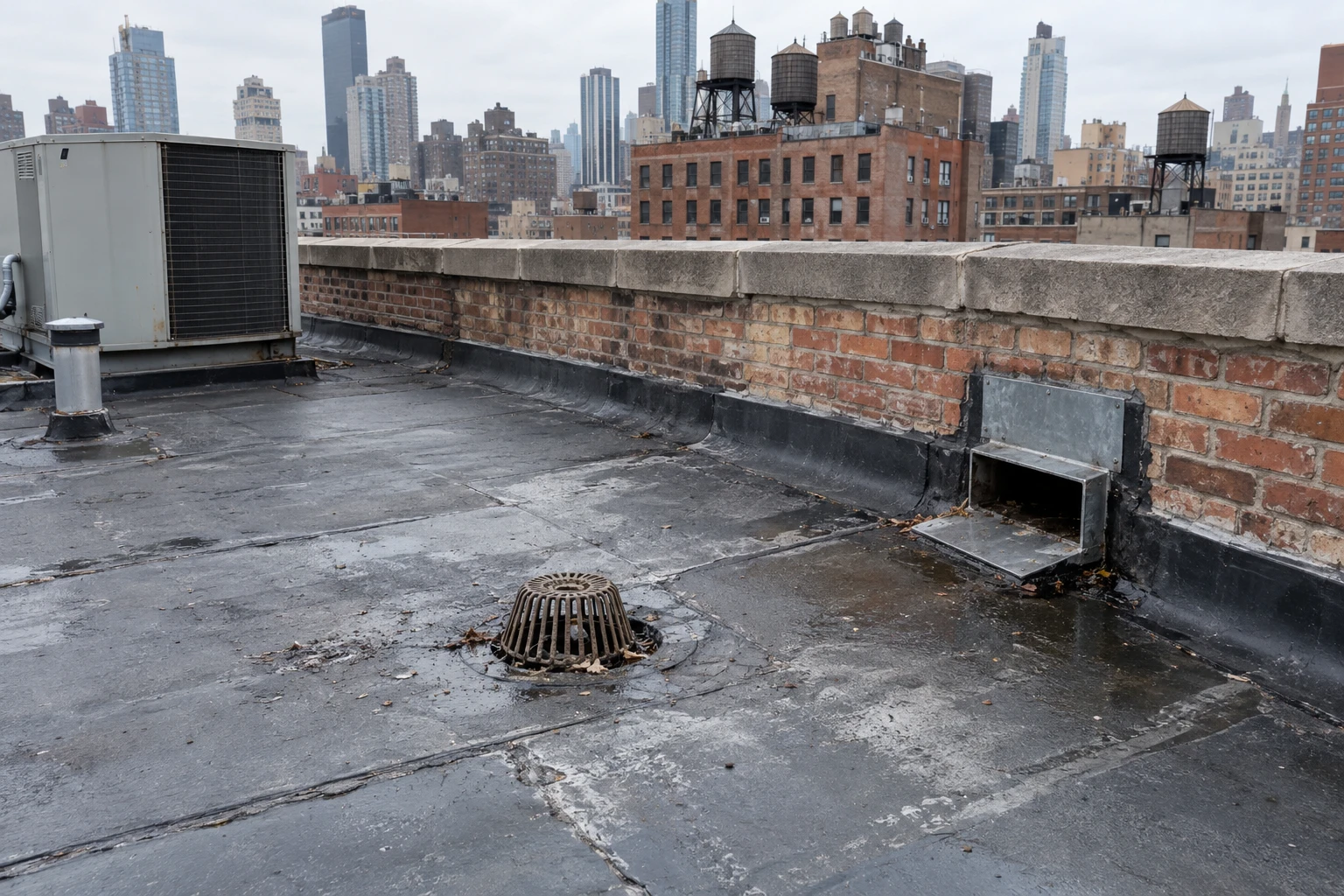
Commercial roof surveys, repair and replacement in Kips Bay, Manhattan, NY, for towers, riverside complexes, medical buildings and converted offices.
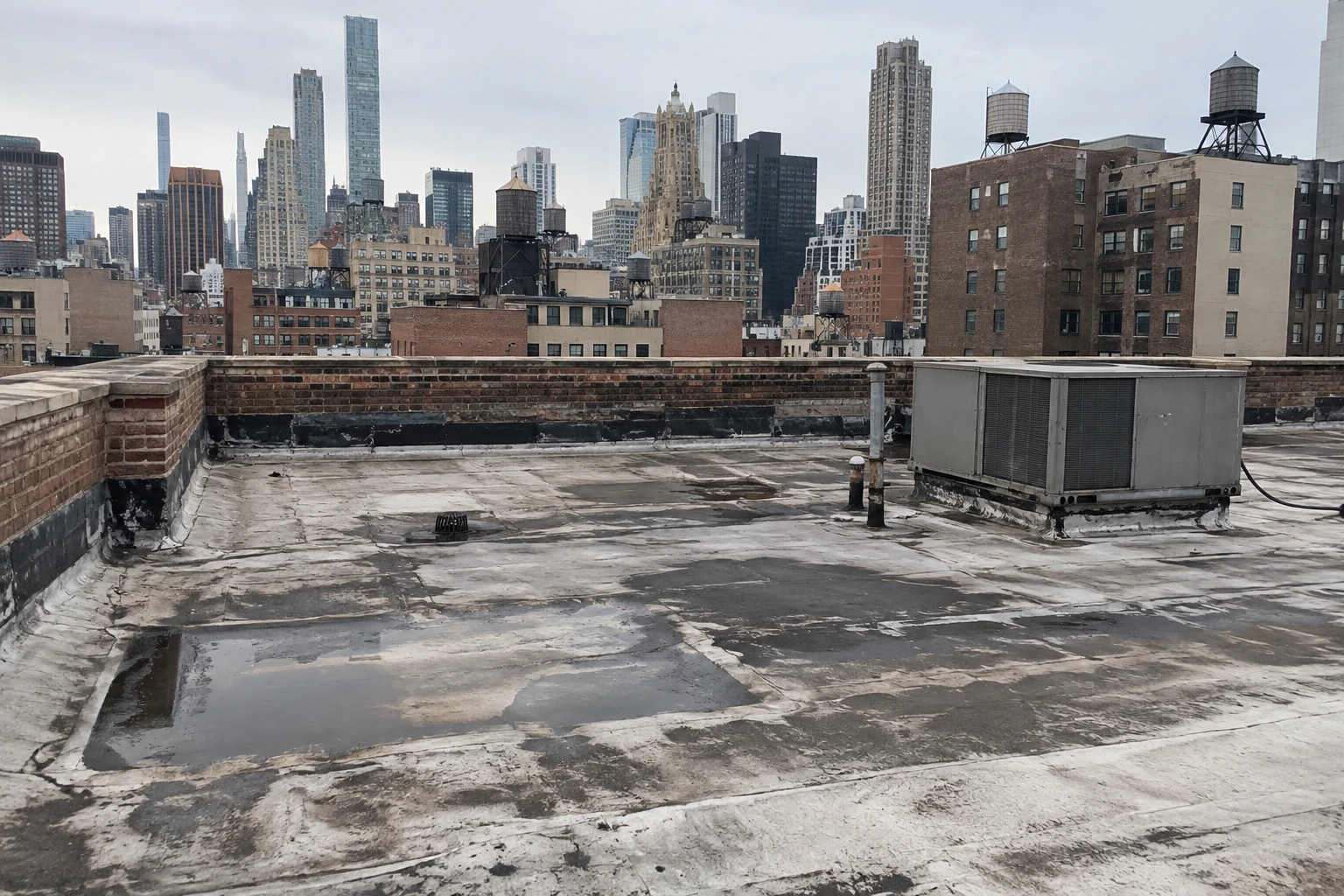
Standing water measured at a roof drain tells you two things at once: how deep the pond is, and how long the building has been living with it. Depth is a number you can put in a report. Duration is what the insulation underneath has already absorbed. Kips Bay gives that measurement real weight, because the district runs along the East River, where wind and flood history sit close to the roofs, and where large residential and medical buildings leave very little room for a roof to be wrong.
In Manhattan, NY, we survey, repair and replace low-slope commercial roofs in Kips Bay, and the work starts from measured findings: moisture maps, drain inventories and condition ratings that an owner or board can put in a capital plan.
What do large residential complexes need from a roof program?
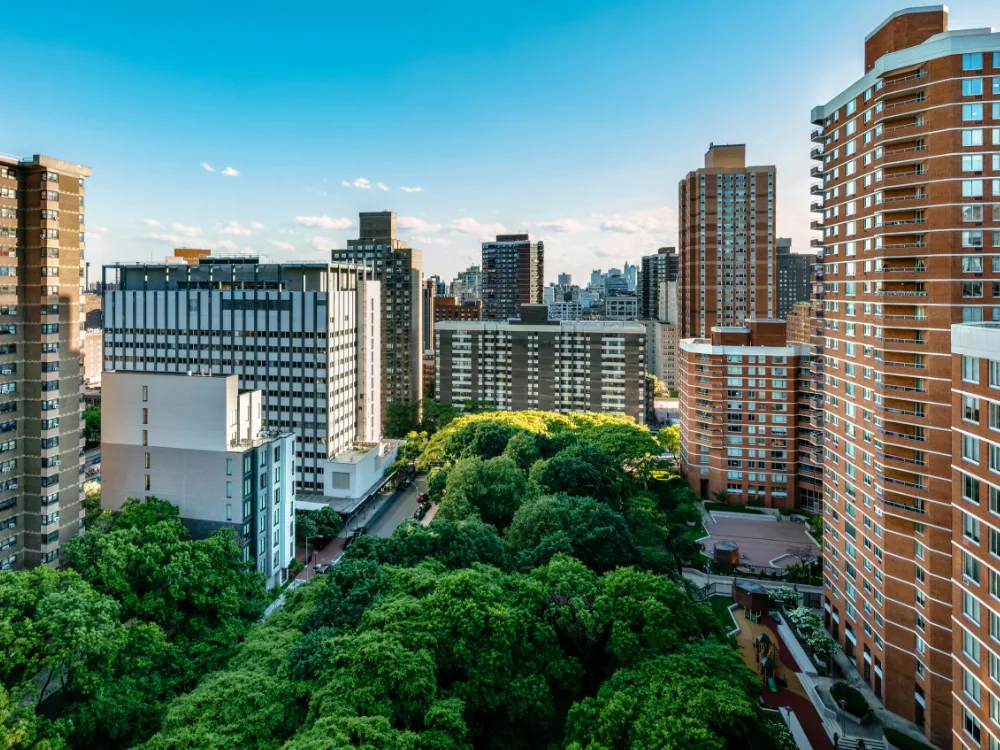
I. M. Pei designed Kips Bay Towers, a 1,112 unit apartment complex finished in 1963 as part of the NYU-Bellevue urban renewal project, and Waterside Plaza, a mix of residential and business space, stands on a pier above the East River between East 25th and 30th Streets. A complex of that scale rarely has one roof. It has main roofs, lower podium decks, mechanical penthouse roofs and terraces, each with its own age and its own drainage path.
A program for buildings like these begins by mapping every roof area and rating it. The map shows which areas are due for repair, which can be recovered and which need replacement, so a board can sequence the spending over several years instead of reacting to the worst leak. A capital plan for the roofs gives the reserve study something firm to carry, and a multifamily roof with many penetrations earns an annual walk.
How does riverfront exposure change the roof detailing?
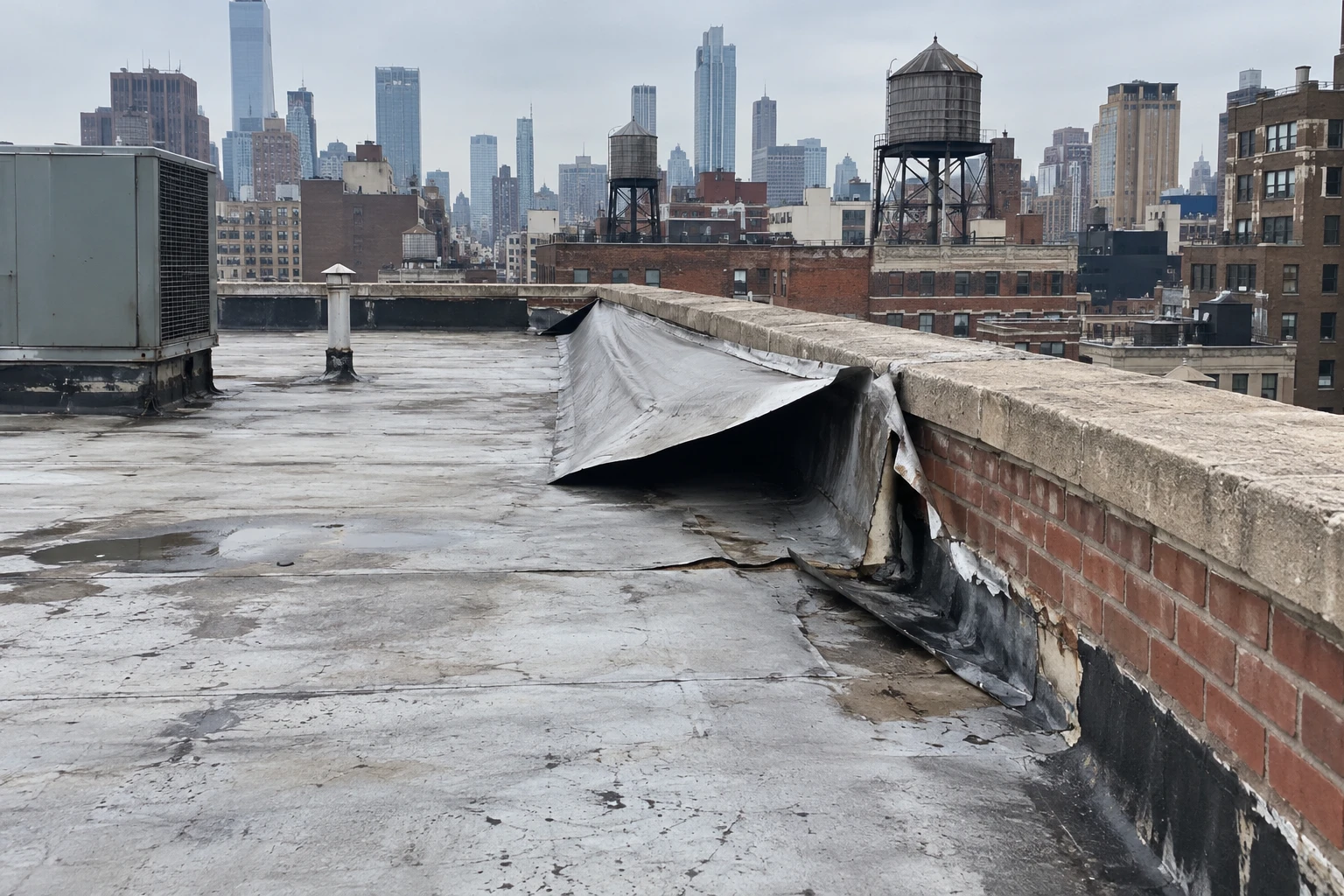
On October 29, 2012 Sandy's surge hit The Battery at 14.06 feet over average low tide while the East River flooded parts of the East Village. A roof is above flood level, but a riverside building feels the same storm through wind, wind-driven rain and power loss. Wind-lifted flashing, loose edge metal and blown gravel are the damage a survey looks for after an event, and a pier-side or avenue-end roof deserves a close look at its perimeter.
Perimeter securement is the key detail. Edge metal that is fastened properly and a membrane that is adhered or ballasted to match the building's exposure hold up far better than a roof whose edge has been patched several times. Where the survey finds a loose edge, the written finding names the stretch, the likely cause and the repair, so wind damage repair is scoped before the next storm instead of after it.
What does roof work look like beside Bellevue, NYU Langone and the VA?
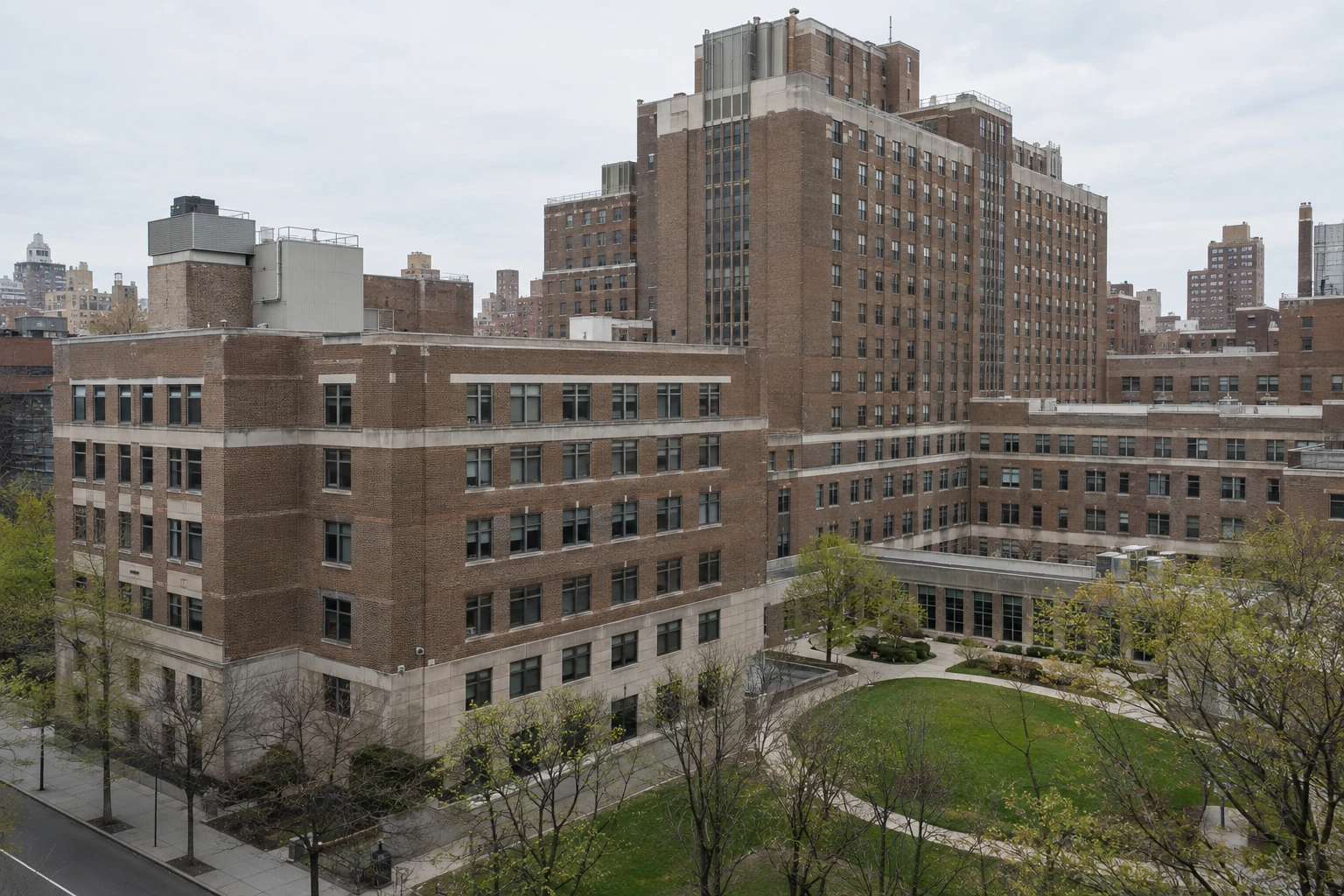
Bellevue and NYU Langone stand in Kips Bay, and the Manhattan VA Medical Center on East 23rd Street adds a third hospital to a corridor of hospital-adjacent buildings. The Sandy flooding in the VA basement damaged its mechanical and fire suppression systems, and about six months passed before the center fully reopened, the last of the city's Sandy-hit hospitals to do so. The lesson for a roof is not about the basement. It is that a building with critical systems needs a roof plan that treats water as a continuity risk.
That means documented drains, a leader inventory, a clear emergency contact and a roof that is inspected before the season, not after a failure. For federal property like the VA campus, access, escort and scheduling rules shape the work, and the roofing follows Unified Facilities Criteria where they apply. Owners of private medical offices nearby can borrow the same discipline, and the way VA medical center roofs are scoped shows how access and scheduling get written down.
How are converted offices and modular buildings surveyed?
The former Kips Bay Brewing Company building on First Avenue between East 37th and 38th Streets dates to 1895 and now holds offices, which is a useful example of an older industrial shell carrying a modern tenant. At the other end of the age scale, Carmel Place holds 55 microapartments of 260 to 360 square feet, assembled from modular units prefabricated at the Brooklyn Navy Yard. A roof over modular construction has joints and lifting points that a conventional building does not.
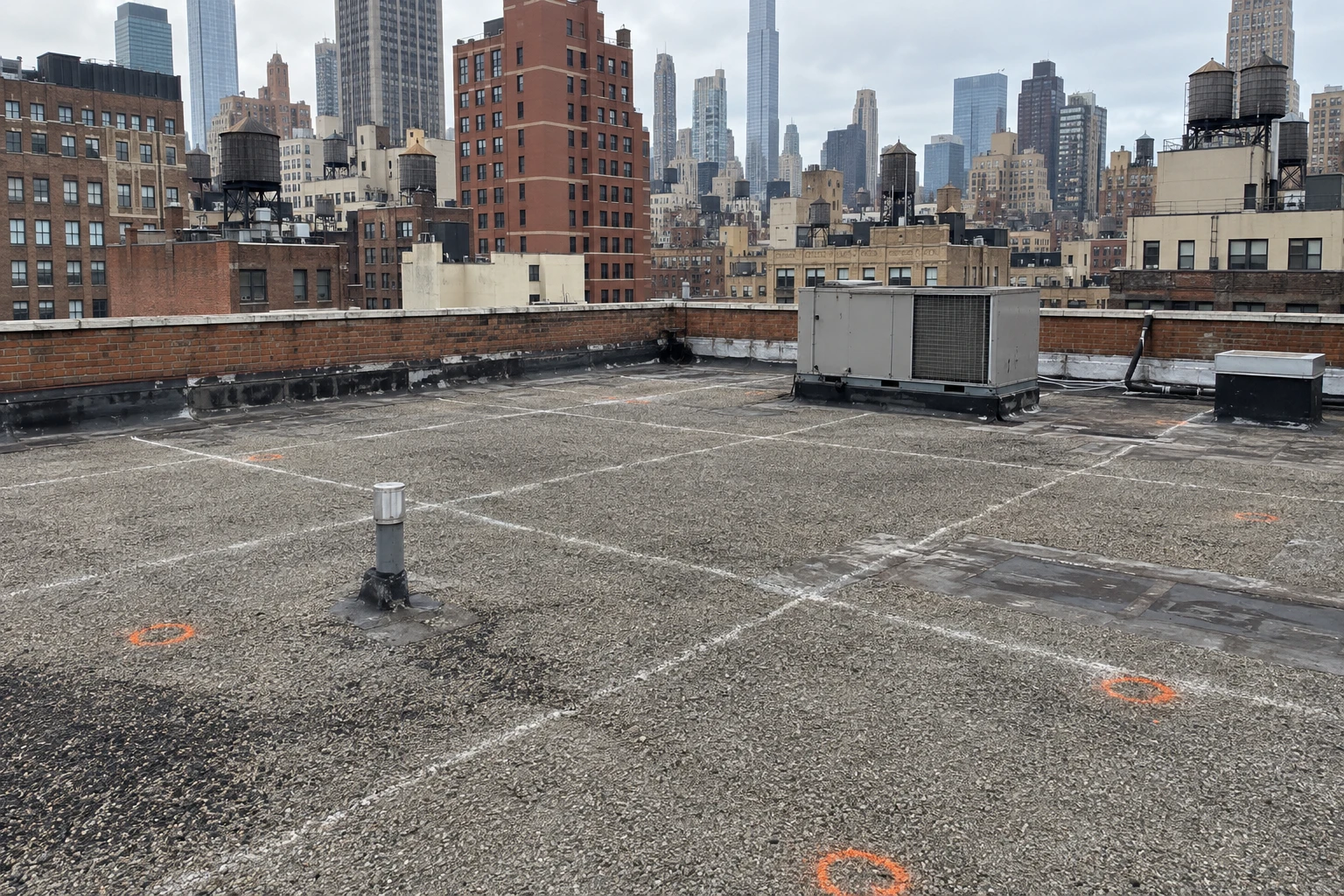
The survey for an older converted building focuses on layers and flashing: how many membranes sit on the deck, how the parapets were flashed, and whether an old tie-in at a bulkhead is still tight. The survey for a modular building focuses on seams and penetrations at the module joints. Either way, an infrared moisture survey separates dry roof from wet roof before anyone cuts the first sample.
Occupied offices change the order of work. Tear-off happens in sections, and each section is dried in by the end of the shift, so a tenant on the floor below never sits under an open deck overnight.
What do rain, snow and heat do to Kips Bay roofs?
Ida's hour of 3.15 inches on September 1, 2021 came with the Weather Service's first flash flood emergency for New York City. Roof drains and scuppers carry that load, and a partly blocked leader turns a flat roof into a shallow pool within minutes. Cleaning and flow-testing roof drains and scuppers before the wet season is cheap next to the interior damage a clogged drain causes.
Snow adds load and ice. Central Park averages 29.8 inches a year, and summer heat, with a recorded 106 F, wears sealants and cooks asphaltic materials. We record every observed defect with a photograph and a location on the roof plan.
What should the owner keep on file?
Keep the condition rating, the infrared scan, the core-cut log, the drain inventory, the permit history and any manufacturer warranty paperwork in one place. When a building changes hands, or a lender asks about the roof, that record answers the question without a new survey. The rating also turns a vague sense that the roof is old into a line item with a date, which is what a reserve study needs.
Owners with neighbouring holdings in Murray Hill or the Upper East Side can bring them into one consistent rating scale, so a portfolio view shows which roof is next and which can wait another season.
Commercial Roofing Questions
How should a board sequence roof work across several roof levels?
Rating each level separately settles it. The oldest, wettest area goes first, a recover candidate follows, and a sound area waits. Spreading the work over a few budget years keeps each assessment smaller and gives the reserve study a defensible schedule.
What do we gain from checking the roof after a major storm?
A post-storm walk catches lifted edge metal, displaced ballast and flooded drain bowls while repairs are still small. It also documents conditions with dates, which supports an insurance claim if a loss is later found.
Can modular buildings use the same repair methods as conventional ones?
Many of the same membrane repairs apply, but the module joints need their own treatment. We inspect the seams between units, confirm the flashing at lifting points and match the repair materials to the original assembly instead of assuming a standard patch.
Who is responsible when a riverside complex has several roof owners?
Responsibility follows the governing documents, so the survey names the roof area each defect belongs to. Photographs and the moisture map make it a matter of record, which speeds a board's decision on shared costs.
What belongs in the written finding for a loose roof edge?
The stretch of edge, the apparent cause, the fastening or sealing method proposed and a photograph of each affected length. With that, a manager can approve the repair knowing exactly what is being fixed and where.