Retrofit and restoration of exposed-fastener metal roofs in Manhattan, NY: fastener pull tests, rust surveys, coating or over-roof options, and clear records.
A damp stain running along the underside of a metal panel from ridge toward eave is the first thing to rule out on an exposed-fastener roof, because condensation looks exactly like a leak and no amount of sealant on the laps will stop it. Once condensation is excluded, the fasteners become the suspects: a screw that turns freely by hand has lost its threads and its washer, and the hole around it is a path for water. Exposed-fastener metal roofs, with ribbed panels screwed through the face, are common on utility, industrial and service buildings. Retrofit, in Manhattan, NY as elsewhere, means giving such a roof a second life without a full tear-off: re-fastening, sealing, coating or covering it with a new system. The owner needs to know which route the metal supports.
What does the survey measure on an exposed-fastener roof?
Four things: fastener condition, panel condition, substrate and slope. We pull-test a sample of fasteners, check washers for cracking and compression, and count the loose ones by area. We examine the panels for rust, pitting, dents and coating loss, mark where laps have opened, and look at the underside for staining and corrosion. If the roof has insulation, an infrared scan and cores check for moisture. And we measure the slope, since low-slope panel roofs rely more on sealant at laps and are more sensitive to ponding.
Results are recorded by area and rated. A roof whose panels are sound and whose problems are fasteners and sealant is a candidate for restoration. A roof with widespread rust-through, a failed substrate or a structure that has moved is not. The condition rating and the cost comparison between routes go into the file.
What does restoration involve, and when does it hold?
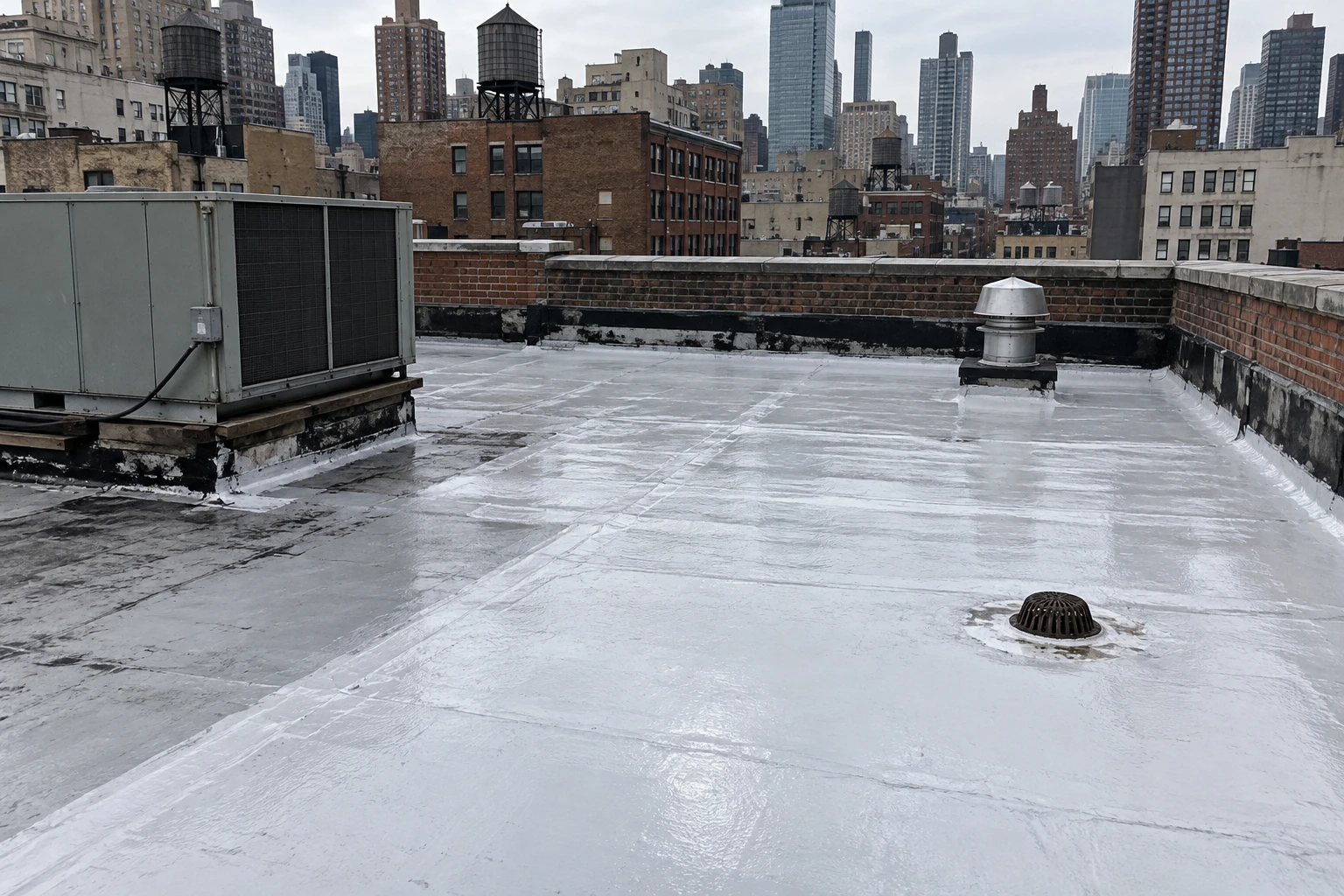
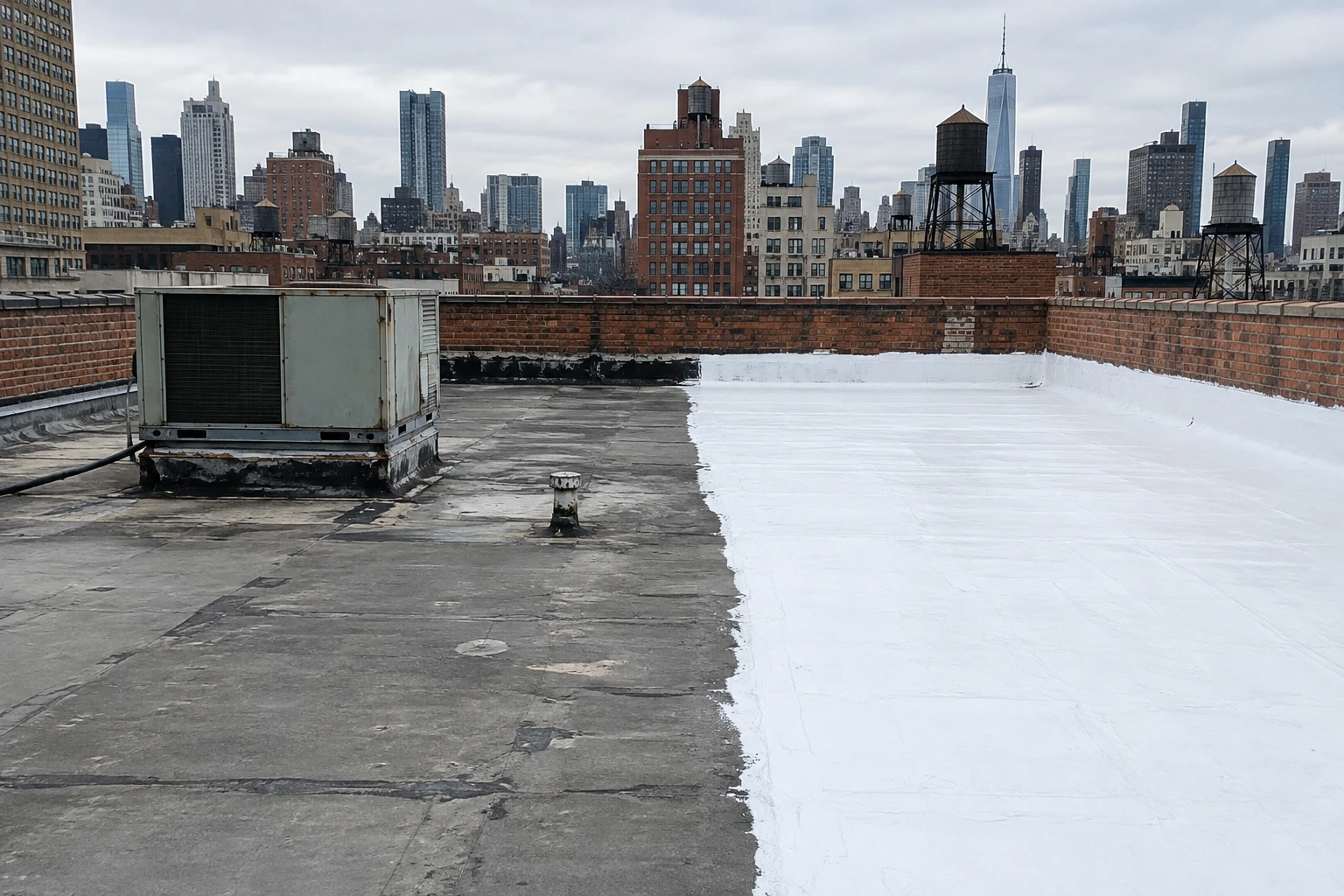
Restoration starts with cleaning and rust treatment, then replaces failed fasteners with larger or better ones, seals laps, ridges and penetrations and applies a coating over the whole surface. A fluid-applied silicone coating or an acrylic coating bridges small gaps, reflects sunlight and extends the life of the metal.
The approach holds when the panels have metal left to protect and the substrate is dry. It does not hold over active rust-through or over panels that flex and fatigue. We test adhesion on a patch before the coating is specified, and we record the cleaning method, the primer and the film thickness. A restoration done this way gives the owner a defined period of service and a plan for recoating, and the cost is usually well below replacement.
When is a new roof installed over the old metal?
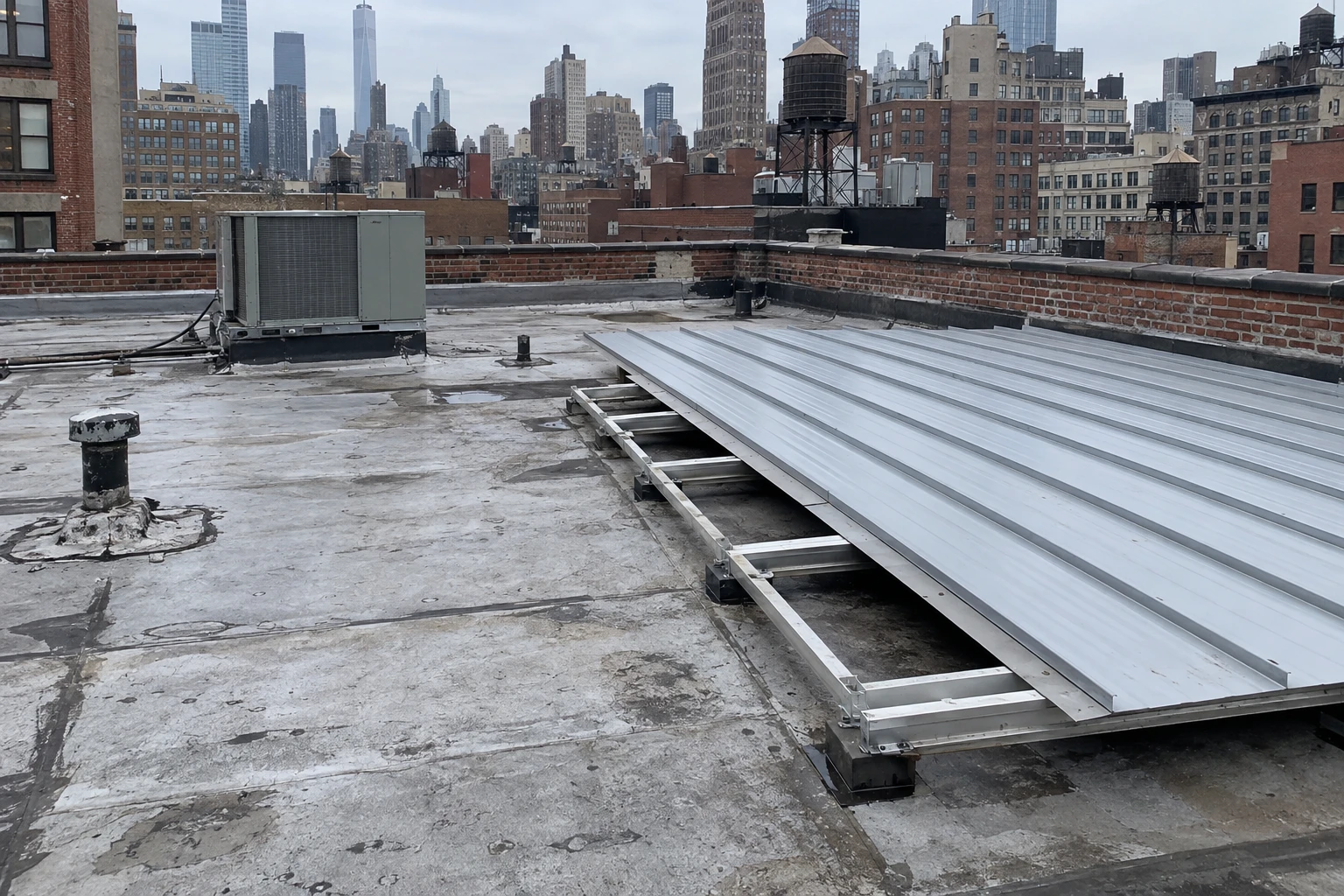
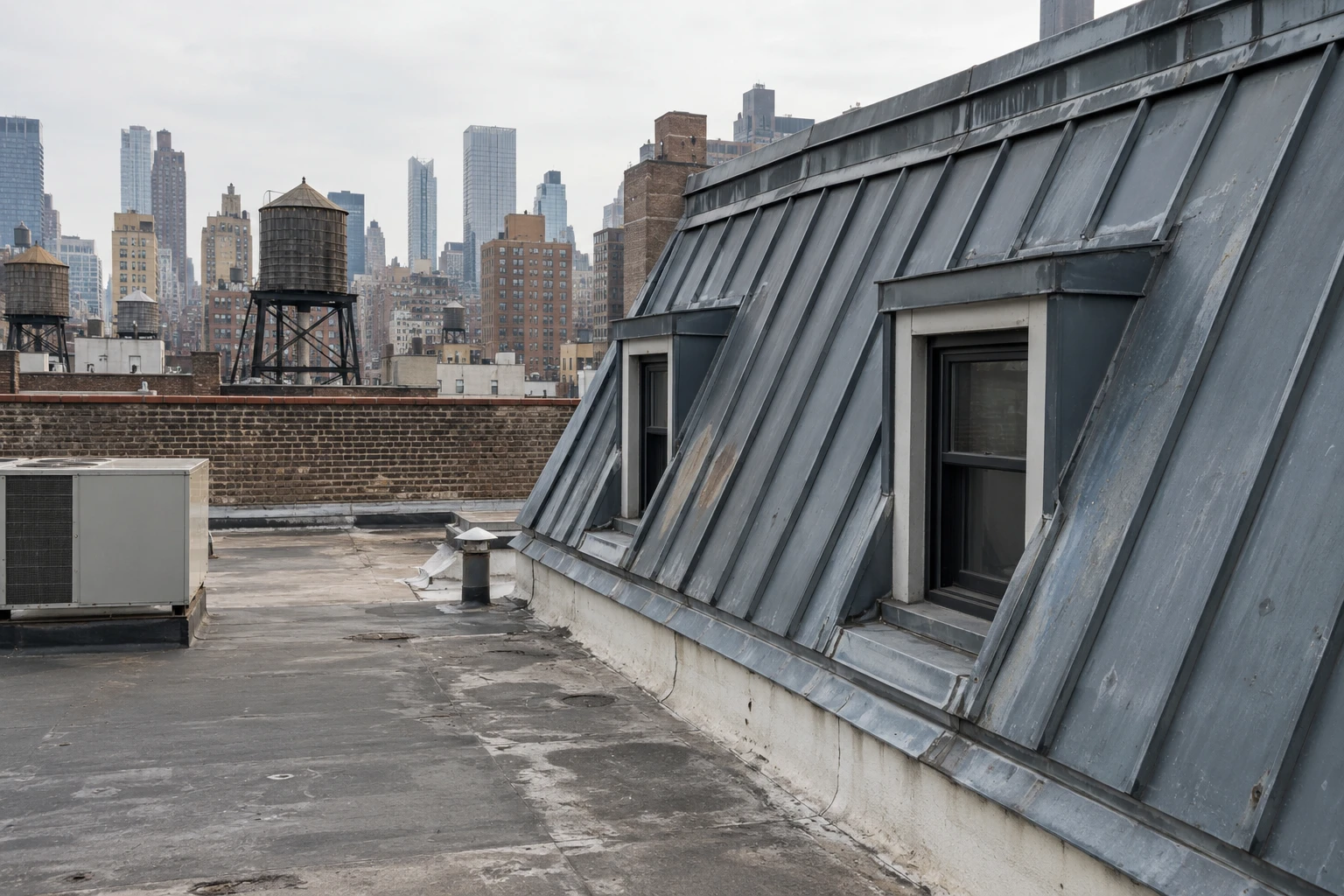
If the metal has deteriorated beyond coating while the structure remains sound, a retrofit system can go over it. Sub-purlins or a framing system create a new plane, and new panels, often standing seam metal, are fastened to it. This avoids tear-off, keeps the building in use and adds insulation if the framing allows. It adds weight, and the building's engineer confirms the structure can carry it, with snow load included. Snow in Central Park averages 29.8 inches a year and reached 27.3 inches in a single fall on January 23, 2016, so dead load and snow load are checked together.
The retrofit must also handle penetrations, skylights and edge details, which are rebuilt rather than patched. Roof access and crane lifts on a tight Manhattan site are planned in advance, and the schedule accounts for the street-use permits.
Which Manhattan buildings are candidates?
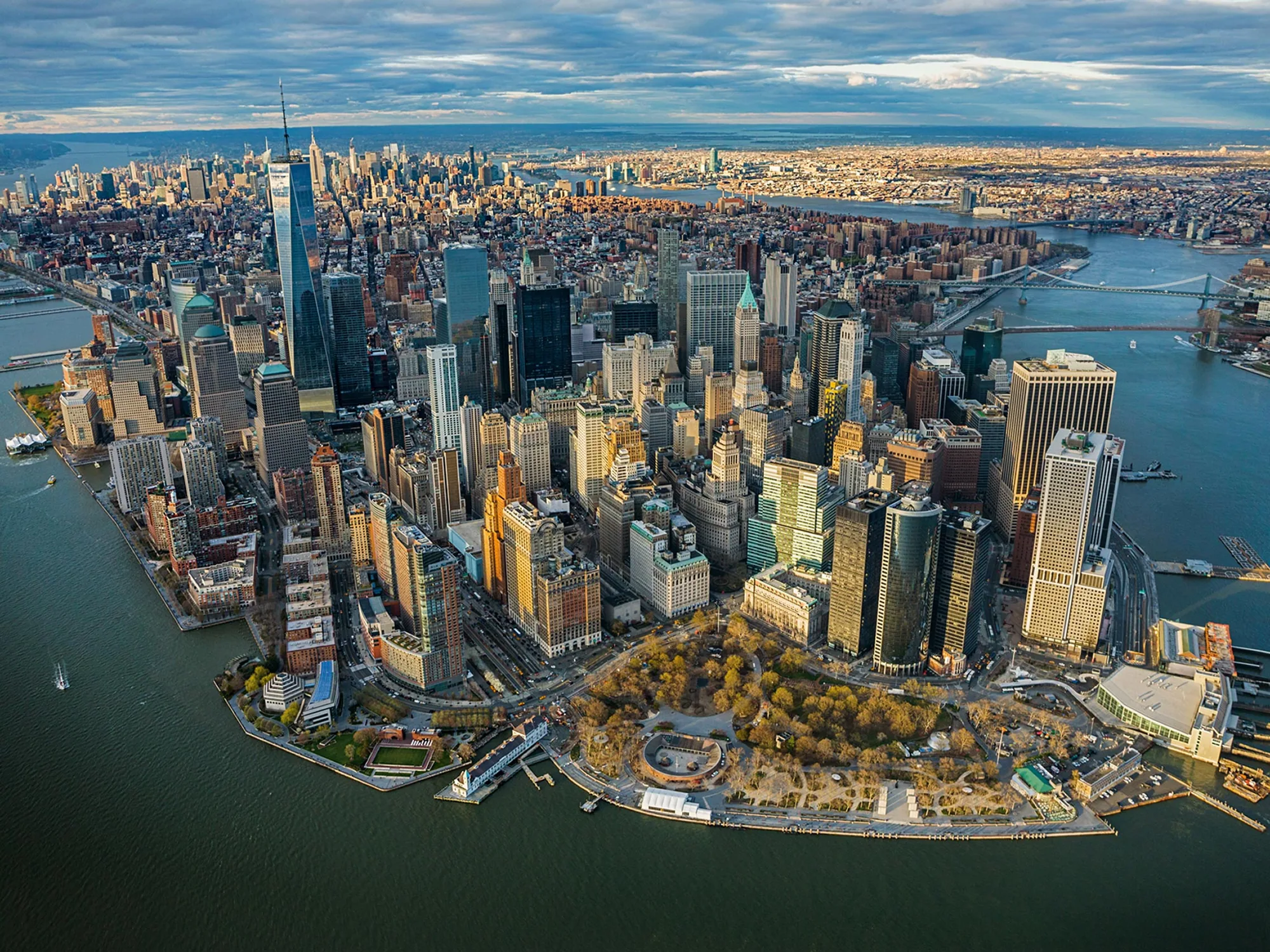
A building's roof type is known only after the survey. Buildings that may carry a metal roof include service buildings and depots, such as the subway, bus and sanitation depots in the industrial area of Sherman Creek in Inwood, which is bounded by Dyckman Street, Tenth Avenue and 207th Street, and the converted warehouses of West Chelsea. A converted building changes the question, because the use below the roof may now be residential or gallery space, and the roof's job has changed with it.
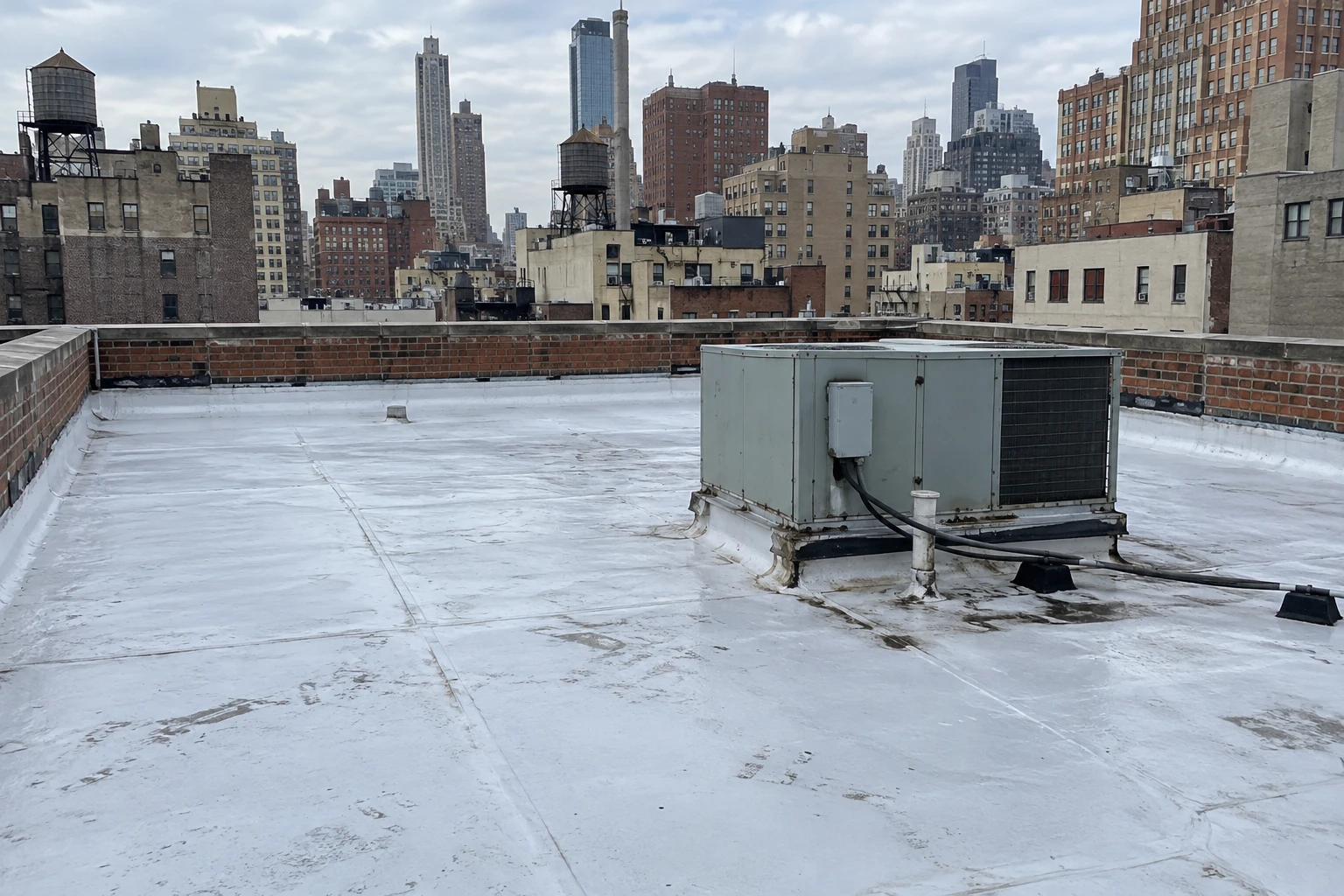
The survey records the metal, the fasteners and the structure, plus the roof's access: where the hatch or stair lands, how panels and equipment would be hoisted, and how much laydown space a street frontage allows. Those logistics often set the schedule more than the metal does. If a building has a mix of roofs, for example a low-slope membrane section next to a metal-panel section, we survey both and report them separately, since the repairs are different.
How does a retrofitted metal roof handle the weather?
Wind is the first concern at laps and edges. Fastener patterns tighten at the perimeter and corners, where the 78 mph gust Central Park recorded on December 2, 1974 would do the most work. Rain is the second. Ida's hourly peak of 3.15 inches on September 1, 2021 will find any lap sealed with a tired bead, and the survey notes where water sits on low-slope panels. The temperature range, from minus 15 F to 106 F in Central Park, moves the panels, which is why sealants and fasteners that allow some movement last longer than rigid ones.
Condensation is the quiet companion of metal. Where a cold panel sits over warm, humid air, moisture forms on the underside and drips like a roof leak. Timing and staining pattern tell the two apart, and when condensation is the cause the remedy is insulation plus an air seal at the deck line rather than more sealant on the laps. A roof that has been repaired for leaks three times without improvement is often a condensation problem that the survey would have caught on the first visit. Ventilation, insulation depth and the humidity of the space below all belong in the report, with the readings that support each conclusion.
What should the owner keep?
The pull-test results, the rust map, the cleaning and coating records with batch numbers and thickness, the structural confirmation for any added weight, the product data and the warranty terms. A roof coating restoration file also records the recoat interval so the next application is planned and not discovered by a leak. If a full replacement is later needed, the layout for the sustainable roofing zone under Local Laws 92 and 94 starts from the same plan. Photographs of the panel laps before they were coated, kept with the batch numbers of the sealant, answer most questions that arise at a later warranty review.
Commercial Roofing Questions
Is replacing the screws enough?
On sound panels, re-fastening with correctly sized screws and fresh washers stops many leaks and counts as a legitimate repair. Once the holes have enlarged or the panels have corroded, new screws cannot hold, and the answer is a coating or an over-roof.
What service life can a metal coating reach?
Product, applied thickness, exposure and surface preparation all move the answer. The survey produces a service-life estimate and a recoat interval, and a coating that is inspected each year and spot-repaired outlasts one that is ignored.
Will a retrofit change the building's height or appearance?
A framed retrofit raises the roof plane slightly, and the new panels may differ in profile. Where a roof is visible from the street, a landmark review may apply. We confirm the status early and show a section drawing with the height change.
What happens when the structure under the panels has rusted?
Structural repair goes first: the building's engineer inspects and specifies it, and the roof work follows. A new roof on a weak structure fails early, so the survey includes a look at purlins and connections where they can be reached.