Soprema roof categories in Manhattan, NY: modified bitumen, self-adhered and liquid-applied systems surveyed with hot work and odor in mind.
Scorch marks on the underside of a wood cornice are a finding from a roof repair made years earlier, and they explain why the application method comes before the product on a Manhattan, NY bituminous roof. Soprema is a roofing and waterproofing manufacturer whose commercial offering centers on modified bitumen membranes, including self-adhered and cold-applied types, and on liquid-applied resin membranes for flashings and waterproofing. The method of application decides the fire risk, the odor, the schedule and the permit path. On a dense block of attached buildings, a torch near a combustible cornice is a risk that no membrane warranty offsets.
We survey, repair and replace these categories of roof. Any specification that exists, the last roof report and any open violations make up the starting file; scope and rating are fixed before a price.
Which application method fits a dense block?
Cold-applied adhesive and self-adhered rolls avoid open flame and suit buildings with combustible materials near the work: wood cornices, old sheathing, attached neighbors. Torch application gives a strong bond and needs fire controls, a fire watch and a permit. Hot-mopped asphalt, used on multi-ply systems, has its own fumes and fire demands.
Union City is historically made up mostly of brownstones and two family homes, and its density of 53,293.7 residents per square mile in 2020 ranks second in New Jersey. In a place like that, or in the prewar tenement blocks of the East Village and Washington Heights, a roof fire has neighbors on every side. We choose the method with the building and its neighbors in view, and we document the choice in the scope so the insurer and the building department see it before work starts. A walk of the adjoining roofs and the shared parapet, with the neighbors' consent, tells us what sits within reach of a spark, and the findings go on the sketch with photographs of every combustible within a few feet of the work.
What does the survey record on a layered bituminous roof?
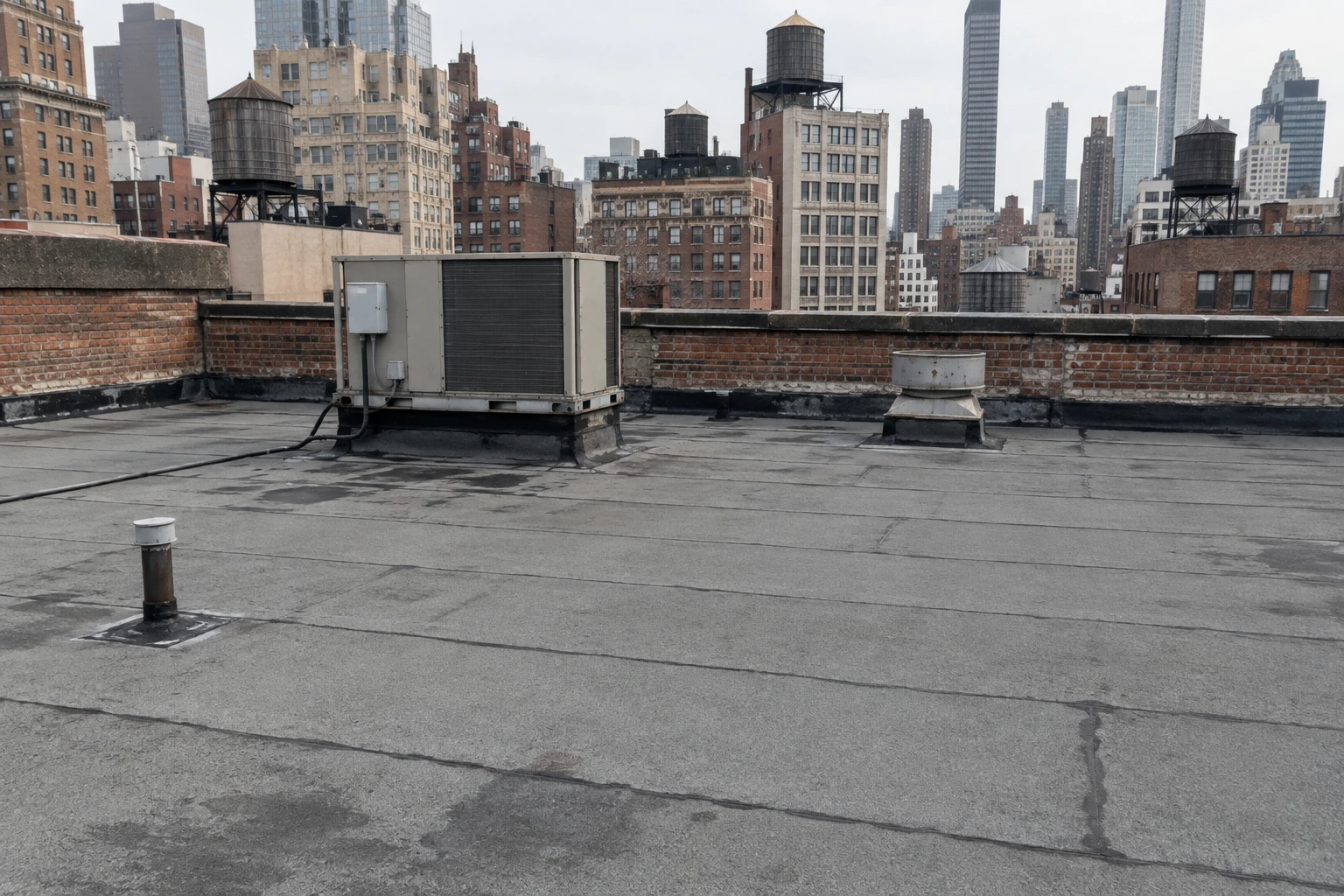
The number of plies, the cap sheet condition, the lap integrity, the granule loss and the moisture content of the layers and the insulation. A core goes through every layer and is logged by thickness and reading. An infrared scan at dusk shows where the roof holds water.
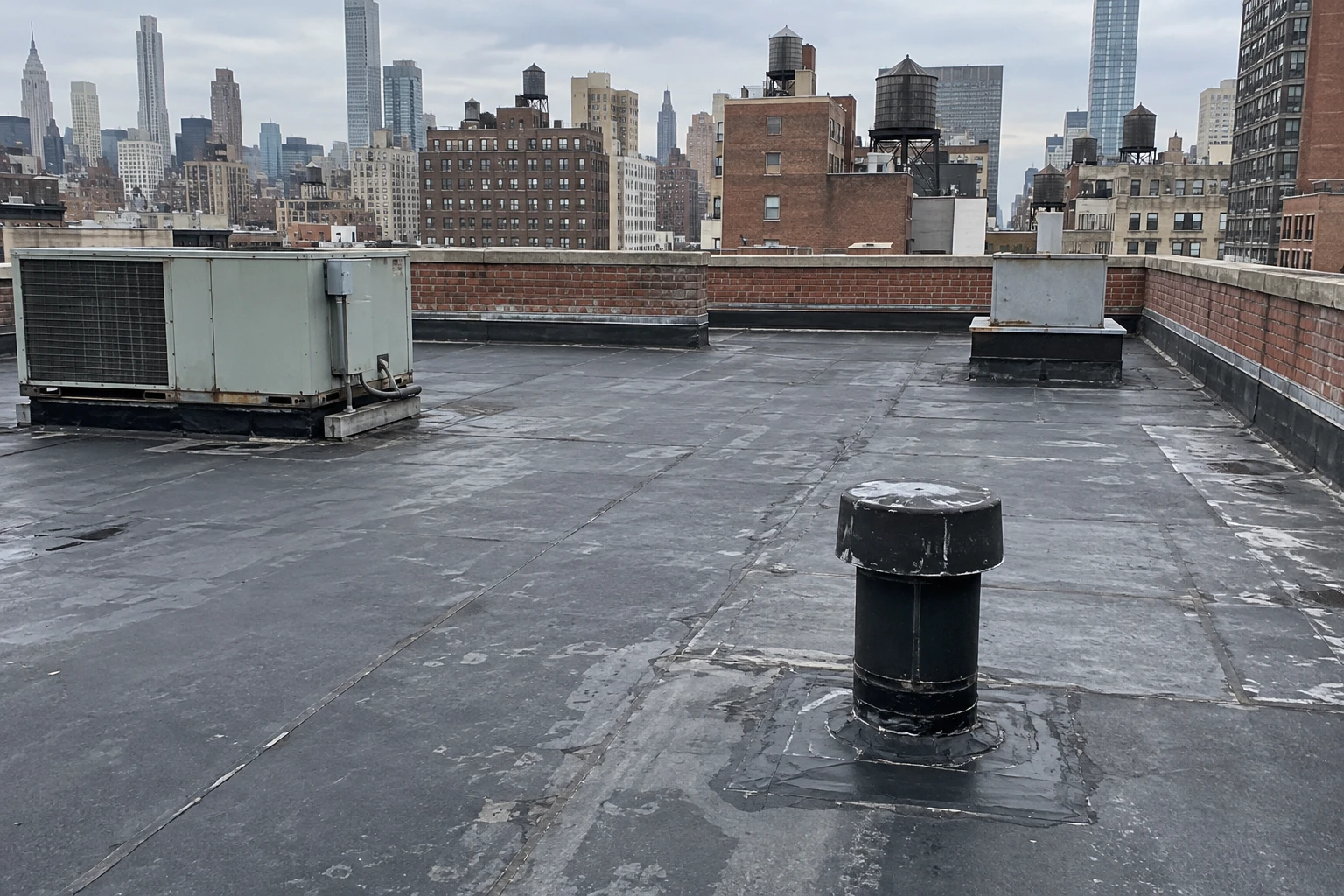
Blisters, ridges, splits and alligatoring each have a cause. A blister is trapped moisture or air between plies. A ridge follows an insulation joint. A split runs over a deck joint. The survey maps each on the sketch. A small split is sealed with reinforced mastic or a patch; a blister is cut, dried and patched with new plies. Widespread blistering is a sign that moisture has entered the layers, and the modified bitumen roof then moves toward recover or replacement according to the cores. The cores show whether the moisture is in the cap, the base or the insulation, and a roof wet only in the upper plies can sometimes be stripped back to a dry base and re-covered, which saves the cost of removing sound material below.
Where does liquid-applied resin outperform sheet?
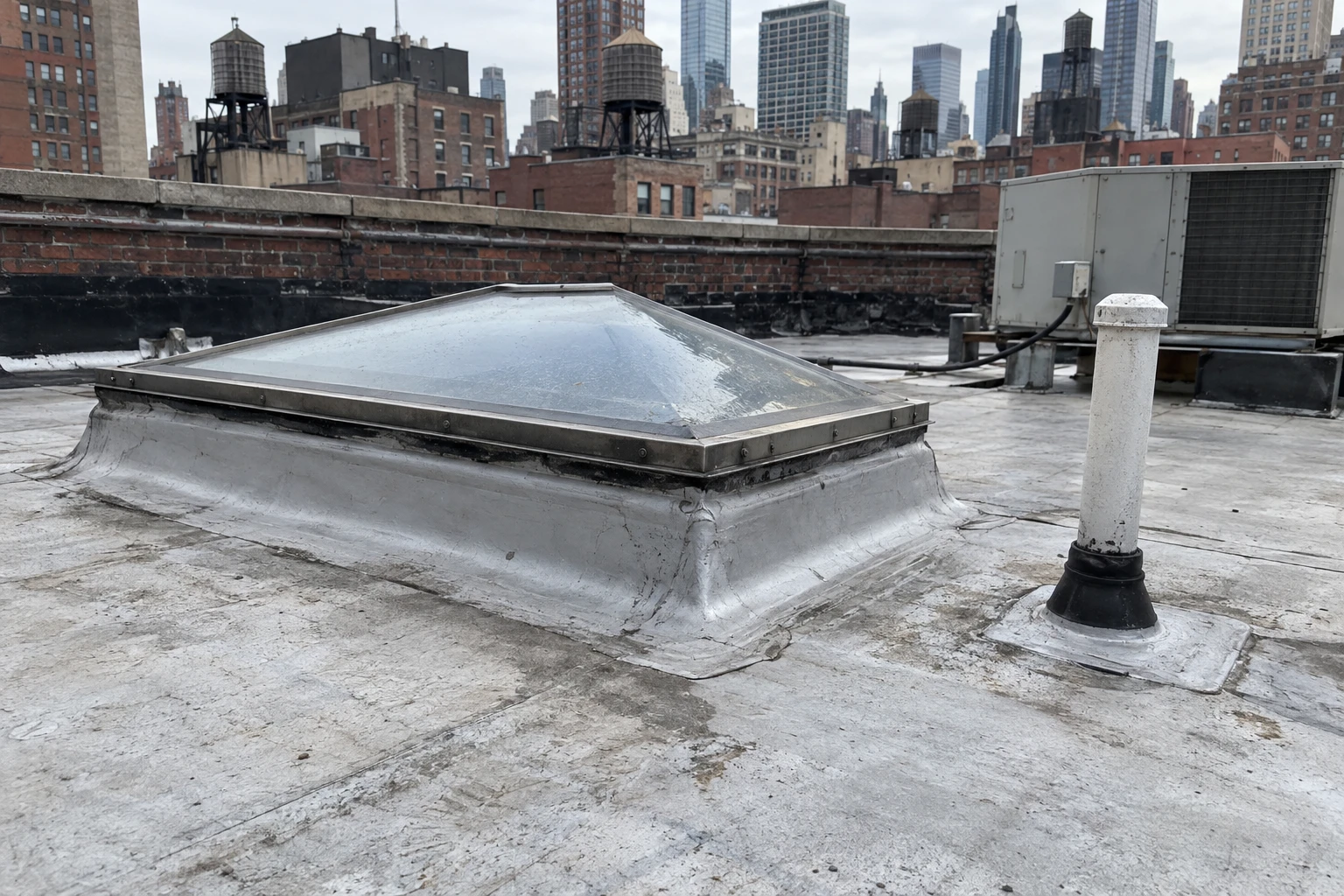
Around clusters of penetrations and irregular shapes, where a flowing resin reinforced with fabric forms a joint-free detail. A stair bulkhead with several corners, a skylight curb with a cracked corner and a group of conduits through a roof are the usual candidates. The resin needs a clean, dry substrate above the dew point, and it is applied in coats with thickness checks.
On a small Manhattan roof in the shade of a taller neighbor, surfaces can stay damp after the sun has dried the field, so we read the substrate with a moisture meter before mixing. A resin over a damp corner blisters on the first hot day. Our skylight and penetration flashing notes record the product category, the thickness and the substrate condition at each location, which gives a later crew the information to match.
How is an occupied building protected?
Low-odor, flame-free methods are chosen where residents or patients are close. Intakes near the work are covered or dampered, and wind direction is checked each morning. Residents get written notice with dates and noisy steps, the stair is protected and a named contact, usually the superintendent, can stop a task. The superintendent knows which apartments need a quieter plan, so we ask about residents who work nights or care for infants, and the schedule moves the loudest steps away from those hours.
Hot work in New York City carries its own permits and fire watch rules under the 2022 NYC Construction Codes, which also hold the Building, Existing Building and Energy Codes. We confirm the permits before the schedule is set. Hoboken's 2020 census counted 30,202 housing units, and Hurricane Sandy in October 2012 flooded 1,700 Hoboken homes, so owners there plan roof and drainage work with storms in mind. The same occupied building reroofing approach applies on both sides of the river.
How do bituminous and single-ply options compare?
On foot traffic tolerance, repair path, weight, odor and fire risk. A layered bituminous roof tolerates traffic and redundancy; a thermoplastic sheet is light and quiet to install. Other makers, GAF and Johns Manville among them, offer bituminous and single-ply alternatives, and the survey tells us which suits the roof.
Ida's 3.15 inches in a single hour in 2021 and Central Park's range from minus 15 F to 106 F set the weather the system has to meet. The comparison table lists each option's weight, odor, permit path and cost range, with the drainage fix for the roof, and it records the fire-watch duration for each method, because that line often decides the winner on a building with combustible neighbors. In the city, a full replacement answers to the roofing zone rule in Local Laws 92 and 94 of 2019, and the table notes which options leave room for solar or a green roof.
Commercial Roofing Questions
What decides whether a torch is acceptable on a given roof?
Combustibles near the work and the building's neighbors. Where wood cornices, old sheathing or attached buildings sit close, we choose cold-applied or self-adhered products. Where the roof is clear, a torch with a fire watch and a permit is an option. The decision is written in the scope.
How long does odor last after a cold-applied install?
Briefly. The smell fades as the solvent leaves the film, over a day or two depending on temperature. Cold adhesives give off solvent odor while they cure, much less than hot asphalt. Intakes near the work are covered during the smelliest steps, and the cure window is part of the schedule.
Can a bituminous roof take a solar array or a green roof?
Often, if the membrane is sound, the insulation is dry and the structure can carry the load. Racking and soil add penetrations and weight. We review the design with the array contractor, and any warranty terms are read first.
What is the main risk of a liquid-applied detail?
A damp or dirty substrate. The resin needs a clean, dry surface, and a blister forms over damp spots. We read the surface with a meter before mixing and prime where needed.
Do New Jersey buildings follow the same hot work rules?
They follow state and municipal rules, which we confirm with the local building and fire officials. Local Laws 92 and 94 apply to New York City buildings only. The survey method is the same on both sides of the river.