Storm damage assessment and repair for Manhattan, NY roofs: wind-lifted coping, drain overflow, flood and snow findings, documented for insurers and owners.
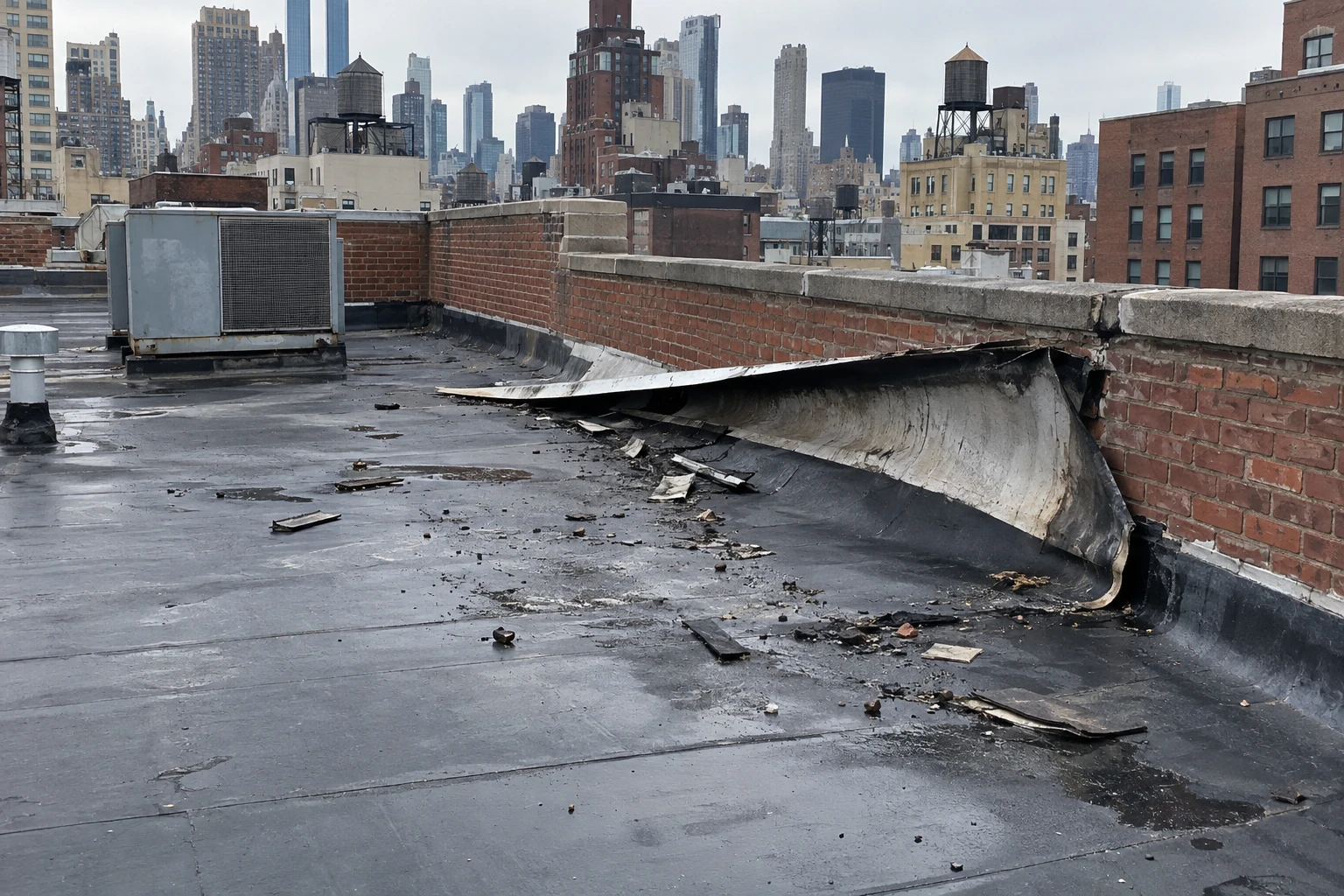
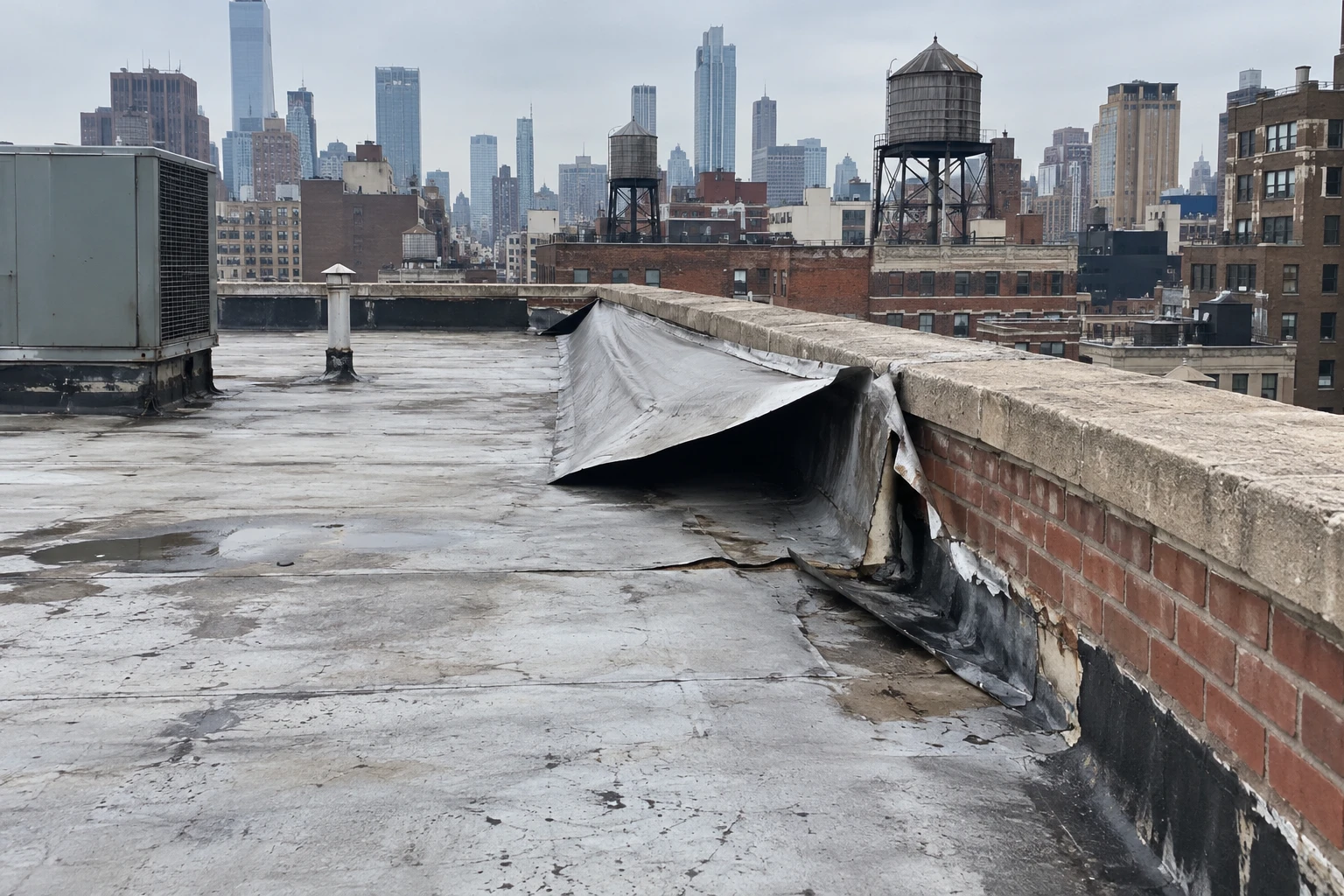
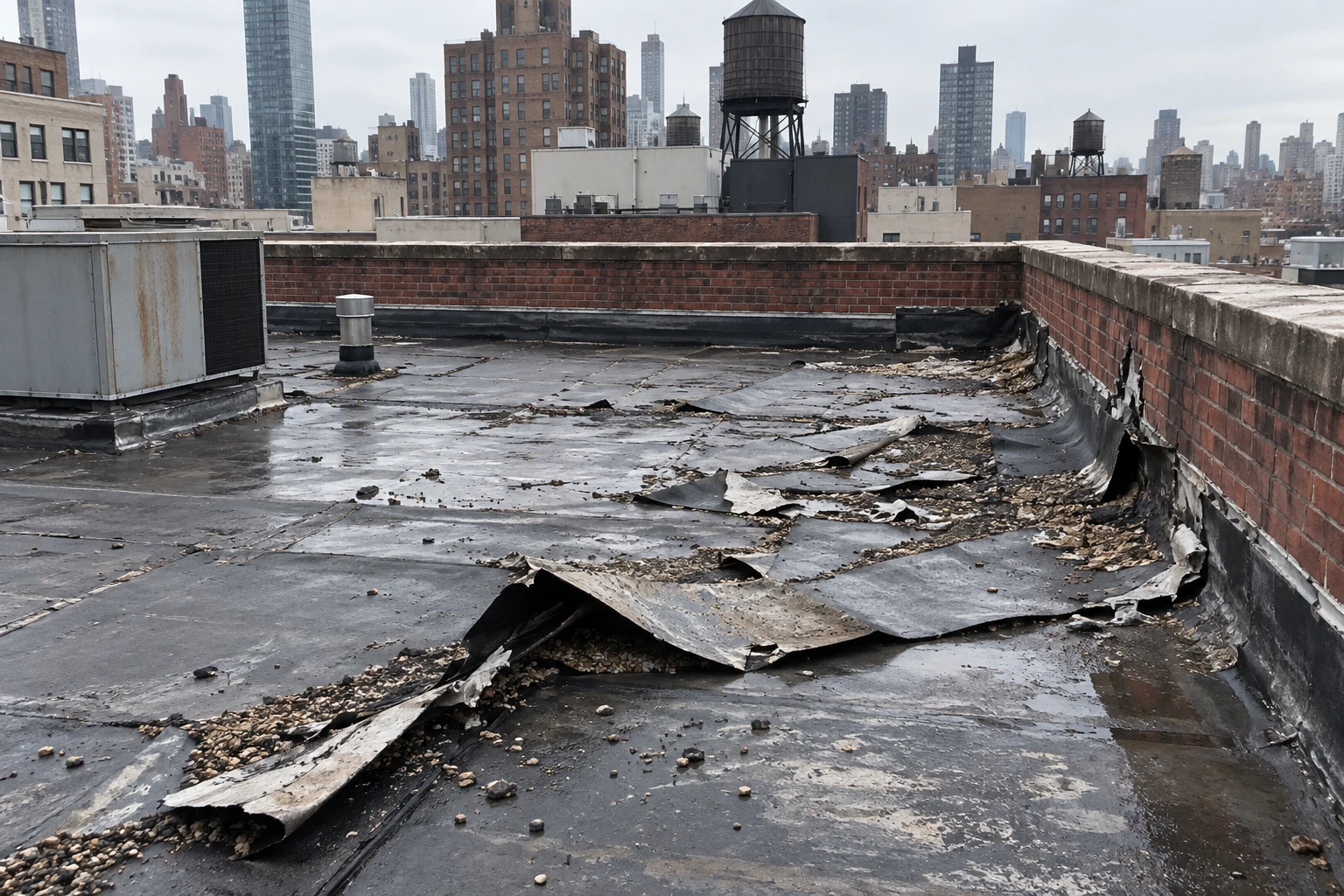
Two coping stones displaced by half an inch each, a membrane edge lifted along twelve feet of parapet and a drain strainer packed with leaves: that is a typical post-storm findings sheet for a Manhattan roof, and none of it is visible from the street. Storm damage in this city rarely announces itself with a hole. It shows up at the edges, the drains and the details, and it grows with every rain after the storm. A prompt survey fixes the scope while the cause is still readable. Photograph the roof edge before anyone touches it, and write down the time the weather peaked.
We assess and repair storm damage on low-slope and metal roofs, and our crews respond at any hour.
What does wind actually do to a roof in a dense city?
Central Park recorded its strongest gust at 78 mph on December 2, 1974, and gusts well below that move loose material. Wind in a canyon of towers behaves unevenly, with corner acceleration and downdrafts at the base of tall neighbors, so a low roof next to a supertall can see uplift from directions the building was not designed for. The first parts to fail are the edge metal, the parapet coping, the flashing heads on the bulkhead and any rooftop equipment cover that was left unsecured.
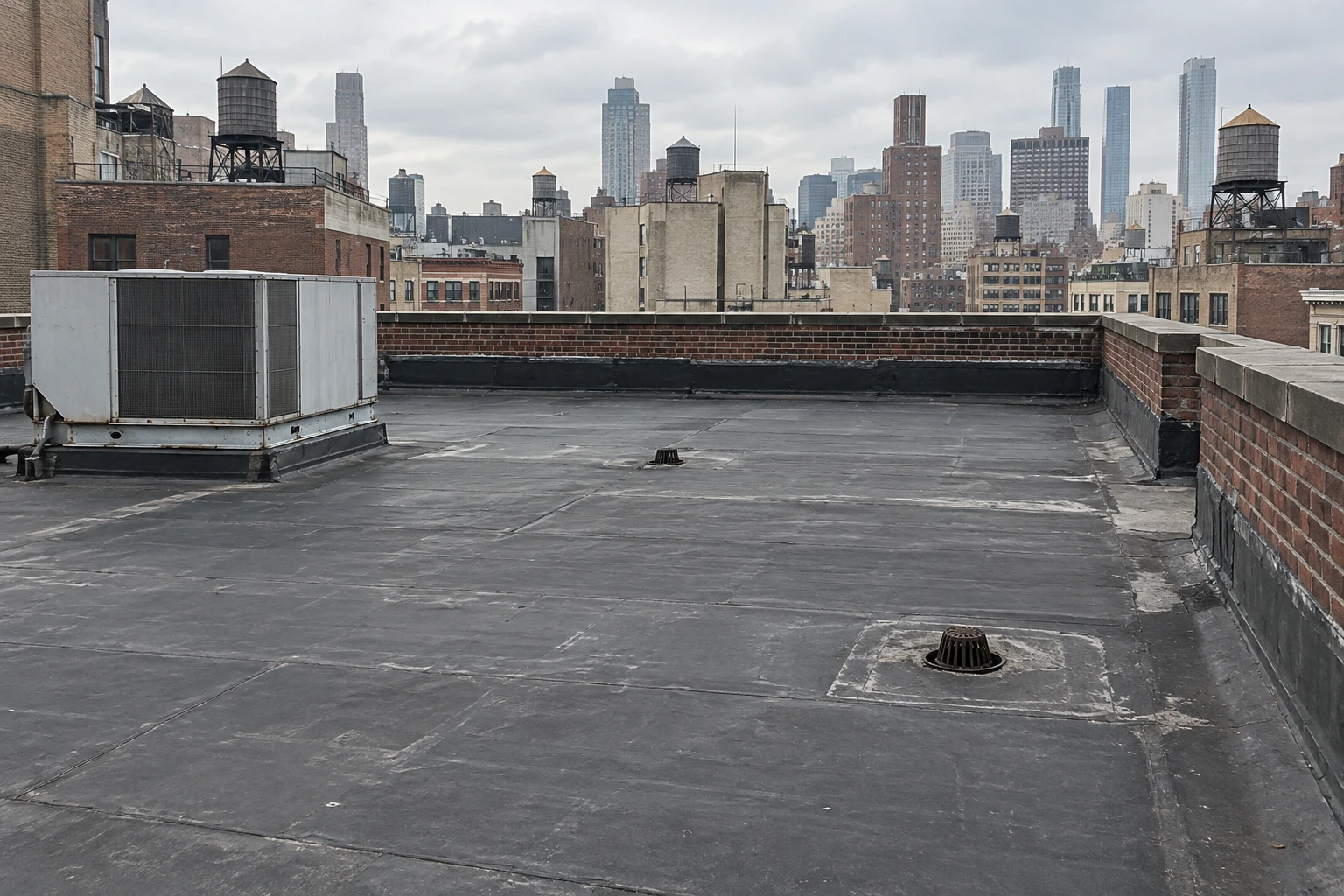
Our survey works from the perimeter inward. We check fastener spacing at the edge, the lap at each coping joint, sealant continuity and any signs of membrane movement such as wrinkles that point toward a corner. A wind damage repair secures the loose material first, because a lifted edge is a path for the next rain, then reinforces the line that moved. Record the wind direction from the weather report and compare it with the damage pattern.
How do we tell rain damage from a flood or a surge?
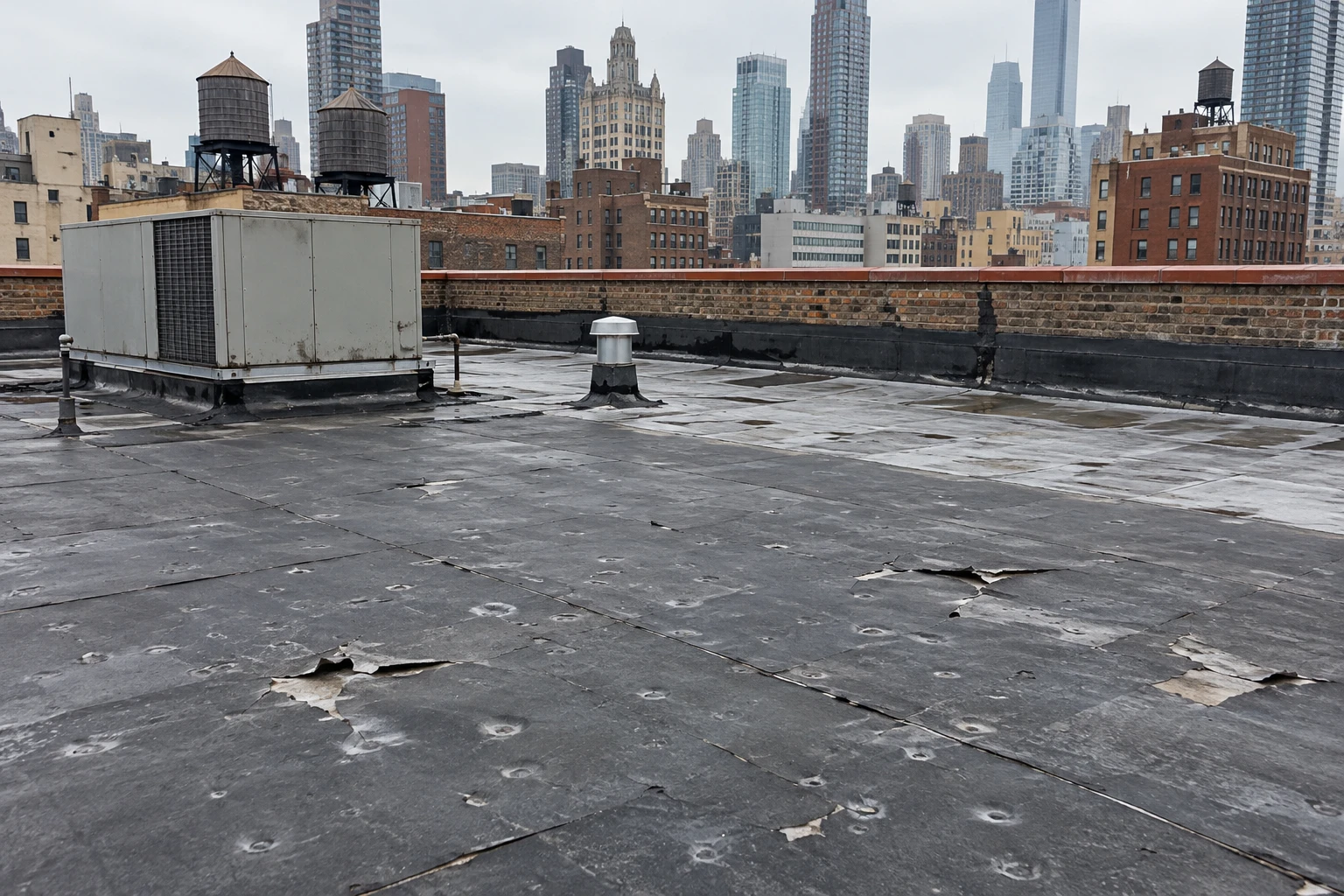
Ida's September 1, 2021 downpour set a city record of 3.15 inches in an hour and left 7.13 inches in Central Park by day's end, and it brought the first flash flood emergency the Weather Service had ever called for the city. On a roof, an hour like that tests the drains. If the leaders are clogged or undersized, water rises against the parapet and enters at the flashings, and the damage looks like a dozen small leaks rather than one big one. We measure the ponding depth that remains and look for tide marks on the walls.
On October 29, 2012 Sandy pushed a surge of 14.06 feet above average low tide into The Battery, flooded about 17 percent of the city and shut every road tunnel into Manhattan except the Lincoln Tunnel. A surge floods basements and lower floors rather than roofs, yet the storm's wind still calls for a check of rooftop equipment and edges. Separating roof damage from basement flooding keeps an insurance file clean. Our hurricane damage repair work starts with that separation.
What does a heavy snow leave behind on the roof?
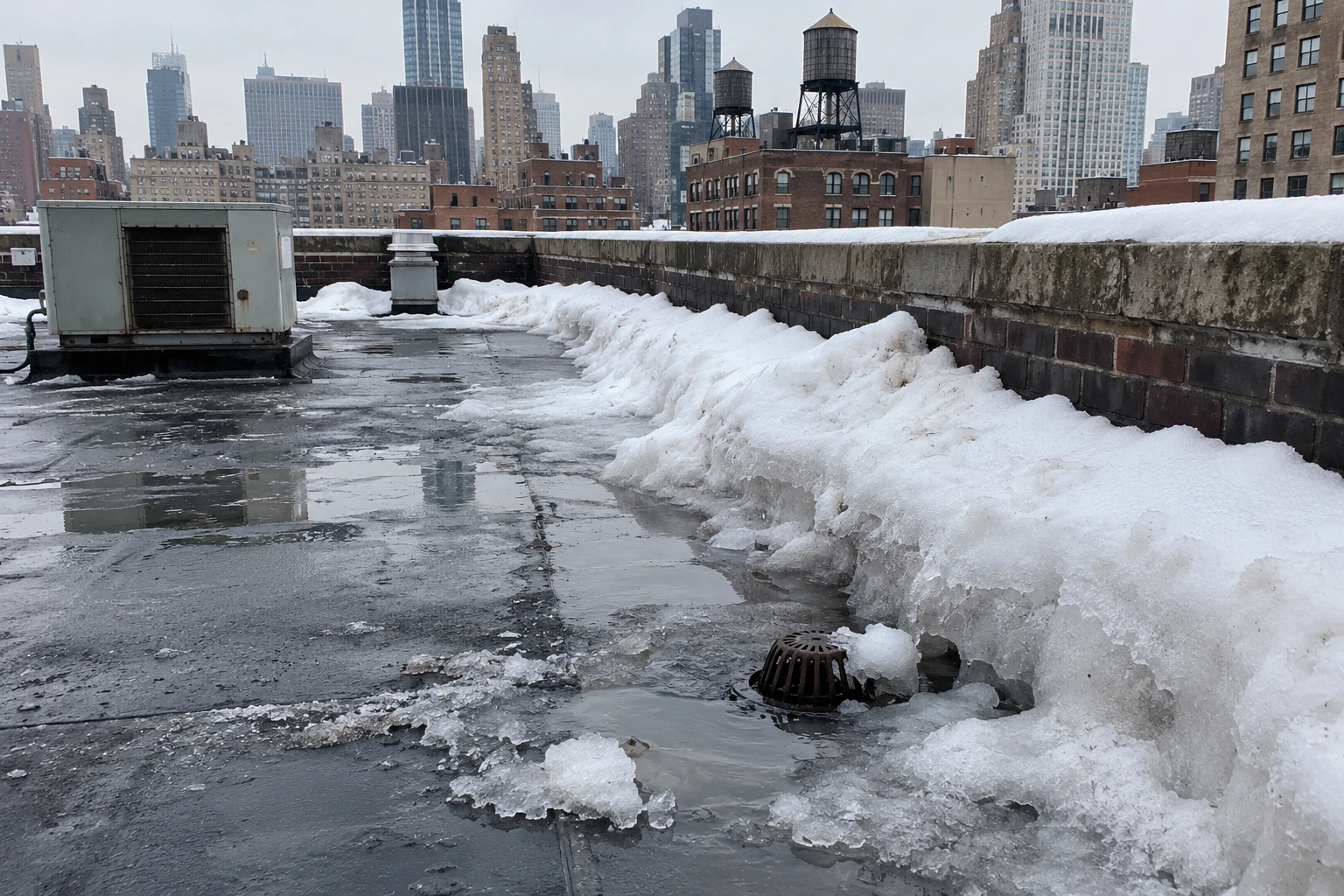
The record snowfall in Central Park was 27.3 inches on January 23, 2016, and the park averages 29.8 inches in a year. Snow loads a flat roof unevenly, drifting against bulkheads and parapets, and then melts into drains that may be frozen. After a storm of that size we check for ponding where the drains iced, for membrane splits at the cold edges, and for flashing pulled loose by sliding ice.
Ice in a roof drain leader can crack a fitting, and the crack reveals itself weeks later as a stain on a ceiling below. We look for these on the first visit and probe the leader with a camera when the stain pattern calls for it. Sound snow and ice damage repair includes clearing ice from drains and leaders, resealing opened joints and recording the new condition rating. Record the storm date and the date of the thaw in the file.
Which findings need repair now, and which can be scheduled?
The survey sorts each finding into three groups. Group one is anything that lets water into the building or exposes a structural attachment, and it is repaired or temporarily dried in at once. Group two is damage that will worsen but does not leak today, such as a displaced coping stone with intact flashing beneath, and it is scheduled within weeks. Group three is cosmetic or monitoring items, and it is logged with a measurement for the next visit.
This sorting is useful to the asset manager because it separates emergency spend from planned spend and gives the insurer a clear account. We keep photographs, locations and the date of each item. For roofs of unknown age, a commercial roof inspection after the storm sets a fresh condition rating. An owner with buildings in Hudson Yards and elsewhere on the island gets one rating per roof, so the next capital decision rests on comparable numbers.
Equipment deserves its own line in the findings. Rooftop units, exhaust fans, antennas and signage frames all attach to the roof through curbs, posts or stands, and a storm that shifts one of them can tear the flashing beneath it without any visible mark on the membrane. We check each attachment, test the fasteners and record whether the curb moved. The trades that own the equipment are notified in writing, so a mechanical contractor does not reset a unit onto a damaged curb.
What does the owner need on file for the insurer?
An insurer's questions come in a fixed order: the condition before the storm, the damage the storm caused, and the work that returns the roof to that condition. The pre-storm record is the last inspection or maintenance report. The storm record is the dated photographs, the weather data and the survey findings. The repair record is the scope, the materials and the completion photographs. Gaps in any of the three slow a claim.
Timing is part of the file. The date of the storm, the date of the first notice to the carrier and the date of each temporary measure should line up in one sequence. A temporary repair made before the adjuster visits is photographed in full, with the damaged material kept or imaged, so the adjuster can see what was replaced and why. Keep the receipts for materials and labor in the same folder as the photographs.
We prepare the documentation as part of the repair, and we separate storm damage from wear that predates the event, since carriers do the same. The roof insurance claim assistance work picks up from the survey and organizes the file for the adjuster. Landmarked buildings add one more item, the landmark review for any visible repair, and a temporary repair that alters the street view should be cleared first. Waterfront roofs in Battery Park City and Tribeca get a post-storm walk first, given their exposure to Sandy's surge.
Commercial Roofing Questions
What decides whether a storm-damaged roof is repaired or replaced?
The extent of the wet insulation and the condition of the membrane away from the damage decide it. A localized failure on a roof that was otherwise sound is repaired. If the survey finds wet insulation across much of the roof, replacement is the better investment, and Local Laws 92 and 94 then add the sustainable roofing zone.
How soon after a storm should the survey happen?
As soon as access is safe, because evidence fades. Debris is cleared, water dries and the next rain adds new damage to the old. A survey within days fixes the cause and the scope in the record.
Who decides what the temporary repair is?
We do, based on the findings and the forecast. A temporary repair dries in the roof with materials meant to last until the permanent work, and it is recorded with the same detail as the permanent repair.
Does storm repair on a landmarked building need review?
A repair that changes visible material or profile does. Temporary protection that leaves the street view unchanged usually proceeds, and the permanent repair is matched to the approved appearance.
Can several buildings be surveyed after one storm?
Yes. A portfolio survey uses the same checklist on every roof, so the ratings compare directly. Owners then see which roof needs the next dollar.