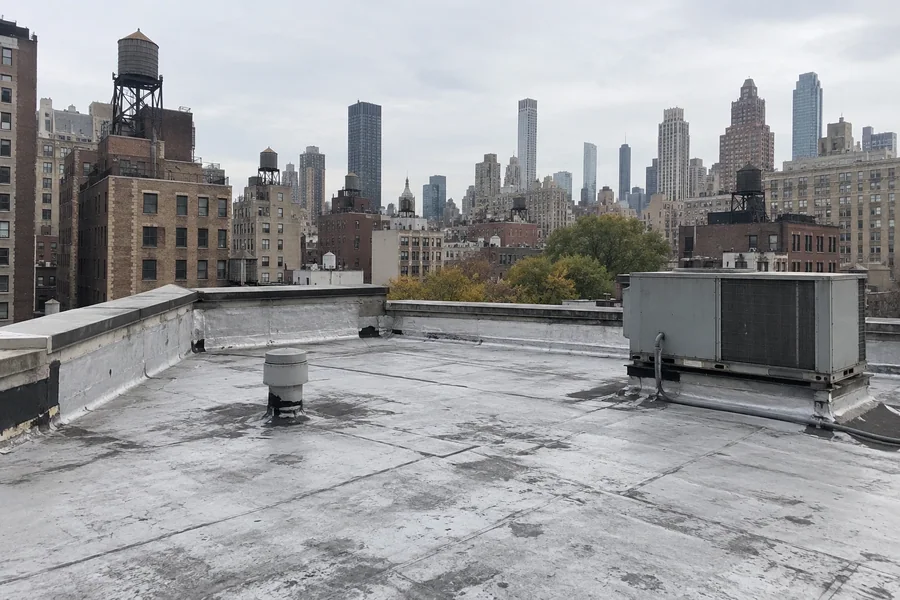
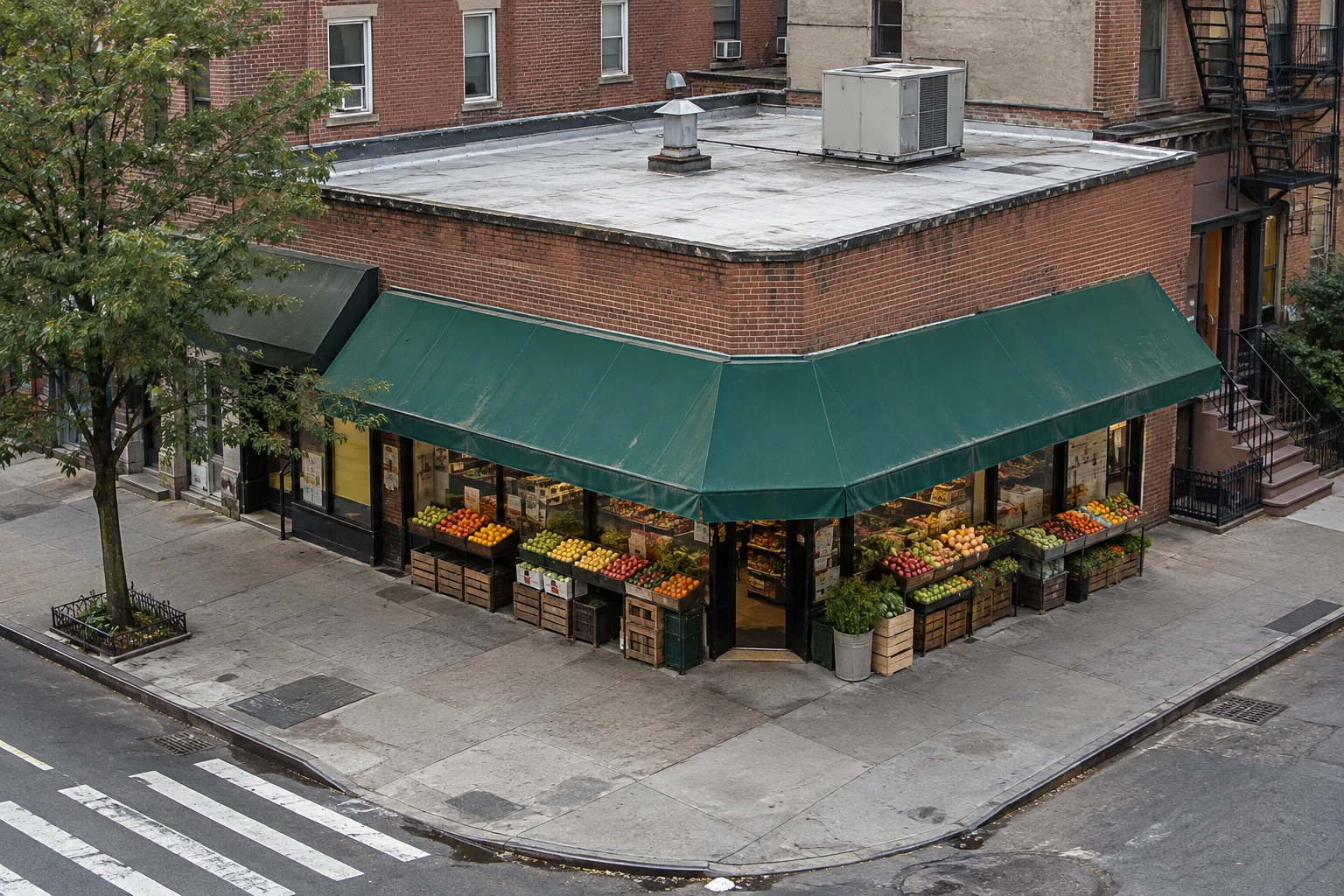
Big-box store roofing in Manhattan, NY and the Hudson corridor: drainage surveys, rooftop unit tie-ins and repair or replacement planned around trading hours.
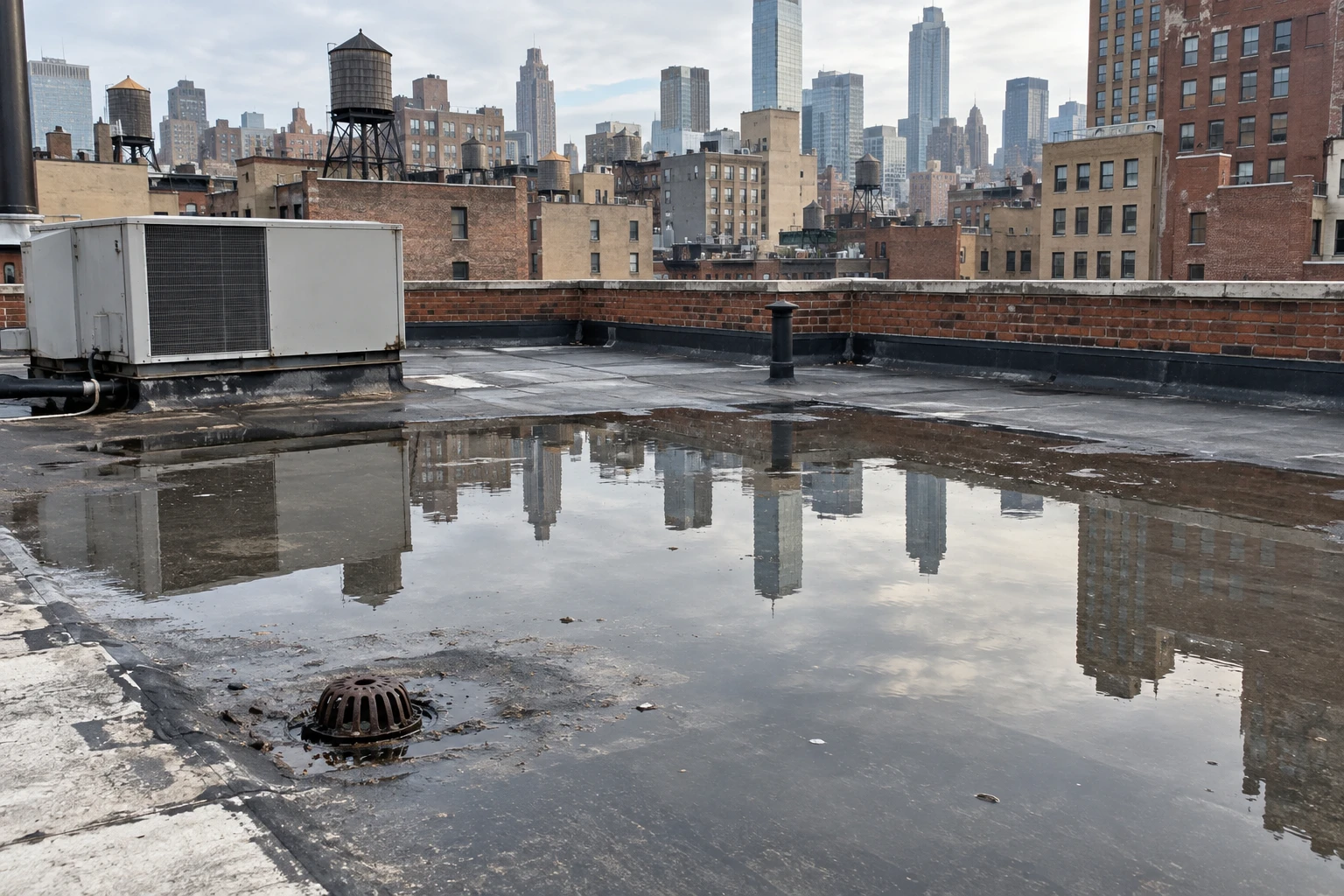
Ponding depth is the number to read first on a big-box roof, measured along the line between two drains where the slope is flattest, because a few tenths of an inch there turns into gallons across a wide field. On a low-slope roof, water that does not reach a drain stays where it is, and the longer the run between a drain and the edge, the more room it has to collect. In Manhattan, NY, where Hurricane Ida put a record 3.15 inches of rain on the city in one hour on September 1, 2021, the first question about any large flat roof is whether the drains can keep up.
We survey, repair and replace roofs on big-box stores, and we write the findings in a form a regional property manager can use across a portfolio. A store's last roof report and the building's age, together with any open violations, make up the starting file, and the survey scope and condition rating come before any price.
What does ponding depth tell us about a large flat roof?
It tells us where the slope has failed and how much load the failure adds. We read depth with a level and a tape at every low spot after a rain, and we photograph each one with a scale. The readings go on a sketch with arrows showing the direction of flow, so a reviewer can see at a glance which drain each pond should reach and which pond has no path at all. A bay with no path to a drain is the first item on the repair list. A pond that is dry within a day is a minor finding. One that persists for days points to a blocked leader, a sagging bay or a drain set above the surface.
The fix follows the cause. A blocked leader is cleaned and flow-tested. A sagging bay is checked by an engineer, because the structure has to be understood before the roof is. A drain set high is lowered or a sump added. Tapered insulation can re-slope a field during replacement. Our ponding water repair scope records depths before and after.
How do rooftop units and skylights affect the rating?
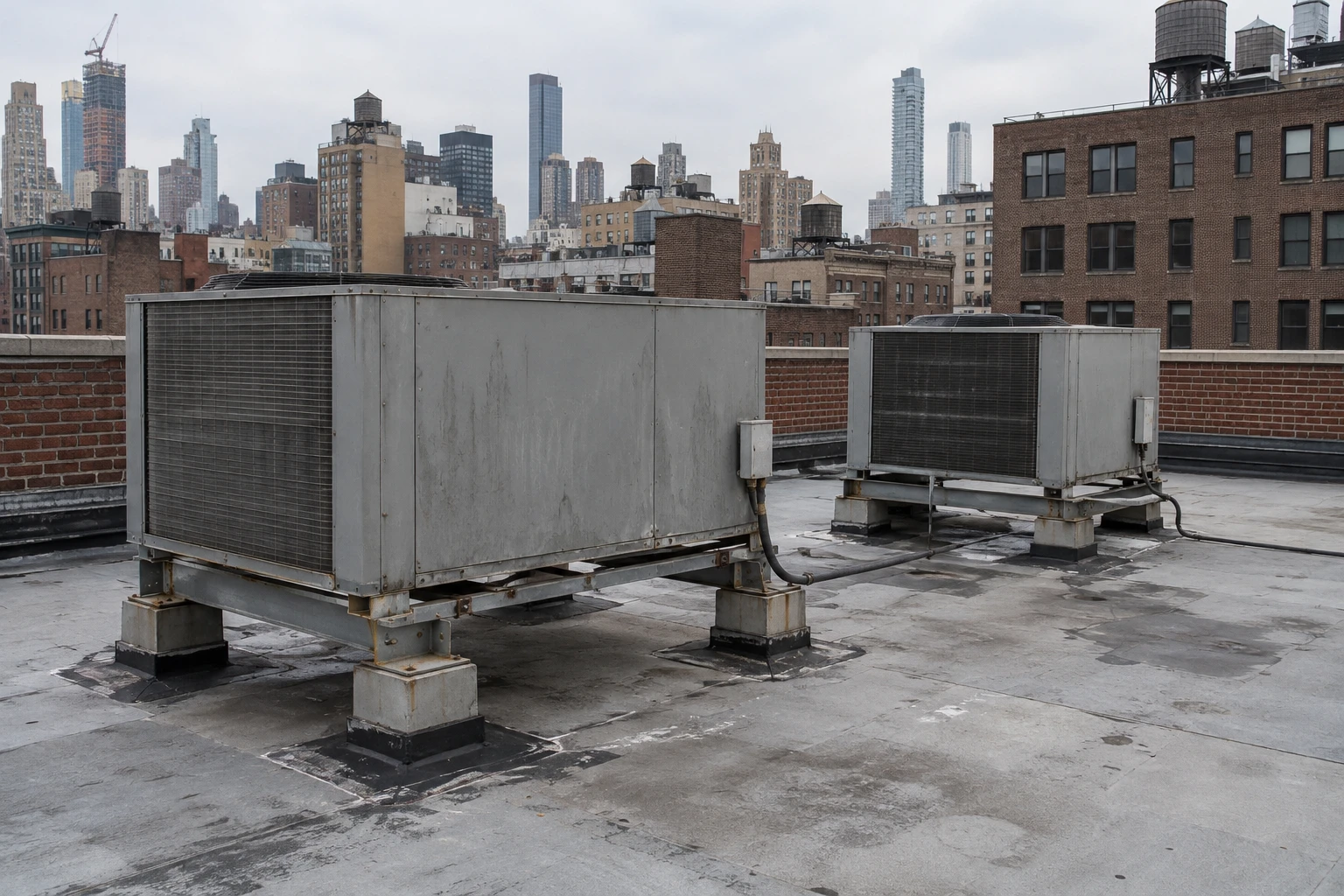
Big-box stores commonly carry several rooftop units and, in some cases, skylights or smoke vents. Each is a penetration with a curb and a flashing. Over years the sealant dries, the boot cracks and the curb settles. Units replaced during store remodels often arrive on old curbs, and the flashing no longer matches. We inspect every curb and measure it against the unit above.
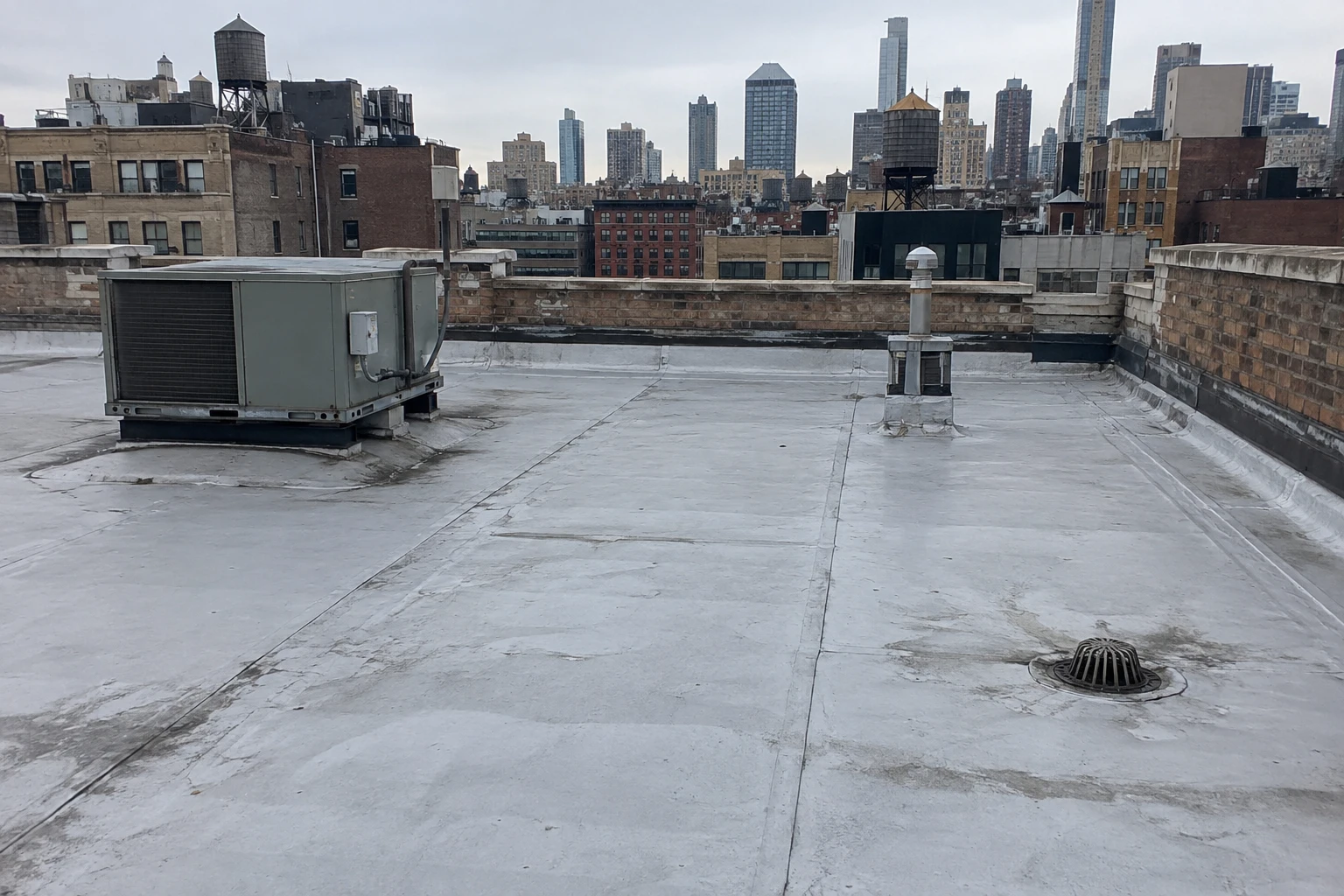
The condition rating lists each unit, its curb, its flashing and its condensate line. Condensate lines that drip onto the membrane wear a patch over time, and refrigerant lines resting on seams rub through. We recommend supports for the lines and walk pads along service routes. Technicians reach the units by the shortest path, and the shortest path usually crosses a seam, so the pads follow that path instead of the one a drawing suggests. Pads are adhered or welded, not loose, because loose pads slide in wind and leave the membrane exposed. The rooftop equipment curbs and supports scope treats each unit as a separate item with its own photograph and entry in the log.
How do retail corridors in New Jersey shape the schedule?
Tonnelle Avenue is one of North Bergen's main retail districts, and U.S. Route 1/9 runs along the township's western edge. In Secaucus, the Plaza at Harmon Meadow includes a convention center, a 14-screen theater and several hotels with about 1,200 rooms. These corridors carry heavy traffic, and a crane lift or a delivery must fit around it.
We schedule lifts for the early morning before trading starts and keep staging away from customer parking. A spotter watches the lot during every pick, and a second person holds the radio contact with the store's manager on duty. Any customer who wanders toward the zone is redirected before the load leaves the ground, and the zone is coned off from the first lift to the last. Holiday periods are blocked out, and a stop rule for rain is written into the plan. For a store in North Bergen, the access route and the delivery window are listed in the scope, and the same attention applies in Manhattan, where street permits add lead time.
What do storms, snow and heat require of the membrane?
Central Park's temperatures run from minus 15 F to 106 F, its snow averages 29.8 inches a year and its strongest gust, 78 mph, came on December 2, 1974. A store roof takes heat on summer afternoons, drifts on the leeward side of equipment and wind at the perimeter. Sandy's October 29, 2012 surge reached 14.06 feet above average low tide at The Battery, and flood exposure at ground level is a separate matter from roof exposure.
We check parapet coping, edge fastening and leaders after every storm. A white reflective membrane lowers surface temperature in the urban heat island, and a roof with a good slope sheds water before it freezes. The rating assumes the extremes and records what the survey saw after the last one. If a storm has passed since the last visit, the first stop is the perimeter: coping, edge metal, flashing at the corners and any equipment cover that moved. We photograph each item before touching it, so the record shows the condition the storm left.
Which option fits: repair, coat, recover or replace?
If wet insulation is limited to a few details, cutting it out and rebuilding the flashing is sound. If the insulation is dry and the membrane is intact, a coating or a recover adds life at lower cost. If the insulation is wet across large areas, replacement is the answer. Within New York City, a complete replacement triggers Local Laws 92 and 94 of 2019, so the sustainable roofing zone has to end up under solar, a green roof or both.
That requirement is a layout study on a roof with several units. Zone, equipment and structure are mapped together before the design is fixed. A shopping center with a large store at one end needs both ratings in one report, and a grocery store adds refrigeration to the list.
Commercial Roofing Questions
What decides whether to replace a store roof or coat it?
The moisture findings. A dry, adhered membrane can take a coating. A roof with wet insulation across large areas cannot, because the coating would trap water. The infrared map and the core log give the proportion, and the proportion sets the answer.
Can a store stay open during a roof replacement?
Yes, in most cases. The work is exterior, loud steps run early, and entrances and parking are protected. We place sheeting under the work zone where needed and keep a catch and a wet vacuum on site. The plan is shared with the store manager.
How do we handle a leak over merchandise?
Cover or move the product, set a catch under the drip and photograph the stain with the time. Give us the store and the aisle; the entry point is found from the roof, a temporary seal goes on and the permanent repair waits for dry weather.
What do regional managers need from a roof report?
The same format for every store: condition rating, moisture map, ponding record, unit list and estimated remaining life. With that, roofs can be ranked and funded in order across the region. We deliver one package per store and a summary table.
Does a New Jersey store fall under the New York City solar and green roof requirements?
No. Those laws bind New York City buildings only. A store in New Jersey answers to state and municipal codes, and the local building department confirms which apply. The survey method is the same.